Sight adjustment
MOA to Mil Converter
Quick answer
One mil equals 3.43775 MOA at every distance, because both are angles and the ratio never changes. At 100 yards 1 MOA subtends 1.047 inches and 1 mil subtends exactly 3.6 inches. The common shorthand of 1 inch per MOA is 4.5 percent small and costs you 14 inches on a 30 MOA come-up at 1,000 yards.
Two angular units are in daily use and they are not interchangeable. A minute of angle is one sixtieth of a degree. A milliradian is one thousandth of a radian. Both describe an angle, so both cover more ground the further away the target is, in direct proportion to distance.
The MOA figure comes from trigonometry: 2 times 3600 inches times the tangent of half a minute gives 1.047 inches at 100 yards. The mil figure needs no trigonometry at all, because a milliradian is by definition one thousandth of the distance to the target, and one thousandth of 3,600 inches is exactly 3.6.
That difference is why mils are easier to compute in your head, and why the 1 inch shorthand for MOA exists at all.
MOA, mil and inch converter
Result
The formula
MOA inches = amount x 1.047197 x (yards / 100) mil inches = amount x 3.6 x (yards / 100)
Scopes and levels that make these numbers usable
Top matches update when you change your numbers.
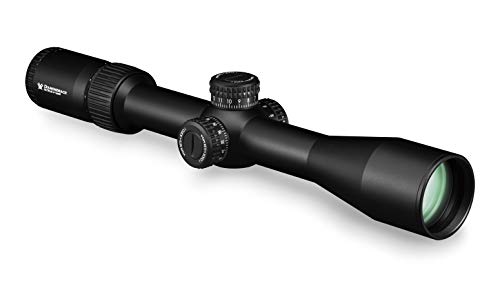
Vortex Diamondback Tactical 4-16x44 First Focal Plane Riflescope, EBR-2C MOA
$399.00 Full specificationsThe cheapest first focal plane scope worth owning, and the one that makes the case for the whole category: the reticle holds its subtension at every magnification, so a hold is a hold rather than a calculation.
Best for: a first precision rifle scope, or a hunting rifle that will be dialled
Check price on Amazon
Athlon Argos BTR GEN3 6-24x50 Riflescope, APRS11 FFP IR MIL Reticle
$379.99 Full specificationsAn illuminated first focal plane mil reticle with a zero stop at a price where those three features almost never appear together, and Athlon transfers its warranty the way Vortex does.
Best for: a mil-reticle precision build on a budget
Check price on Amazon
Vortex Viper PST Gen II 5-25x50 First Focal Plane Riflescope, EBR-7C MOA
$999.00 Full specificationsThe reference precision scope in this price band. The turrets return to zero reliably, which sounds like a low bar and is the single thing cheap scopes fail at after a season.
Best for: a precision rifle that will be dialled hard and often
Check price on Amazon
Vortex Riflescope Bubble Level, 1 inch
$39.00A permanent anti-cant level clamped to the tube, visible in your peripheral vision as you settle behind the rifle. It fixes the error at the moment it matters rather than at the bench.
Best for: checking cant on every shot rather than once at mounting
Check price on Amazon
Monstrum Pro Series 7075 Aluminium Scope Level Bubble, 30mm
$16.99A machined anti-cant level at a fraction of the price of the branded ones, and a bubble is a bubble. This is the accessory category where a budget part is genuinely fine.
Best for: an anti-cant level on a second or third rifle
Check price on Amazon
Vortex Crossfire HD 1400 Laser Rangefinder
$196.88The entry point with angle compensation built in, which is the feature that actually matters: an uncompensated range up a steep slope will make you shoot high.
Best for: a first rangefinder for hunting distances
Check price on AmazonWhere the shooter shorthand stops being harmless
Treating a minute of angle as exactly one inch per hundred yards is called shooter MOA or inches per hundred yards. It is 4.5 percent small, and the last column is what that costs per minute of angle.
At 1,000 yards, 1 MOA is 10.47 inches and the shorthand gives 10, so a 30 MOA come-up computed in shorthand is about 14 inches short.
Sourced figure
| Distance | True MOA | 1 mil | Shooter MOA | Error per MOA |
|---|---|---|---|---|
| 100 yd | 1.05 in | 3.6 in | 1 in | 0.05 in |
| 200 yd | 2.09 in | 7.2 in | 2 in | 0.09 in |
| 300 yd | 3.14 in | 10.8 in | 3 in | 0.14 in |
| 400 yd | 4.19 in | 14.4 in | 4 in | 0.19 in |
| 500 yd | 5.24 in | 18 in | 5 in | 0.24 in |
| 600 yd | 6.28 in | 21.6 in | 6 in | 0.28 in |
| 800 yd | 8.38 in | 28.8 in | 8 in | 0.38 in |
| 1000 yd | 10.47 in | 36 in | 10 in | 0.47 in |
The error is per minute of angle, so it multiplies by however much you dial. Inside 300 yards it is smaller than a group. Past 600 it is one of the larger avoidable errors in the shot.
Which unit should you use?
Neither is more accurate. What matters is that your reticle and your turrets use the same unit, so a correction you read off the glass is a correction you can dial without arithmetic.
A mil reticle with MOA turrets means multiplying every reading by 3.43775, in the field, under time pressure, with cold hands. That is where errors come from, and it is a configuration you should simply never buy.
Beyond matching, mils have a small practical edge: the constant is a round 3.6 and the ranging constant is a round 27.78, which are easier to hold in your head than 1.047 and 95.49. MOA has finer common click values, a quarter MOA being 0.26 inches at 100 yards against 0.36 for a tenth mil, though on most targets that difference is academic.
The conversions worth memorising
One mil is 3.43775 MOA and one MOA is 0.29089 mil, at every distance without exception.
Sourced figure
| From | To | Multiply by |
|---|---|---|
| Mils | MOA | 3.43775 |
| MOA | Mils | 0.29089 |
| MOA | Inches at 100 yd | 1.047198 |
| Mils | Inches at 100 yd | 3.6 |
| Mils | Centimetres at 100 m | 10 |
| MOA | Degrees | 0.016667 |
Every figure here is exact rather than rounded convention, except where the decimal itself has been truncated for reading.
Sources
- Definition of a minute of angle, one sixtieth of one degree
- Definition of a milliradian, one thousandth of a radian
Frequently asked questions
How many MOA is 1 mil?
One mil is 3.43775 MOA, at every distance. Both are angular units, so the ratio between them is fixed and does not change with range. To go the other way, one MOA is 0.29089 mil. These two numbers are worth memorising if you own a scope whose reticle and turrets disagree.
Is 1 MOA exactly 1 inch at 100 yards?
No. It is 1.047 inches, and the difference is exact trigonometry rather than a matter of opinion. The 1 inch figure is a convention called shooter MOA or inches per hundred yards. It is harmless inside about 300 yards and it costs roughly 14 inches on a 30 MOA come-up at 1,000 yards.
Why is a mil exactly 3.6 inches at 100 yards?
Because a milliradian is defined as one thousandth of a radian, and at the small angles involved that means one thousandth of the distance to the target. One hundred yards is 3,600 inches, and one thousandth of 3,600 is 3.6. No trigonometry is involved, which is what makes mil arithmetic simpler to do in your head.
Which is better for long range shooting?
Whichever your scope uses consistently. Competitive precision shooting has largely standardised on mils, mostly because the round constants make spotting and correcting faster when calling for another shooter. Hunting in North America still skews MOA. Neither choice will cost you a hit if the reticle and turrets agree.
How do I convert a mil hold to MOA clicks?
Multiply the mils by 3.43775 to get MOA, then divide by your click value. A 1.5 mil hold is 5.16 MOA, which on a quarter MOA turret is 20.6 clicks, so 21. Doing this under time pressure is exactly why a matched reticle and turret is worth more than any other feature on the scope.
Does the unit affect how precisely I can adjust?
Slightly, and less than people think. A quarter MOA click moves 0.26 inches at 100 yards and a tenth mil click moves 0.36 inches, so MOA turrets are marginally finer in their most common form. On any target large enough to shoot at, that difference is smaller than the rifle and the shooter contribute.
Researched, not professional advice. This page is compiled from published manufacturer specifications, published optical and ballistic formulas, and owner-review consensus, not hands-on testing. Figures described as a rule of thumb are shooter convention rather than sourced numbers, and they are labelled that way wherever they appear. Ballistic figures come from a point mass model using the ballistic coefficient the maker publishes, so treat them as a starting point and confirm them on paper at a measured distance. Confirm your firearm is unloaded with the action open before you mount, level, torque or bore sight anything. Verify a zero only on a supervised range or a safe, legal backstop, know what lies beyond your target, and follow the law where you hunt and shoot, including rules on land access and permitted cartridges.