Mounting and fit
Scope Ring Height Calculator
Quick answer
Ring height to the tube centre equals half the objective bell outside diameter plus your clearance, usually an eighth of an inch. A 50 mm objective needs roughly 1.19 to 1.27 inches, and it is a range rather than a figure because manufacturers publish the lens diameter and not the bell diameter.
Ring height is the mounting figure that stops a build dead, and the hardest one to look up, because nobody publishes the outside diameter of the objective bell. The lens diameter is printed on the scope. The housing around the lens is what actually hits the barrel, and it is not.
If you have the scope in your hands, measure the bell with a caliper and enter it below. That is the accurate answer. If you are buying, enter the lens diameter and the calculator will work from a realistic housing wall of four to eight millimetres across the diameter, which gives you an honest range instead of a confident guess.
Ring height calculator
Ring height needed, rail to tube centre
The formula
ring height to tube centre = (bell outside diameter / 2) + clearance
Rings that clear your objective
Top matches update when you change your numbers.
Only rings matching your tube diameter that actually clear the bell are promoted. Anything that would foul the barrel sinks to the bottom rather than being recommended against this page's own arithmetic.
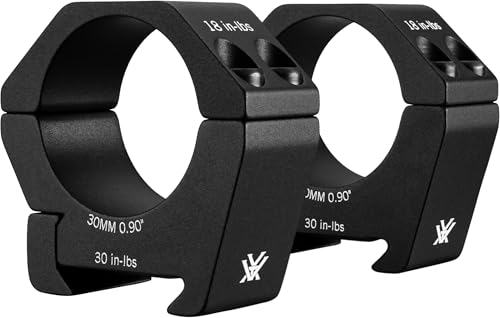
Vortex Sport Riflescope Rings, 30mm, Medium 0.90 inch
$39.00The height that fits the most common combination on this site: a 30 mm tube with a 44 mm objective.
Best for: a 30 mm tube with a 40 to 44 mm objective
Check price on Amazon
Vortex Sport Riflescope Rings, 30mm, High 1.1 inch
$39.00Clears a 50 mm objective on most bolt actions with a fraction to spare, which is the ring height most 50 mm scopes actually need.
Best for: a 50 mm objective on a bolt action
Check price on Amazon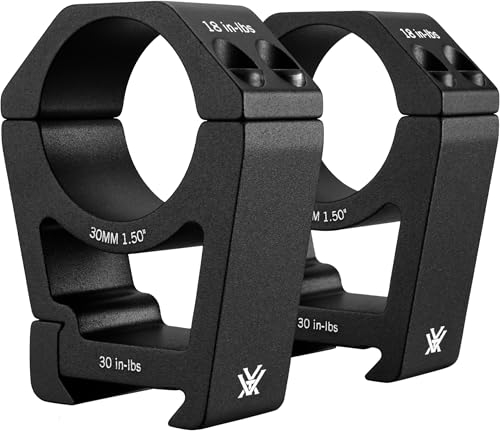
Vortex Sport Riflescope Rings, 30mm, Extra High 1.5 inch
$39.00For a 56 mm objective, or for an LPVO on a flat top receiver where the optical centre needs to be raised to roughly 1.5 inches above the rail.
Best for: a 56 mm objective, or an LPVO on a flat top
Check price on Amazon
Vortex Pro Series Riflescope Rings, 30mm, Medium 1.00 inch
$75.99A full inch to the tube centre, which clears a 50 mm objective comfortably and is the safe default when you cannot measure first.
Best for: a 50 mm objective when you cannot test fit
Check price on Amazon
Vortex Pro Series Riflescope Rings, 30mm, High 1.26 inch
$71.88A 1.26 inch centre height, which is where a 56 mm objective needs to sit and where an LPVO on a flat top starts to feel natural.
Best for: a 56 mm objective or a raised LPVO mount
Check price on Amazon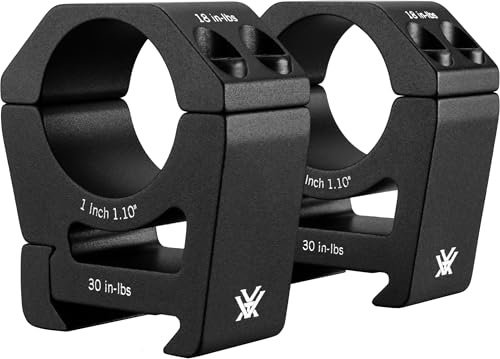
Vortex Sport Riflescope Rings, 1 inch, High 1.1 inch
$39.00Enough height for a 44 mm objective on most rifles, and the common answer when a medium ring turns out to foul the barrel by a fraction.
Best for: a 40 to 44 mm objective on a one inch tube
Check price on Amazon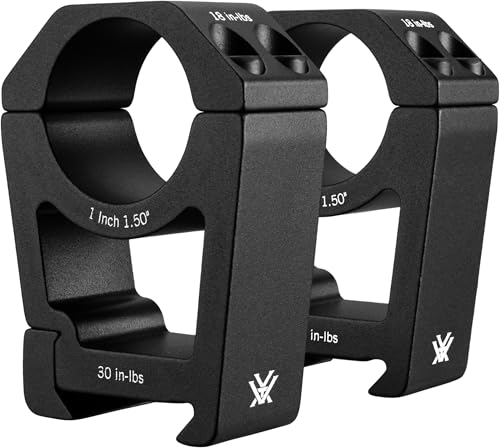
Vortex Sport Riflescope Rings, 1 inch, Extra High 1.5 inch
$39.00For a 50 mm objective on a one inch tube, or for a flat top receiver where the rail already sits well above the bore.
Best for: a 50 mm objective, or a flat top receiver
Check price on Amazon
Vortex Pro Series Riflescope Rings, 34mm, Medium 1.10 inch
$78.99The workhorse height for a 34 mm precision scope with a 50 or 52 mm objective.
Best for: a 34 mm tube with a 50 mm objective
Check price on Amazon
Vortex Pro Series Riflescope Rings, 34mm, High 1.45 inch
$79.00For a 56 mm objective on a 34 mm tube, which is the largest ordinary combination and the one that most often needs more height than people expect.
Best for: a 56 mm objective on a 34 mm tube
Check price on Amazon
Vortex Precision Matched Rings, 30mm, 0.87 inch Height, Picatinny
$157.41Matched and lapped as a pair, with the height published to a hundredth rather than as a word. This is the ring to buy when the answer matters.
Best for: a precision rifle where ring alignment is not negotiable
Check price on AmazonThe two conventions that make published ring heights confusing
Before trusting any number, including the ones on this page, know these two things.
- Height is measured to the CENTRE of the ring here, which is how most American ring makers publish it. Several makers publish to the BOTTOM of the ring instead, which gives a number roughly half a tube diameter smaller for the same physical part. There is no standard.
- Height names are marketing. One maker medium is another maker low. In the same Vortex catalogue, the Sport low is 0.80 inches and the Pro low is 0.90. Always buy by the published number in inches.
Common objective sizes and what they need
Worked for a standard eighth of an inch of clearance. The middle column is the estimated bell outside diameter, which is the figure nobody publishes and the reason the answer is a range.
A 50 mm objective needs roughly 1.19 to 1.27 inches of ring height to tube centre, and a 32 mm objective needs about 0.84 to 0.91 inches.
Shooter convention
| Objective lens | Estimated bell outside diameter | Ring height to tube centre |
|---|---|---|
| 32 mm | 36 to 40 mm | 0.83 to 0.91 in |
| 40 mm | 44 to 48 mm | 0.99 to 1.07 in |
| 42 mm | 46 to 50 mm | 1.03 to 1.11 in |
| 44 mm | 48 to 52 mm | 1.07 to 1.15 in |
| 50 mm | 54 to 58 mm | 1.19 to 1.27 in |
| 56 mm | 60 to 64 mm | 1.31 to 1.39 in |
The eighth of an inch of clearance is shooter convention rather than a standard. It exists so a lens cap, a gloved finger or a slightly bent rail cannot bring the bell into contact with the barrel.
The heights that are actually sold
What you will find in catalogues, with the names each height is commonly sold under.
Stocked heights run from 0.75 to 1.45 inches to tube centre, and the same physical height is sold under different names by different makers.
Shooter convention
| Height to tube centre | Commonly sold as |
|---|---|
| 0.75 in | Ultra low, extra low |
| 0.87 in | Low |
| 0.92 in | Low, medium |
| 1 in | Medium |
| 1.1 in | Medium, high |
| 1.26 in | High |
| 1.45 in | Extra high, X high |
Buy by the number in the first column. The second column is what the packaging calls it, and it is not consistent between makers or even between product lines.
Sources
- Manufacturer published ring heights from the product listings in our catalog
- Objective lens diameters as published by each scope manufacturer
Frequently asked questions
How do I know what ring height I need?
Measure the outside diameter of the objective bell with a caliper, halve it, and add about an eighth of an inch of clearance. That gives the height from the rail to the centre of the scope tube. If you do not have the scope yet, work from the lens diameter and add four to eight millimetres for the housing, which gives you a range.
Is ring height measured to the centre or the bottom of the ring?
There is no standard, which is the most confusing thing about this subject. Most American makers publish to the centre of the ring, and that is the convention used throughout this site. Some publish to the bottom of the ring instead, producing a number roughly half a tube diameter smaller for an identical part. Check which the maker means before comparing.
What happens if my rings are too low?
The objective bell touches the barrel, which is obvious, or it nearly touches, which is worse. A bell resting on the barrel transmits recoil and vibration straight into the scope, and one clearing by a few thousandths will contact the moment anything flexes. If a folded note will not pass under it, go up a height.
Should I always use the lowest rings that fit?
Usually, because a low mount keeps your cheek on the stock and your head position repeatable, which is worth more than most people expect. Two honest exceptions: a flat top receiver often wants the optic raised to about 1.5 inches for a natural head position, and a stock with a high comb built for iron sights may need the scope lifted to match.
Does a 30 mm tube need taller rings than a 1 inch tube?
Only marginally, and not for the reason people assume. Tube diameter does not change the objective bell, so the clearance requirement is identical. What changes is that height is measured to the tube centre, so a larger tube sits with its centre slightly higher in the same ring. In practice the objective decides the height, not the tube.
Can I mix a low front ring with a high rear ring?
Not deliberately. Matched rings hold the tube straight, and mismatched heights bend it, which stresses the erector assembly and can shift your zero unpredictably. If you want deliberate cant to gain elevation travel, use a canted base or an insert system designed for it rather than mismatched rings.
Researched, not professional advice. This page is compiled from published manufacturer specifications, published optical and ballistic formulas, and owner-review consensus, not hands-on testing. Figures described as a rule of thumb are shooter convention rather than sourced numbers, and they are labelled that way wherever they appear. Ballistic figures come from a point mass model using the ballistic coefficient the maker publishes, so treat them as a starting point and confirm them on paper at a measured distance. Confirm your firearm is unloaded with the action open before you mount, level, torque or bore sight anything. Verify a zero only on a supervised range or a safe, legal backstop, know what lies beyond your target, and follow the law where you hunt and shoot, including rules on land access and permitted cartridges.