Mounting and fit
Parallax Error Calculator
Quick answer
Parallax error at the target is approximately eye offset times (target distance divided by parallax distance, minus one). With a 100 yard fixed parallax and a tenth of an inch of eye movement, a target at 300 yards carries about 0.2 inches of available error, which is far less than most shooters fear.
Parallax happens when the image of the target does not land exactly in the plane of the reticle. With the two planes separated, moving your eye off the optical axis makes the reticle appear to slide across the target, and wherever it sits when the shot breaks is where you aimed.
The framing most discussions get wrong: parallax error is not a fixed amount of inaccuracy your scope adds. It is a ceiling on how much error your head position can introduce. Keep your eye centred and the error goes to zero no matter how badly the parallax is set.
Which means the number that matters as much as the parallax setting is how consistently you get behind the rifle.
Parallax error calculator
Available aiming error
The geometry
error at target = eye offset x ((target distance / parallax distance) - 1)
Scopes with parallax you can actually set
Top matches update when you change your numbers.
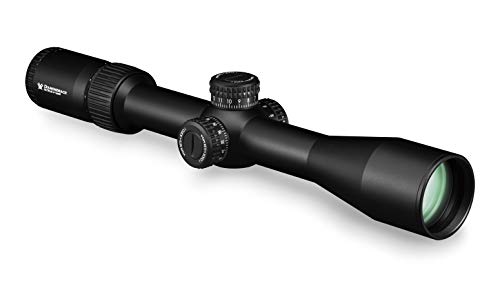
Vortex Diamondback Tactical 4-16x44 First Focal Plane Riflescope, EBR-2C MOA
$399.00 Full specificationsThe cheapest first focal plane scope worth owning, and the one that makes the case for the whole category: the reticle holds its subtension at every magnification, so a hold is a hold rather than a calculation.
Best for: a first precision rifle scope, or a hunting rifle that will be dialled
Check price on Amazon
Athlon Argos BTR GEN3 6-24x50 Riflescope, APRS11 FFP IR MIL Reticle
$379.99 Full specificationsAn illuminated first focal plane mil reticle with a zero stop at a price where those three features almost never appear together, and Athlon transfers its warranty the way Vortex does.
Best for: a mil-reticle precision build on a budget
Check price on Amazon
Vortex Viper PST Gen II 5-25x50 First Focal Plane Riflescope, EBR-7C MOA
$999.00 Full specificationsThe reference precision scope in this price band. The turrets return to zero reliably, which sounds like a low bar and is the single thing cheap scopes fail at after a season.
Best for: a precision rifle that will be dialled hard and often
Check price on Amazon
Vortex Diamondback 2-7x35 Rimfire Riflescope, V-Plex MOA
$239.00 Full specificationsBetter glass than the Crossfire II in the same rimfire-specific configuration, and a 35 mm objective that keeps the image bright at seven power.
Best for: a rimfire that gets shot in poor light
Check price on Amazon
Vortex Crossfire II 2-7x32 Rimfire Riflescope, V-Plex Reticle
$118.99 Full specificationsBuilt with its parallax set for rimfire distances rather than 100 yards, which removes an aiming error that a centrefire scope quietly introduces at 25 and 50 yards.
Best for: a .22 used at realistic rimfire distances
Check price on Amazon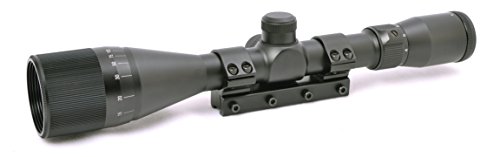
Hammers 3-9x40AO Air Rifle Scope with Mount
$89.90Built to survive the two-directional recoil of a spring piston air rifle, which destroys ordinary riflescopes from the inside. An adjustable objective lets you set parallax down to airgun distances.
Check before buying: A springer recoils forward as well as backward. A scope not rated for spring piston use can fail on an air rifle even though it would last a lifetime on a centrefire.
Best for: a spring piston air rifle, where an ordinary scope will not survive
Check price on AmazonWhat each fixed parallax setting costs at distance
Every fixed parallax setting scopes are sold with, against the distances you might shoot, assuming a tenth of an inch of eye movement off the optical axis. That is an ordinary amount for a shooter with a reasonable cheek weld.
A 100 yard fixed parallax scope used at 300 yards carries about 0.2 inches of available error, while a 50 yard setting used at 500 yards carries about 0.9 inches.
Sourced figure
| Parallax set for | 25 yd | 50 yd | 100 yd | 200 yd | 300 yd | 500 yd |
|---|---|---|---|---|---|---|
| 36 yards | 0.03 in | 0.04 in | 0.18 in | 0.46 in | 0.73 in | 1.29 in |
| 50 yards | 0.05 in | 0 in | 0.1 in | 0.3 in | 0.5 in | 0.9 in |
| 100 yards | 0.08 in | 0.05 in | 0 in | 0.1 in | 0.2 in | 0.4 in |
| 150 yards | 0.08 in | 0.07 in | 0.03 in | 0.03 in | 0.1 in | 0.23 in |
Error is zero at the parallax distance by definition. The geometry is an approximation of a real optical system, so treat these as the right scale rather than exact to the thousandth.
Three things must all be true before parallax costs you a shot
It is genuinely important in some shooting and a non-issue in most, and the difference is not a matter of opinion.
- A large mismatch between the setting and the target distance. The error scales with the ratio between them, so a 100 yard setting at 150 yards is nothing and a 50 yard setting at 500 yards is real.
- Inconsistent head position. This is the one you control, and it is the multiplier on everything else. A repeatable cheek weld removes most of the available error regardless of the setting.
- A target small enough for the error to matter. A fraction of an inch is nothing on a deer vital zone and everything on a prairie dog or a scoring ring.
This is exactly why parallax is a serious consideration in precision rimfire, where targets are small and distances vary constantly, and largely irrelevant for big game hunting inside 300 yards.
Setting parallax properly
- Confirm the rifle is unloaded. Action open, chamber empty, before you put your eye behind anything.
- Focus the reticle first, on a blank sky. Turn the eyepiece diopter until the reticle snaps sharp the instant you look through. Do this before anything else, or you will chase a reticle focus problem with the parallax knob and never fix either.
- Put the reticle on your target. Settle behind the rifle with the cheek weld you actually use, at the distance you will actually shoot.
- Move your head deliberately. Shift your eye up, down, left and right within the eye box. If the reticle appears to slide across the target, parallax is not set for that distance.
- Adjust until the sliding stops. Turn the side focus or adjustable objective until the reticle stays put as your head moves. Ignore the yardage markings on the knob: they are a starting point and are frequently well out. Your eye is the instrument.
Sources
- Geometric derivation of parallax error from the separation of the image and reticle planes
- Manufacturer published fixed parallax settings by optic class
Frequently asked questions
What is parallax on a rifle scope?
The apparent movement of the reticle against the target when you move your eye, caused by the target image not falling exactly in the plane of the reticle. It is a focus relationship rather than a fault, and it is zero at whatever distance the scope parallax is set for.
Do I need adjustable parallax?
For big game hunting inside 300 yards, no: a fixed 100 yard setting produces less error than your own head position does. For precision rimfire, small targets, or anything where distance varies widely between shots, yes. The clearest test is whether your targets are small enough for a fraction of an inch to matter.
Why is my rimfire scope parallax set at 50 yards?
Because that is where rimfire is actually shot. A centrefire scope parallax-free at 100 yards introduces error at 50, which is the distance a .22 spends most of its life at. Rimfire specific scopes are commonly set at 36 or 50 yards for exactly this reason, and it is a genuine specification difference rather than marketing.
Is the yardage marking on a side focus knob accurate?
Frequently not, and it does not need to be. The markings are a manufacturing starting point and they drift with temperature and between individual scopes. Set parallax by moving your head and watching the reticle, then note where the knob actually ended up for that distance and use your own mark thereafter.
Does parallax change where the bullet goes?
No. It changes where you aimed. The rifle sends the bullet wherever the barrel was pointing, and parallax means the reticle was not where you thought it was when the shot broke. The practical consequence is identical to an aiming error, which is why it looks like inaccuracy in a group.
How much eye movement is realistic?
A practised shooter with a consistent cheek weld is within about a twentieth of an inch of the optical axis. A tenth of an inch is ordinary. Three tenths is a poor position on an awkward shot. Your eye also cannot move further off axis than the edge of the exit pupil without the image blacking out, which caps the worst case.
Researched, not professional advice. This page is compiled from published manufacturer specifications, published optical and ballistic formulas, and owner-review consensus, not hands-on testing. Figures described as a rule of thumb are shooter convention rather than sourced numbers, and they are labelled that way wherever they appear. Ballistic figures come from a point mass model using the ballistic coefficient the maker publishes, so treat them as a starting point and confirm them on paper at a measured distance. Confirm your firearm is unloaded with the action open before you mount, level, torque or bore sight anything. Verify a zero only on a supervised range or a safe, legal backstop, know what lies beyond your target, and follow the law where you hunt and shoot, including rules on land access and permitted cartridges.