Zero distance comparison
100 Yard Zero or 200 Yard Zero: Which Should You Use?
Quick answer
A .308 Winchester zeroed at 100 yards sits 3.97 inches low at 200 yards and 14.7 inches low at 300, using a 168 grain match load at a catalogue 2,650 feet per second and a 1.8 inch sight height. Zeroed at 200 yards instead, the same rifle sits 1.99 inches high at 100 and only 8.74 inches low at 300, a flatter far end bought with a higher middle.

Vortex Diamondback 3-9x40 Riflescope, Dead-Hold BDC Reticle
$249.00 Full specificationsA 3-9x40 hunting scope, the class most often zeroed at 100 yards because that is the distance nearly every public range has a line for.
Best for: the buy-once hunting scope at a sensible price
Check price on Amazon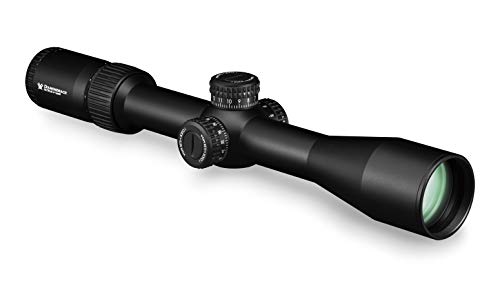
Vortex Diamondback Tactical 4-16x44 First Focal Plane Riflescope, EBR-2C MOA
$399.00 Full specificationsA first focal plane long range scope with exposed turrets, the class more often zeroed further out by shooters who expect shots stretching past 200 yards.
Best for: a first precision rifle scope, or a hunting rifle that will be dialled
Check price on AmazonChoosing a zero distance is choosing where you want your error to be, not eliminating it. Every rifle's trajectory crosses the line of sight exactly once at whatever distance you zero it, rises above that line before it, and falls below it after, and moving the zero further out simply moves where those two facts land. There is no zero distance that avoids both a period of shooting high and a period of shooting low.
The figures on this page assume a 168 grain match hollow point .308 Winchester load at a catalogue 2,650 feet per second and a 1.8 inch sight height, computed with this site's own G1 point mass trajectory model. Both of those assumptions matter. A rifle that differs by 100 feet per second in muzzle velocity, which is ordinary between a catalogue figure and a real barrel, or by half an inch of sight height, will not match this table exactly at distance.
What does a 100 yard zero actually do to a .308 at distance?
The working
G1 point mass model, BC 0.462, muzzle velocity 2,650 fps, sight height 1.8 in, zero 100 yd
Computed with this site's own G1 point mass model, the same math the moment-of-truth zero pages on this site use. It is not radar data and does not model spin drift or Coriolis.
A 100 yard zero is easy to confirm and easy to reason about, since almost every range has a line at exactly that distance. Here is exactly what it costs past that distance.
A 100 yard zero on this load is 3.97 inches low at 200 yards and 14.7 inches low at 300, needing 4.68 MOA of come-up to centre the hold at 300.
Sourced figure
| Distance | Path | Come up (MOA) | Come up (mil) |
|---|---|---|---|
| 100 yd | 0.0 in, at zero | 0.00 | 0.00 |
| 200 yd | 3.97 in low | 1.90 | 0.55 |
| 300 yd | 14.7 in low | 4.68 | 1.36 |
Figures come from this site's own trajectory model for the stated load. Confirm the far column at a measured distance before trusting it, since a real barrel's muzzle velocity commonly differs from a catalogue figure by 100 feet per second or more.
What does a 200 yard zero do instead?
The identical load and rifle, zeroed 100 yards further out. Notice what moves and what does not.
A 200 yard zero on this load sits 1.99 inches high at 100 yards and only 8.74 inches low at 300, roughly 6 inches flatter at 300 than the 100 yard zero, at the cost of shooting high in the middle distance.
Sourced figure
| Distance | Path | Come up (MOA) | Come up (mil) |
|---|---|---|---|
| 100 yd | 1.99 in high | not needed, already high of centre | not needed |
| 200 yd | 0.0 in, at zero | 0.00 | 0.00 |
| 300 yd | 8.74 in low | 2.78 | 0.81 |
The 1.99 inch high figure at 100 yards is well within the vital zone of most game animals for a centre hold, so a 200 yard zero rarely costs a hunter a shot at that distance even though the rifle is not printing exactly at point of aim.
Why the 200 yard zero looks flatter and what that actually costs
The direct comparison is stark: 14.7 inches low at 300 with a 100 yard zero against 8.74 inches low at 300 with a 200 yard zero, a difference of roughly 6 inches purely from where the zero is set, with no change to the rifle, the scope or the ammunition. That is the entire appeal of zeroing further out for anyone who expects shots stretching toward 300 yards or beyond.
The cost is smaller than shooters often assume, but it is real. A 200 yard zero shoots 1.99 inches high at 100 yards instead of dead on, which matters for a small target or a precise shot placement requirement and rarely matters for a typical big game vital zone. Confirm your own required precision at the ranges you actually shoot before assuming either zero is automatically correct.
Elevation travel: what each zero actually asks of your turret
Reaching 300 yards from a 100 yard zero on this load needs 4.68 MOA of dialled come-up. Reaching the same 300 yards from a 200 yard zero needs only 2.78 MOA, since the zero has already absorbed part of the climb. A scope with limited total elevation travel, or one already using part of its range to correct for a base or a mounting issue, benefits from starting the zero further out for exactly this reason: it leaves more usable travel for whatever distance actually needs it.
Sources
- Published factory load specification: 168 grain match hollow point at a catalogue 2,650 feet per second
- G1 standard drag function, the published Ingalls and Siacci reference
Frequently asked questions
Should I zero my .308 at 100 or 200 yards?
Zero at 100 yards if you mostly shoot inside that distance or want the simplest possible reference point, since it is dead on at the range distance nearly everyone has access to. Zero at 200 yards if you expect shots stretching toward 300 yards, since it trades 1.99 inches of high impact at 100 yards for roughly 6 fewer inches of drop at 300.
How low is a .308 at 300 yards with a 100 yard zero?
About 14.7 inches low, for a 168 grain match load at a catalogue 2,650 feet per second and a 1.8 inch sight height. That requires 4.68 MOA of dialled come-up, or an equivalent holdover, to centre a shot at that distance. Your own rifle's real muzzle velocity, measured with a chronograph, will shift this figure somewhat.
Does a 200 yard zero make my rifle shoot too high up close?
Not usually. For this .308 load, a 200 yard zero sits 1.99 inches high at 100 yards, which is well inside the vital zone of most big game animals for a centre hold. It matters more for a small target or a precision shot requirement than for typical hunting distances inside 150 yards.
How much elevation travel does a 300 yard shot need from each zero?
From a 100 yard zero, 4.68 MOA of come-up. From a 200 yard zero, only 2.78 MOA, since the zero itself has already absorbed part of the climb to that distance. A scope with limited total elevation travel benefits from a zero further out for exactly this reason.
Does this comparison apply to cartridges other than .308?
The concept does, the numbers do not. Every cartridge and load has its own velocity and ballistic coefficient, which changes exactly how much a given zero distance costs at any other range. Run your own load's figures with the zero distance calculator, or check this site's cartridge-specific zero pages, rather than applying these .308 numbers to a different round.
Why does the 100 yard zero remain the most common choice?
Mostly because it is the easiest to confirm. Almost every public and private range has a marked 100 yard line, which makes verifying the zero simple and repeatable. A 200 yard zero requires access to a range with that specific distance available, which is a real practical barrier separate from which zero is ballistically better for a given shooter's typical range.
Researched, not professional advice. This page is compiled from published manufacturer specifications, published optical and ballistic formulas, and owner-review consensus, not hands-on testing. Figures described as a rule of thumb are shooter convention rather than sourced numbers, and they are labelled that way wherever they appear. Ballistic figures come from a point mass model using the ballistic coefficient the maker publishes, so treat them as a starting point and confirm them on paper at a measured distance. Confirm your firearm is unloaded with the action open before you mount, level, torque or bore sight anything. Verify a zero only on a supervised range or a safe, legal backstop, know what lies beyond your target, and follow the law where you hunt and shoot, including rules on land access and permitted cartridges.