Long range scope reviews
Vortex Diamondback Tactical 6-24x50 Review
Quick answer
The Vortex Diamondback Tactical 6-24x50 at $425.99 puts 24x magnification and a 50mm objective under $500, but the number that matters most is a 2.08mm exit pupil at full power, which makes 24x a bright-day setting rather than a low-light one.
Twenty four power and a 50mm objective for under $500 looks like an obvious upgrade over a 16x scope until you compute what happens to the light at the top of that range. The Vortex Diamondback Tactical 6-24x50 is a genuinely capable long range scope, and its own numbers are the honest way to explain where its ceiling actually sits.
This review is built from Vortex's own published specifications, the exact optical arithmetic those specs allow, and the consensus of verified owner reviews. We did not test this scope in person.
On this page
- What does 24x actually cost you in light?
- What reticle does this scope actually ship with?
- What ring height does a 50mm objective on a 30mm tube need?
- What does owner-review consensus say about this scope at 24x?
- The weakness: what 24x actually costs you in light
- A budget-pick alternative with a better exit pupil, or an illuminated one instead
What does 24x actually cost you in light?
The working
exit pupil = objective / magnification, twilight factor = sqrt(objective x magnification)
Exact arithmetic from the published 50mm objective and 6-24x magnification range.
Exit pupil falls from 8.33mm at 6x to just 2.08mm at 24x, which is why full power on this scope suits bright, high-contrast conditions rather than dusk or an overcast range day.
Sourced figure
| Magnification | Exit pupil | Twilight factor |
|---|---|---|
| 6x | 8.33mm | 17.3 |
| 12x | 4.17mm | 24.5 |
| 24x | 2.08mm | 34.6 |
See the full breakdowns for a 50mm objective at 6x and a 50mm objective at 24x for how this scope compares against every other 50mm scope on this site at each end of its range.
What reticle does this scope actually ship with?
Vortex's own listing for this configuration does not name a specific reticle model, unlike the Diamondback Tactical 4-16x44 in the same line, which publishes the EBR-2C MOA reticle by name. That is worth stating plainly rather than guessing: buyers should confirm the exact reticle pattern from current product listings before ordering, since it is not part of the published specification set for this model.
What ring height does a 50mm objective on a 30mm tube need?
A 50mm objective is the largest this site's long range cluster covers, and it needs real ring height on a 30mm tube to clear the barrel. See the worked figures for a 50mm objective on a 30mm tube before ordering rings, since a height that clears a 44mm objective will not necessarily clear this one.
What does owner-review consensus say about this scope at 24x?
The recurring theme is that 24x is genuinely usable on a bright day against high-contrast targets like steel plates, and genuinely disappointing in flat light or against a low-contrast target, which is exactly what a 2.08mm exit pupil predicts. Owners consistently describe running the scope at 12x to 16x for most practical shooting and reserving 24x specifically for confirming a hit or reading fine detail in good light.
The first focal plane construction and turret tracking draw the same praise as the 4-16x44 in this line: repeatable clicks and a reticle that subtends correctly at any power, which is the harder engineering problem this price point solves reliably.
The weakness: what 24x actually costs you in light
A 2.08mm exit pupil is well below the 5 to 7mm a dark-adapted eye can use, which means the last hour of usable range time in flat or fading light is spent at 12x or 16x rather than at the magnification printed on the box. That is not a defect, it is the same exit pupil formula every scope obeys, but it means the headline number, 24x, overstates what this scope actually delivers in anything but good light.
The unpublished reticle name is a smaller but real gap: a shooter choosing between reticle patterns for a specific discipline cannot confirm the exact subtension of this scope's reticle from Vortex's own published specification the way they can for the 4-16x44 in the same line.
A budget-pick alternative with a better exit pupil, or an illuminated one instead
If low-light performance matters more than top-end magnification, the Diamondback Tactical 4-16x44 at $399.00 keeps a 2.75mm exit pupil at its top power rather than 2.08mm, reviewed separately. If you want the same 6-24x50 configuration with a named illuminated mil reticle and a zero stop instead, the Athlon Argos BTR GEN3 6-24x50 at $379.99 adds both for less money.
| Model | Price | Magnification | Objective lens | Tube diameter | Focal plane | Reticle |
|---|---|---|---|---|---|---|
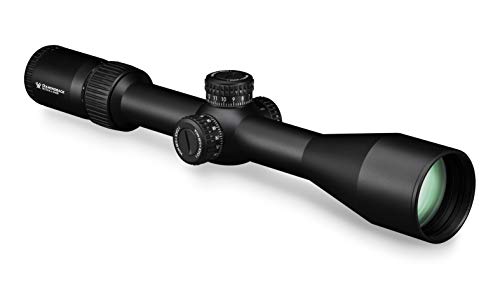 Vortex Diamondback Tactical 6-24x50 First Focal Plane Riflescope Vortex Diamondback Tactical 6-24x50 First Focal Plane Riflescope | $425.99 | 6-24x | 50 mm | 30 mm | First | - |
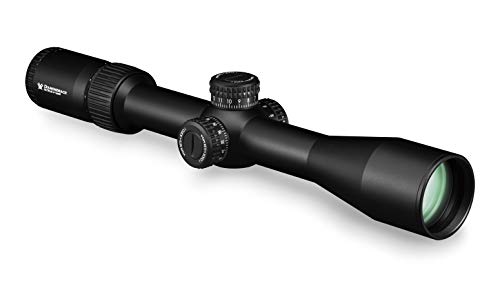 Vortex Diamondback Tactical 4-16x44 First Focal Plane Riflescope, EBR-2C MOA Vortex Diamondback Tactical 4-16x44 First Focal Plane Riflescope, EBR-2C MOA | $399.00 | 4-16x | 44 mm | 30 mm | First | EBR-2C MOA |
 Athlon Argos BTR GEN3 6-24x50 Riflescope, APRS11 FFP IR MIL Reticle Athlon Argos BTR GEN3 6-24x50 Riflescope, APRS11 FFP IR MIL Reticle | $379.99 | 6-24x | 50 mm | 30 mm | First | APRS11 MIL |
A dash means the manufacturer does not publish that figure. We leave it blank rather than estimating it.
How we chose
We did not test these optics in person and we never claim to. Picks are researched from manufacturer specification sheets, published optical and ballistic formulas, and the recurring themes in verified owner reviews. Every pick is matched to a real objective diameter, a real tube size, a real ring height or a real exit pupil rather than to a price bracket, and it is placed in the tier where its capability actually belongs. Where a figure is shooter convention rather than a sourced number we label it, and where a manufacturer does not publish a figure we leave it out instead of estimating it.
Sources
- Vortex published specifications for the Diamondback Tactical 6-24x50 FFP
- Owner-review consensus on 24x usability and low-light performance
Frequently asked questions
What is the exit pupil of the Diamondback Tactical 6-24x50 at 24x?
2.08mm, calculated as the 50mm objective divided by 24x magnification. That is well below what a dark-adapted eye can use, which is why 24x on this scope is best treated as a bright-day, high-contrast setting rather than one you rely on at dawn, dusk or in flat overcast light.
Is 24x overkill on a scope this size?
Not overkill exactly, but it comes with a real light penalty: the 2.08mm exit pupil at 24x is roughly a quarter the area of the 8.33mm exit pupil at 6x. Many owners run this scope at 12x to 16x for most shooting and save 24x specifically for confirming hits or reading fine detail in good light.
What reticle does the Diamondback Tactical 6-24x50 have?
Vortex's own published listing for this configuration does not name a specific reticle model, unlike its 4-16x44 sibling, which publishes the EBR-2C MOA reticle by name. Confirm the exact reticle pattern from current product listings before ordering rather than assuming it matches another scope in the same line.
What ring height does this scope need?
Enough to clear a 50mm objective bell on a 30mm tube, which is taller than what a 44mm or 40mm objective needs. Check the published clearance figures for a 50mm objective on a 30mm tube against your own base height, since this is the largest objective this site's ring height charts cover.
Does the Diamondback Tactical 6-24x50 have a zero stop?
No, unlike the Athlon Argos BTR GEN3 6-24x50 sold in the same magnification and objective size, which publishes a zero stop. Returning to a hunting zero after dialing elevation on this scope means counting clicks back rather than spinning a turret to a hard mechanical stop.
Is this scope better than the 4-16x44 version for long range shooting?
Only if you specifically need magnification past 16x in good light. The 4-16x44 delivers a brighter 2.75mm exit pupil at its top power against 2.08mm here, and both scopes share the same first focal plane construction and turret quality, so the choice comes down to how much top-end reach you actually use.
Researched, not professional advice. This page is compiled from published manufacturer specifications, published optical and ballistic formulas, and owner-review consensus, not hands-on testing. Figures described as a rule of thumb are shooter convention rather than sourced numbers, and they are labelled that way wherever they appear. Ballistic figures come from a point mass model using the ballistic coefficient the maker publishes, so treat them as a starting point and confirm them on paper at a measured distance. Confirm your firearm is unloaded with the action open before you mount, level, torque or bore sight anything. Verify a zero only on a supervised range or a safe, legal backstop, know what lies beyond your target, and follow the law where you hunt and shoot, including rules on land access and permitted cartridges.