Rangefinding binoculars
Best Rangefinding Binoculars
Quick answer
The best all-round rangefinding binocular is the Vortex Fury HD 5000 10x42 Laser Rangefinding Binoculars at $979.00, because it puts a 2,000 yard-plus laser inside a real 10x42 binocular, so the animal never has to be found twice through a separate device.
A rangefinding binocular solves a specific annoyance: finding an animal in a binocular, lowering it, picking up a separate rangefinder, and finding the same animal again through a different eyepiece before you can range it. Combining the two into one body removes that second search entirely.
The honest tradeoff is that you are now carrying one expensive instrument instead of two moderately priced ones, and a failure in either the optical half or the laser half means the whole unit goes in for service rather than just the cheaper part. That is why this category sits at the top of the glassing budget rather than the bottom.
These recommendations come from published manufacturer specifications and owner-review consensus. Nobody on this site shot these units against each other in a field test, and any comparison that claims otherwise for a category this expensive should be read skeptically.
On this page
- What you are actually buying: two instruments, one point of failure
- Exit pupil in a 10x42 rangefinding binocular
- Rangefinding binoculars by objective, published range and price
- Beginner: the entry point into the category
- Intermediate: the buy-once combination
- Expert: the longest range in the smallest package
What you are actually buying: two instruments, one point of failure
Every rangefinding binocular is, mechanically, a full binocular and a full laser rangefinder sharing a chassis and a battery. The optical quality question is exactly the same as buying a standalone binocular: objective diameter, magnification, glass and coatings all apply unchanged.
What changes is risk. A standalone binocular that fails optically and a standalone rangefinder that fails electronically are two separate repairs. A combined unit that fails in either half is one repair, and while modern units are reliable, this is the real argument for keeping a standalone rangefinder as a backup on a serious hunt rather than an argument against buying one at all.
The other real cost is weight and bulk. A rangefinding binocular is heavier than a comparable standalone binocular because it is carrying a laser, a rangefinding computer and a second battery compartment, and that weight is on the strap around your neck all day.
Exit pupil in a 10x42 rangefinding binocular
A 4.2 mm exit pupil is comfortably usable into dusk for most adults, though it is smaller than the 5.25 mm an 8x42 gives at the same objective size, which is the same tradeoff that applies to any 8x42 against 10x42 decision. See the full breakdown at 8x on a 42 mm objective for the comparison, and the same objective at 10x for the figure this category actually uses.
Some units in this category step up to a larger objective for more low-light margin. Checking the closest points on the exit pupil matrix, a 56 mm objective gives 4.67 mm at 12x and 3.5 mm at 16x, which brackets where a 15x56-class rangefinding binocular would sit if this catalog carried one at that size.
The working
exit pupil = objective diameter / magnification = 42 / 10 = 4.2 mm
Every 10x42 rangefinding binocular in this catalog shares this figure, because it is set entirely by the objective and the magnification, not by the laser module inside.
Rangefinding binoculars by objective, published range and price
Every model here is a 10x42, which keeps the optical comparison to price, published range and the ranging feature named in the manufacturer's own title.
Prices in this category run from about $535.25 to over $1,081.07 for a 10x42 configuration, with the spread driven almost entirely by the laser module and glass quality rather than the magnification.
Sourced figure
| Model | Configuration | Price |
|---|---|---|
| Bushnell Fusion X 10x42 Ranging Binoculars with ARC Technology | 10x42, ARC ranging | $535.25 |
| Vortex Ranger HD 3000 10x42 Laser Rangefinding Binoculars | 10x42, 3,000 yd class | $799.00 |
| Burris SignatureHD LRF Rangefinding Binocular | 10x42, LRF | $789.99 |
| SIG SAUER Canyon 10x42 Laser Rangefinding Binoculars | 10x42, LRF | $799.99 |
| Vortex Fury HD 5000 10x42 Laser Rangefinding Binoculars | 10x42, 5,000 yd class | $979.00 |
| Leupold BX-4 Range HD TBR/W 10x42 Rangefinding Binocular | 10x42, TBR/W | $1,081.07 |
Published range figures are measured against reflective targets, exactly as with a standalone rangefinder. Expect roughly a third to a half of the stated maximum on a soft, non-reflective animal.
Beginner: the entry point into the category
This tier optimizes for the lowest cost to a genuinely combined instrument, accepting a shorter published range in exchange for a real reduction in price over the flagship units.
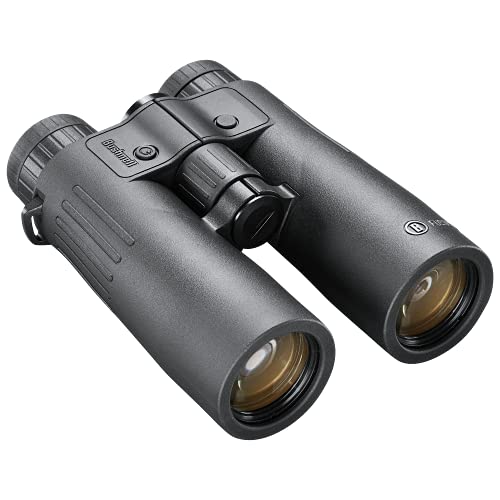
Bushnell Fusion X 10x42 Ranging Binoculars with ARC Technology
$535.25The lowest price into a true rangefinding binocular in this catalog, with ARC angle-compensated ranging built in rather than added as an afterthought.
Best for: A hunter who wants the convenience of one instrument and is willing to accept a shorter published range than the flagship units.
Check price on AmazonIntermediate: the buy-once combination
This is where most hunters who decide the category is worth it should land: a genuine step up in published range and glass quality over the entry tier, without paying flagship prices.
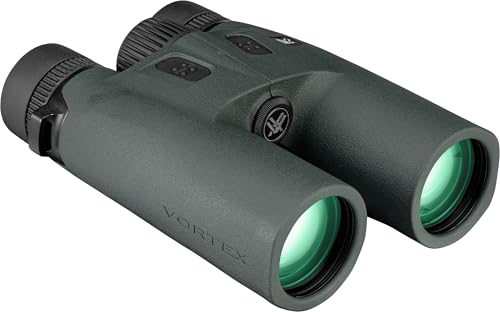
Vortex Ranger HD 3000 10x42 Laser Rangefinding Binoculars
$799.00 Full specificationsA published range well past what almost any ethical hunting shot requires, in HD glass that resolves detail at distance better than the entry tier.
Best for: A hunter upgrading from a separate binocular and rangefinder who wants one instrument going forward.
Check price on Amazon
SIG SAUER Canyon 10x42 Laser Rangefinding Binoculars
$799.99Comparable published range and glass quality to the Vortex Ranger, worth cross-shopping on price and hand feel.
Best for: A buyer who already owns other SIG SAUER optics and wants a consistent reticle and control layout across their kit.
Check price on AmazonExpert: the longest range in the smallest package
This tier is the performance ceiling for range and glass in a single rangefinding binocular, aimed at open country hunters who genuinely range past 600 yards regularly.

Leupold BX-4 Range HD TBR/W 10x42 Rangefinding Binocular
$1,081.07TBR/W ballistic ranging is built into the display, folding a holdover suggestion directly into the same glass you are already looking through, at the top of this category's published performance.
Best for: An open country hunter who wants a single device that ranges, compensates for angle and suggests a hold in one look.
Check price on AmazonWho should not buy this tier: Not for a hunter whose shots stay inside 400 yards, and not for anyone unwilling to accept the cost of replacing two instruments at once if the unit ever needs service. A standalone binocular plus a mid-tier rangefinder covers that hunter for less money with less risk.
How we chose
We did not test these optics in person and we never claim to. Picks are researched from manufacturer specification sheets, published optical and ballistic formulas, and the recurring themes in verified owner reviews. Every pick is matched to a real objective diameter, a real tube size, a real ring height or a real exit pupil rather than to a price bracket, and it is placed in the tier where its capability actually belongs. Where a figure is shooter convention rather than a sourced number we label it, and where a manufacturer does not publish a figure we leave it out instead of estimating it.
Sources
- Vortex Optics published specifications
- Leupold published specifications
- SIG SAUER published specifications
- Burris published specifications
- Bushnell published specifications
- Exit pupil, objective diameter divided by magnification, standard published optical formula
Frequently asked questions
Are rangefinding binoculars worth the extra cost over separate instruments?
If you already carry both a binocular and a rangefinder on every outing, the case is strong: the animal stays in the glass when you press the range button instead of needing to be found again through a separate monocular. The tradeoff is a single point of failure and higher weight, which is why this sits above a standalone rangefinder in price and risk.
Do rangefinding binoculars have worse glass than a dedicated binocular at the same price?
Usually somewhat, because part of the budget goes to the laser module and its electronics rather than glass alone. A dedicated 10x42 binocular at the same price as a rangefinding one will typically show a brighter or sharper image, which is the honest cost of the added convenience.
What magnification is standard for a rangefinding binocular?
10x42 is the default across almost every maker in this category, giving a 4.2 mm exit pupil. It is a compromise between the steadiness of 8x and the reach of 12x, chosen because both finding and ranging benefit from a magnification most people can hold reasonably still without a tripod.
How far will a rangefinding binocular actually read on an animal?
The same rule applies as any standalone rangefinder: expect roughly a third to a half of the published reflective-target maximum on a soft, non-reflective animal in ordinary field conditions. A unit rated to 5,000 yards on a reflective target is not promising 5,000 yards on a deer.
Should I still carry a backup rangefinder?
On a serious or remote hunt, it is a reasonable precaution rather than paranoia. A rangefinding binocular combines the two most-used pieces of glassing equipment into one unit, and a failure of either half takes both functions offline at once, which a small backup rangefinder in a pack pocket solves cheaply.
Can I use a rangefinding binocular on a tripod?
Yes, and it helps the laser lock as much as it helps the image. Most full-size models accept the same threaded tripod adapters as a standard binocular, hidden under a cap near the hinge, and a steadier hold speeds up a confident read on a small or distant target.
Researched, not professional advice. This page is compiled from published manufacturer specifications, published optical and ballistic formulas, and owner-review consensus, not hands-on testing. Figures described as a rule of thumb are shooter convention rather than sourced numbers, and they are labelled that way wherever they appear. Ballistic figures come from a point mass model using the ballistic coefficient the maker publishes, so treat them as a starting point and confirm them on paper at a measured distance. Confirm your firearm is unloaded with the action open before you mount, level, torque or bore sight anything. Verify a zero only on a supervised range or a safe, legal backstop, know what lies beyond your target, and follow the law where you hunt and shoot, including rules on land access and permitted cartridges.