Riflescopes
Best Riflescopes
Quick answer
The best riflescope for most shooters is the Vortex Diamondback 3-9x40 Riflescope, Dead-Hold BDC Reticle at $249.00, because a 3-9x40 hunting configuration with a transferable lifetime warranty covers more real shooting than any single spec upgrade above it. Faster shooters and longer distances need a different tier, covered below.
A riflescope is one job wearing a lot of marketing: point a reticle at the same place every time, across recoil, temperature and years. Almost every spec on the box is either how it does that job or noise, and this page sorts one from the other before it gets to any product.
Two numbers do more work than the rest of the spec sheet combined. Exit pupil, which is objective diameter divided by magnification, decides how the image holds up as the light goes: a 44 mm objective at 16x gives a 2.75 mm exit pupil, comfortable in daylight and thin at dusk. And 1 MOA, which is exactly 1.047 inches at 100 yards by trigonometry rather than the rounded 1 inch that shooters use as shorthand, decides how far a turret click actually moves the impact.
Everything below is researched from published manufacturer specifications and owner-review consensus across major retailers, not from a hands-on shooting session, and any roundup that claims otherwise is telling you a story rather than reporting a spec sheet. Where a figure is not published, such as an exact objective bell diameter, this page says so instead of estimating it.
On this page
- What actually separates one riflescope from another?
- How much riflescope do most shooters actually need?
- The best riflescope for a first hunting rifle
- The buy-once riflescope for a committed shooter
- The performance ceiling for a dedicated hunting riflescope
- Does a bigger tube make the image brighter?
What actually separates one riflescope from another?
Four decisions account for almost the entire spread in price and capability, and none of them is the number printed largest on the box.
Focal plane. A second focal plane reticle stays a constant size on the glass as you change magnification, which is what most hunting scopes use because the crosshair stays visible against a dark animal at any power. A first focal plane reticle grows and shrinks with magnification so its subtensions are correct at every power, which is what dialling and precision holdovers need. Neither is universally better; they solve different problems.
Tube diameter. A 30 mm or 34 mm tube does not gather more light and does not change what a turret click is worth. What it buys is room for the internal erector to travel further, which means more total elevation available before the scope runs out. A 1 inch tube on a scope that never gets dialled past 300 yards gives up nothing.
Turret type. Capped hunting turrets are set once and left alone. Exposed turrets with a zero stop are built to be dialled in the field and returned to zero by feel. Buying exposed turrets for a scope that will only ever be sighted in once is paying for a feature that never gets used.
Warranty. Vortex, Leupold, Athlon and Primary Arms all transfer a lifetime warranty to a private-party buyer with no receipt required, which is worth more over twenty years than a small step up in glass quality and is the reason the picks below lean toward those makers at every tier.
How much riflescope do most shooters actually need?
Before any product, the category. Four broad configurations cover almost every rifle in the country, and picking the wrong one wastes more money than picking the wrong brand inside the right one.
A 3-9x40 second focal plane hunting scope covers most rifles shot inside 300 yards, while a first focal plane scope on a 30 mm or 34 mm tube is the category built for dialling come-ups past that distance.
Shooter convention
| Category | Typical magnification | Reticle plane | Best for |
|---|---|---|---|
| Hunting scope | 3-9x to 4-12x | Second | General purpose shooting inside 300 yards with a simple duplex or BDC reticle |
| Low power variable (LPVO) | 1-6x to 1-10x | Second, sometimes First | A fast, close to mid range optic built to compete with a red dot up close |
| Long range precision | 4-16x to 6-24x | First, almost always | Dialling or holding a computed come-up at distance, with exposed turrets |
| Rimfire and airgun | 2-7x to 4-12x | Second | Parallax corrected for short distance rather than for 100 yards |
These are conventions from how the market actually segments products, not a manufacturer standard, and plenty of scopes blur the lines deliberately.
The best riflescope for a first hunting rifle
The job at this tier is lowest total cost to something that reliably holds zero, not the most features per dollar. A scope that will not hold a zero is worse than no scope, regardless of price.

Vortex Crossfire II 3-9x40 Riflescope, Dead-Hold BDC Reticle
$128.99 Full specificationsA transferable lifetime warranty on a scope this inexpensive means the worst case outcome is a free replacement rather than a lost purchase, and the 3-9x40 range covers essentially all hunting distances.
Best for: a first optic on a budget-conscious build
Check price on Amazon
Bushnell Banner 2 3-9x40 Riflescope, DOA Quick Ballistic Reticle
$89.00The floor of scopes worth mounting at all. Below this price band the failure rate climbs fast enough that the savings disappear the first time a scope has to be replaced mid-season.
Best for: the tightest possible first-rifle budget
Check price on AmazonThe buy-once riflescope for a committed shooter
This tier optimizes value per dollar rather than lowest cost, on the theory that a scope bought once and never replaced is cheaper than two scopes bought in sequence.

Vortex Diamondback 3-9x40 Riflescope, Dead-Hold BDC Reticle
$249.00 Full specificationsMeaningfully better glass and turret feel than the Crossfire line for a modest step up in price, with the same transferable lifetime warranty behind it.
Best for: a hunting rifle that will be owned for a decade or more
Check price on Amazon
Leupold VX-Freedom 3-9x40 CDS Duplex Riflescope
$299.99 Full specificationsThe CDS turret is the actual upgrade: Leupold will cut a custom elevation dial marked in yards for your specific load, turning a dialled come-up into reading a number rather than doing arithmetic at the bench.
Best for: a shooter who wants one dial matched to one load
Check price on AmazonThe performance ceiling for a dedicated hunting riflescope
At this tier the money buys glass quality visible at last light and turret mechanisms that keep tracking correctly after years of temperature swings and recoil, not more magnification.
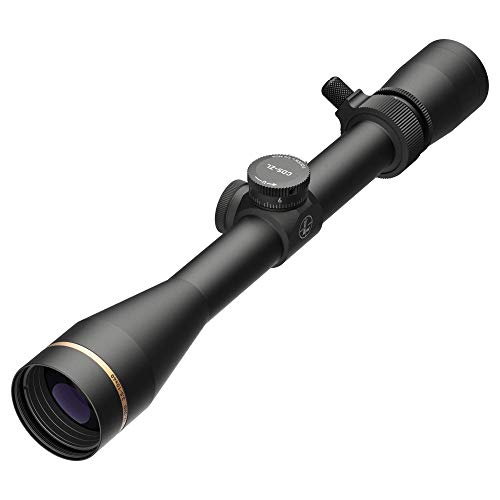
Leupold VX-3HD 3.5-10x40 CDS-ZL Duplex Riflescope
$599.99 Full specificationsA CDS-ZL turret with a zero stop on premium Leupold glass, at a price that undercuts most of the field still chasing the same light transmission figures.
Best for: a hunting rifle where dusk and dawn light matter as much as daylight resolution
Check price on AmazonWho should not buy this tier: Anyone who plans to dial come-ups past roughly 400 yards or wants a first focal plane reticle for precise holdovers. This is a second focal plane hunting scope with capped turrets, built to be set once and left alone, not a dialling platform. Someone chasing distance should look at the long range tier instead.
Does a bigger tube make the image brighter?
No. This is the single most persistent myth in the category. Light entering the optic is set by the objective lens, full stop. The tube is a housing the internal erector assembly lives inside, and a wider tube leaves room for that erector to travel further, which is a real benefit for a scope that gets dialled hard. It has no effect on brightness at all.
A 44 mm objective at 16x gives a 2.75 mm exit pupil whether the tube is 1 inch, 30 mm or 34 mm. See what your own combination gives at a 44 mm objective at 16x or run any pairing on the exit pupil calculator below.
Exit pupil, the figure that actually governs brightness
exit pupil (mm) = objective diameter (mm) / magnification 44 mm objective at 16x = 44 / 16 = 2.75 mm
This is exact arithmetic with no trigonometry involved. It says nothing about tube diameter, which does not appear anywhere in the formula.
How we chose
We did not test these optics in person and we never claim to. Picks are researched from manufacturer specification sheets, published optical and ballistic formulas, and the recurring themes in verified owner reviews. Every pick is matched to a real objective diameter, a real tube size, a real ring height or a real exit pupil rather than to a price bracket, and it is placed in the tier where its capability actually belongs. Where a figure is shooter convention rather than a sourced number we label it, and where a manufacturer does not publish a figure we leave it out instead of estimating it.
Sources
- Vortex Optics published specifications and warranty terms
- Leupold published specifications and warranty terms
- Manufacturer published objective diameters and tube diameters across the catalog
Frequently asked questions
What magnification riflescope do I actually need?
For almost all hunting inside 300 yards, 3-9x covers it, and the extra range past 9x on most hunting scopes gets used rarely if at all. Buy magnification for the shots you actually take rather than the longest shot you can imagine, and put the money you save into glass quality and warranty instead.
Is first focal plane worth it for hunting?
Usually not. In first focal plane the reticle shrinks at low magnification, which can make it hard to see against a dark animal at last light, exactly when hunting shots are often taken. Second focal plane keeps the reticle a constant visual size, which is the better trade for most hunting rifles.
Does a 30mm tube gather more light than a 1 inch tube?
No. Light entering an optic is governed entirely by the objective lens, and the tube is a housing for the internal erector mechanism. A larger tube gives more room for internal elevation travel, which matters for dialling at distance, but it does not change brightness or exit pupil at all.
How much should I spend on a first riflescope?
A transferable lifetime warranty from a maker like Vortex or Leupold is available starting around $128.99, and that warranty is worth more over the life of the scope than most of the feature upgrades above it. Spend to get the warranty first, then upgrade glass once you know what you actually shoot.
What is the difference between MOA and mil scopes?
Both are angular units. A minute of angle is 1.047 inches at 100 yards by trigonometry, and a mil is exactly 3.6 inches at 100 yards by definition. Neither is more accurate; what matters is buying a scope whose reticle and turrets use the same unit, so a correction read off the glass is a correction you can dial without converting it first.
Can I mount a riflescope without special tools?
You can, and many people do, but a level and a fixed torque limiter cost less than a box of ammunition components and remove the two most common causes of a scope that will not hold zero: a canted reticle and ring screws that are under or over torqued. See the mounting guide before skipping them.
Researched, not professional advice. This page is compiled from published manufacturer specifications, published optical and ballistic formulas, and owner-review consensus, not hands-on testing. Figures described as a rule of thumb are shooter convention rather than sourced numbers, and they are labelled that way wherever they appear. Ballistic figures come from a point mass model using the ballistic coefficient the maker publishes, so treat them as a starting point and confirm them on paper at a measured distance. Confirm your firearm is unloaded with the action open before you mount, level, torque or bore sight anything. Verify a zero only on a supervised range or a safe, legal backstop, know what lies beyond your target, and follow the law where you hunt and shoot, including rules on land access and permitted cartridges.