Parallax, 36 yard setting
How much parallax error is a 36 yard setting at 200 yards?
Quick answer
A scope with parallax set for 36 yards, used on a target at 200 yards, produces roughly 0.46 inches of aiming error for a tenth of an inch of eye movement off the optical axis, which is 0.22 MOA. That is small but measurable.
Parallax is what happens when the image of the target does not land exactly in the plane of the reticle. When the two planes are separated, moving your eye off the centre of the eyepiece makes the reticle appear to slide across the target, and wherever the reticle happens to be sitting when you break the shot is where you aimed.
A fixed parallax scope is set at the factory for one distance. Rimfire scopes built for small targets at short range. At any other distance there is some error available, and how much depends on how far your eye is from the optical axis.
The honest framing that most discussions of this miss: parallax error is not a fixed amount of inaccuracy your scope adds. It is a ceiling on how much error your head position can introduce. Keep your eye centred and the error goes to zero no matter how badly the parallax is set.
On this page
How much error is actually available at 200 yards?
The geometry
error at the target = eye offset x (target distance / parallax distance - 1) = eye offset x (200 / 36 - 1) = eye offset x 4.56
A geometric approximation of a real optical system, so treat it as the right scale rather than exact to the thousandth. It is zero when the two distances match, and it changes sign either side.
Eye offset is how far the centre of your pupil sits from the optical axis of the scope. A well practised shooter with a consistent cheek weld is within about a twentieth of an inch. A tenth of an inch is ordinary. Three tenths is a bad position on an awkward shot.
With a tenth of an inch of eye offset, this combination gives about 0.46 inches of error at 200 yards, which is 0.22 MOA.
Sourced figure
| Eye offset from the optical axis | Error at the target | In MOA | In mils |
|---|---|---|---|
| 0.05 in | 0.23 in | 0.11 MOA | 0.03 mil |
| 0.1 in | 0.46 in | 0.22 MOA | 0.06 mil |
| 0.15 in | 0.68 in | 0.33 MOA | 0.09 mil |
| 0.2 in | 0.91 in | 0.44 MOA | 0.13 mil |
| 0.3 in | 1.37 in | 0.65 MOA | 0.19 mil |
Your eye cannot move further off axis than the edge of the exit pupil without the image blacking out, so the exit pupil puts a hard ceiling on the bottom row of this table.
The same setting at other distances
Holding the parallax setting at 36 yards and a tenth of an inch of eye offset, across every distance you might shoot.
Error is zero at 36 yards by definition and grows to about 1.57 inches at 600 yards.
Sourced figure
| Target distance | Error at 0.1 in offset | In MOA | |
|---|---|---|---|
| 25 yd | 0.03 in | 0.12 MOA | |
| 50 yd | 0.04 in | 0.07 MOA | |
| 100 yd | 0.18 in | 0.17 MOA | |
| 200 yd | 0.46 in | 0.22 MOA | This page |
| 300 yd | 0.73 in | 0.23 MOA | |
| 400 yd | 1.01 in | 0.24 MOA | |
| 500 yd | 1.29 in | 0.25 MOA | |
| 600 yd | 1.57 in | 0.25 MOA |
In angular terms the error is nearly constant with distance, which is why parallax feels like a fixed penalty rather than one that grows.
When parallax actually costs you a shot
Three conditions have to line up before parallax is the reason you missed, and all three are needed.
- A large mismatch between the parallax setting and the target distance. Here that ratio is 5.56, so the mismatch is substantial and there is real error available.
- Inconsistent head position. This is the one you control. A repeatable cheek weld removes most of the error regardless of the setting.
- A target small enough for 1.37 inches to matter. On a deer vital zone at 200 yards it does not. On a prairie dog or a scoring ring it does.
Which is why parallax is genuinely important for precision rimfire, where targets are small and distances vary, and genuinely a non-issue for most big game hunting inside 300 yards.
How to check and set parallax properly
- Confirm the rifle is unloaded. Action open, chamber empty, before you put your eye behind anything.
- Focus the reticle first. Point at a blank sky and turn the eyepiece diopter until the reticle is sharp instantly when you look through. Do this before anything else, or you will chase a reticle problem with the parallax knob.
- Look at your target. Settle behind the rifle with your normal cheek weld and put the reticle on the target at the distance you will shoot.
- Move your head deliberately. Move your eye up, down, left and right within the eye box. If the reticle appears to slide across the target, parallax is not set for that distance.
- Adjust until the sliding stops. On a side focus or adjustable objective scope, turn it until the reticle stays put on the target as your head moves. Ignore the yardage markings on the knob: they are a starting point and they are frequently a long way out. Your eye is the instrument here.
Scopes with parallax you can actually set
Chosen against the numbers on this page rather than from a general list, so the recommendation cannot contradict the arithmetic above.

Leupold Mark 4HD 4.5-18x52 M5C3 Side Focus FFP PR2-Mil Riflescope
$1,499.99 Full specificationsThe professional end of this catalogue. A 34 mm tube, a locking elevation dial with a revolution indicator, and Leupold building it in Oregon with a service department behind it.
Best for: a rifle where a failed scope is not an option
Check price on Amazon
Vortex Viper PST Gen II 5-25x50 First Focal Plane Riflescope, EBR-7C MOA
$999.00 Full specificationsThe reference precision scope in this price band. The turrets return to zero reliably, which sounds like a low bar and is the single thing cheap scopes fail at after a season.
Best for: a precision rifle that will be dialled hard and often
Check price on Amazon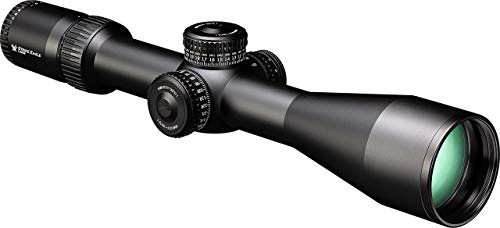
Vortex Strike Eagle 5-25x56 First Focal Plane Riflescope, EBR-7C MOA
$799.00 Full specificationsA big illuminated first focal plane reticle on a 34 mm tube, aimed squarely at practical precision matches where a stage is shot fast and the reticle does the work.
Best for: practical and PRS style competition
Check price on Amazon
Athlon Optics Midas TAC HD 6-24x50 First Focal Plane Riflescope, APRS3 FFP MIL
$569.00 Full specificationsThe step from Argos to Midas is glass and turret feel rather than features, and turret feel is what stops you losing count of clicks in the dark with cold hands.
Best for: a competition rifle where the turrets get used every string
Check price on Amazon
Swampfox Kentucky Long 5-30x56 FFP Riflescope, MOA Illuminated
$510.00 Full specificationsThirty power on a 56 mm objective, which is a lot of scope for the money and a genuinely useful combination for reading mirage on a known distance range.
Best for: high magnification work at a mid price
Check price on AmazonHow we chose
We did not test these optics in person and we never claim to. Picks are researched from manufacturer specification sheets, published optical and ballistic formulas, and the recurring themes in verified owner reviews. Every pick is matched to a real objective diameter, a real tube size, a real ring height or a real exit pupil rather than to a price bracket, and it is placed in the tier where its capability actually belongs. Where a figure is shooter convention rather than a sourced number we label it, and where a manufacturer does not publish a figure we leave it out instead of estimating it.
Sources
- Geometric derivation of parallax error from the separation of the image and reticle planes
- Manufacturer published fixed parallax settings by optic class
Frequently asked questions
Does a 36 yard parallax setting work at 200 yards?
Yes, comfortably. The available error with an ordinary tenth of an inch of eye offset is about 0.46 inches at 200 yards, which is smaller than the group most rifles shoot at that distance and far smaller than any target you would engage.
What is parallax on a rifle scope?
It is the apparent movement of the reticle against the target when you move your eye, and it happens because the target image is not falling exactly in the plane of the reticle. It is a focus relationship rather than a fault, and it is zero at whatever distance the scope parallax is set for.
Do I need adjustable parallax?
For most big game hunting inside 300 yards, no: a fixed 100 yard setting produces less error than your own position does. For precision rimfire, small targets, or anything where the distance varies widely between shots, yes. The clearest test is whether your targets are small enough for an inch to matter.
Is the yardage marking on a side focus knob accurate?
Frequently not, and it does not need to be. The markings are a manufacturing starting point and they drift with temperature and between individual scopes. Set parallax by moving your head and watching whether the reticle slides, then note where the knob actually ended up for that distance and use that mark in future.
Does parallax affect where the bullet goes?
No. It affects where you aimed. The rifle sends the bullet wherever the barrel was pointing, and parallax means the reticle was not where you thought it was when you broke the shot. The practical consequence is identical to an aiming error, which is why it looks like inaccuracy.
Can I fix parallax by focusing the eyepiece?
No, and confusing the two is the most common mistake here. The eyepiece diopter focuses the reticle for your eye and nothing else. The parallax adjustment, whether a side focus knob or an adjustable objective, focuses the target image into the reticle plane. Set the diopter once on a blank sky and then leave it alone.
Researched, not professional advice. This page is compiled from published manufacturer specifications, published optical and ballistic formulas, and owner-review consensus, not hands-on testing. Figures described as a rule of thumb are shooter convention rather than sourced numbers, and they are labelled that way wherever they appear. Ballistic figures come from a point mass model using the ballistic coefficient the maker publishes, so treat them as a starting point and confirm them on paper at a measured distance. Confirm your firearm is unloaded with the action open before you mount, level, torque or bore sight anything. Verify a zero only on a supervised range or a safe, legal backstop, know what lies beyond your target, and follow the law where you hunt and shoot, including rules on land access and permitted cartridges.