Long range and precision riflescopes
Primary Arms SLx 3-18x50 FFP Gen II Review
Quick answer
The Primary Arms SLX 3-18x50mm FFP Gen II Riflescope is a 3-18x50 first focal plane riflescope built around Primary Arms's own ACSS reticle, priced at $499.99. The reticle handles ranging, holdover and a 20 mph wind hold in one etched pattern, aimed at a shooter who holds rather than dials.
Most first focal plane precision scopes are built around the turrets: dial a computed correction, confirm it against a zero stop, take the shot. The SLx 3-18x50 is built around the opposite workflow. Primary Arms designs its own ACSS reticles specifically so a shooter can range a target, read a holdover and read a wind hold directly off the glass without ever touching a turret, and the reticle calibration is tied to a specific cartridge class rather than a generic mil or MOA grid.
At $499.99 this scope competes directly with dial-first designs like the Athlon Midas TAC at a similar magnification range, and the honest comparison is not glass quality but workflow: whether you would rather range, hold and shoot, or dial a computed number and shoot.
This review is researched from Primary Arms published specifications and owner-review consensus, not from a hands-on shooting session, and marks the ACSS reticle's calibrated figures as manufacturer-published rather than independently verified.
On this page
- What does the ACSS reticle actually do that a plain mil reticle does not?
- What does the 50 mm objective give you across the zoom range?
- Do the Easy Stop turrets matter if the reticle does the work?
- What ring height and mount does this scope need?
- Where the SLx 3-18x50 costs you: no published spec sheet for total elevation travel
- Budget alternatives and a step up for dialing instead of holding
- Instead of holding, a step up for dialling
What does the ACSS reticle actually do that a plain mil reticle does not?
A generic mil or MOA reticle gives you a ruler: hash marks at even intervals that you convert to a holdover or a wind hold using a ballistic calculation you run yourself, in the field, before the shot. The ACSS Apollo reticle in this scope is calibrated instead, meaning Primary Arms has already run that calculation for a specific cartridge class, in this case .308 Winchester and 6.5 Grendel, and etched the result directly into the glass as ranging brackets, holdover dots and wind hold marks scaled for those loads specifically.
The trade is scope-specific and load-specific. A reticle this tightly calibrated is faster to use correctly for the cartridge it was built around and less useful, or actively misleading, if you load a different cartridge or a load with a meaningfully different trajectory than what the reticle assumes. Read the manufacturer's calibration assumptions before trusting the marks with an unusual load.
What does the 50 mm objective give you across the zoom range?
Exit pupil, computed
exit pupil (mm) = objective diameter (mm) / magnification at 18x: 50 / 18 = 2.778 mm, rounded to 2.78 mm at 3x: 50 / 3 = 16.67 mm
Exact arithmetic. A dark-adapted human pupil rarely exceeds 5 to 7 mm depending on age, which is a population convention rather than a published spec.
An 18x top end is more forgiving on exit pupil than the 24x and 25x scopes elsewhere in this catalog, which is worth seeing laid out by magnification.
The SLx 3-18x50 gives a 2.78 mm exit pupil at its maximum 18x, meaningfully wider than a 24x or 25x competitor at the same objective size.
Sourced figure
| Magnification | Exit pupil | What it means |
|---|---|---|
| 3x | 16.67 mm | Far larger than any human pupil; this end of the range is about field of view, not brightness |
| 9x | 5.56 mm | Comfortable through dusk for nearly all adult eyes |
| 12x | 4.17 mm | Good through early dusk |
| 18x | 2.78 mm | The narrowest setting; still wider than a comparable 24x scope at this objective size |
Compared with a 6-24x50 scope, this scope's lower top-end magnification gives up ranging reach at extreme distance in exchange for a brighter image at maximum power.
Do the Easy Stop turrets matter if the reticle does the work?
Primary Arms includes capped Easy Stop turrets with tactile and audible 0.1 mil clicks, which is a genuine precision feature and one this scope's core design intends most owners to use rarely. The reticle is built to make dialling optional for most shots inside its calibrated range, which means the turret quality matters most as a fallback for a shot that falls outside the reticle's holdover marks, or for a shooter who zeros the scope and then dials a single correction for an unusually long shot rather than holding it.
This is the opposite emphasis from the Athlon Midas TAC and Vortex Viper PST Gen II reviewed elsewhere on this site, where the turret is the primary tool and the reticle is a reference. Neither approach is wrong; they solve the shot differently, and which one suits you depends on whether you would rather range and hold under time pressure or dial a known correction.
What ring height and mount does this scope need?
Primary Arms's published listing describes a rugged 30 mm aluminum body on this scope, so mounting follows the same rules as any 50 mm objective on a common 30 mm tube. Check what ring height a 50 mm objective needs on a 30 mm tube before ordering, since the bell diameter rather than the tube sets the clearance requirement.
With 3.5 to 3.9 inches of published eye relief and a dovetail-compatible magnification ring that accepts a throw lever sold separately, mounting position and eye relief consistency matter more here than on a longer-relief hunting scope, particularly at the low end of the zoom range where the reticle's wide field of view is meant to be used for fast target acquisition.
Where the SLx 3-18x50 costs you: no published spec sheet for total elevation travel
The honest limitation of this scope is not the reticle, which does exactly what Primary Arms says it does for the cartridges it is calibrated for. It is a gap in what Primary Arms publishes: unlike some competitors in this price range, a specific total elevation and windage travel figure comparable across the line is not consistently published for this configuration, which makes it harder to verify in advance how much dialled correction the scope has available if you do need to use the turrets for a shot beyond the reticle's calibrated holdover range.
The other real limitation is cartridge specificity: the ACSS Apollo reticle etched into this scope is calibrated for .308 Winchester and 6.5 Grendel. A shooter running a materially different cartridge and load will find the ranging brackets and holdover dots correct in shape but wrong in distance, which is a limitation of the reticle rather than a defect, and worth knowing before ordering.
Budget alternatives and a step up for dialing instead of holding
Two directions: a cheaper dial-first competitor, and a genuine step up if you decide you want to dial rather than hold after all.
| Model | Price | Magnification | Objective lens | Focal plane | Tube diameter |
|---|---|---|---|---|---|
 Primary Arms SLX 3-18x50mm FFP Gen II Riflescope Primary Arms SLX 3-18x50mm FFP Gen II Riflescope | $499.99 | 3-18x | 50 mm | First | - |
 Athlon Argos BTR GEN3 6-24x50 Riflescope, APRS11 FFP IR MIL Reticle Athlon Argos BTR GEN3 6-24x50 Riflescope, APRS11 FFP IR MIL Reticle | $379.99 | 6-24x | 50 mm | First | 30 mm |
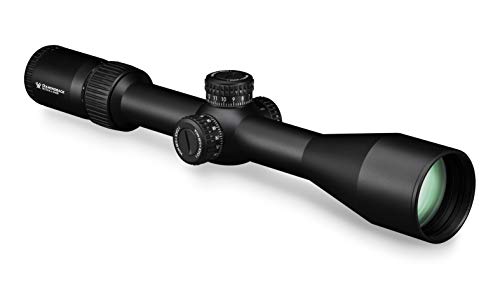 Vortex Diamondback Tactical 6-24x50 First Focal Plane Riflescope Vortex Diamondback Tactical 6-24x50 First Focal Plane Riflescope | $425.99 | 6-24x | 50 mm | First | 30 mm |
A dash means the manufacturer does not publish that figure. We leave it blank rather than estimating it.
Instead of holding, a step up for dialling
The Vortex Diamondback Tactical 4-16x44 First Focal Plane Riflescope, EBR-2C MOA and Athlon Argos BTR GEN3 6-24x50 Riflescope, APRS11 FFP IR MIL Reticle are both budget-friendly dial-first alternatives with a generic mil reticle and a zero stop, better suited to a shooter who wants to compute and dial rather than hold a calibrated reticle. For a genuine step up in turret repeatability while keeping the option to dial hard, look at the Vortex Viper PST Gen II 5-25x50 First Focal Plane Riflescope, EBR-7C MOA, which trades the ACSS reticle's built-in ranging for a documented reputation on tracking after repeated adjustment.
How we chose
We did not test these optics in person and we never claim to. Picks are researched from manufacturer specification sheets, published optical and ballistic formulas, and the recurring themes in verified owner reviews. Every pick is matched to a real objective diameter, a real tube size, a real ring height or a real exit pupil rather than to a price bracket, and it is placed in the tier where its capability actually belongs. Where a figure is shooter convention rather than a sourced number we label it, and where a manufacturer does not publish a figure we leave it out instead of estimating it.
Sources
- Primary Arms published specifications for the SLx 3-18x50mm FFP Gen II Riflescope
- Owner-review consensus from verified purchaser reviews on major retail listings
Frequently asked questions
What does the ACSS reticle in the Primary Arms SLx 3-18x50 do?
It combines ranging brackets, holdover dots and wind hold marks in one etched first focal plane pattern, calibrated by Primary Arms specifically for .308 Winchester and 6.5 Grendel. It lets a shooter range a target and hold a correction directly off the glass rather than dialling a computed number on the turret.
What exit pupil does the SLx 3-18x50 give at full magnification?
2.78 mm at 18x, computed exactly as the 50 mm objective divided by 18x magnification. That is meaningfully brighter than a 24x or 25x scope with the same objective, because this scope's lower top-end magnification trades extreme distance ranging reach for a wider exit pupil at maximum power.
Is the ACSS reticle useful with a different cartridge than .308 or 6.5 Grendel?
The ranging brackets and holdover dots will be wrong in distance for a materially different trajectory, since Primary Arms calibrates them to specific published loads. The reticle still functions as a plain first focal plane reticle, but the calibrated holdover advantage is specific to the cartridges it was built around.
Do I still need to dial the turrets on this scope?
Rarely, for shots inside the reticle's calibrated holdover range, which is the design's whole point. The Easy Stop turrets remain useful as a fallback for a shot beyond that range or for a shooter who prefers to zero once and dial a single known correction for an unusually long or unusual shot.
What tube size does the SLx 3-18x50 use?
Primary Arms's published listing describes a rugged 30 mm aluminum body. The tube size affects available internal elevation and windage travel rather than image brightness, and 30 mm is the common standard for this class of precision scope.
What ring height does a 50 mm objective need on a 30 mm tube?
Roughly the same range as any 50 mm objective on a common tube, since the objective housing rather than the tube diameter sets the clearance requirement against the barrel. Measure the actual bell before ordering rather than assuming a catalog ring height name applies.
Researched, not professional advice. This page is compiled from published manufacturer specifications, published optical and ballistic formulas, and owner-review consensus, not hands-on testing. Figures described as a rule of thumb are shooter convention rather than sourced numbers, and they are labelled that way wherever they appear. Ballistic figures come from a point mass model using the ballistic coefficient the maker publishes, so treat them as a starting point and confirm them on paper at a measured distance. Confirm your firearm is unloaded with the action open before you mount, level, torque or bore sight anything. Verify a zero only on a supervised range or a safe, legal backstop, know what lies beyond your target, and follow the law where you hunt and shoot, including rules on land access and permitted cartridges.