Prism sights
Primary Arms SLx 3x32 Gen III Prism Review
Quick answer
The Primary Arms SLX 3x32 Gen III Prism Scope is a fixed 3x32 prism sight with a glass-etched ACSS reticle, priced at $299.99. Primary Arms publishes a 10.3 mm exit pupil, and because the reticle is etched into glass rather than projected, it stays sharp for a shooter whose astigmatism turns a red dot into a smear.
A red dot sight projects a point of light onto a curved lens, and for an eye with astigmatism, that point does not focus to a clean dot. It smears into a star or a comma shape, and no amount of adjusting the sight fixes it, because the distortion happens inside the eye rather than inside the optic. A prism sight solves the problem differently: the reticle is etched directly into a piece of glass inside the sight, so it is a genuinely sharp physical pattern regardless of how the eye focuses the light around it.
The SLx 3x32 Gen III is Primary Arms's answer to that problem at a fixed 3x, built around the same ACSS reticle philosophy as the company's LPVOs: ranging, holdover and wind holds calibrated to a specific cartridge class, here 7.62x39 and .300 Blackout, etched into one pattern. At $299.99 it is priced above a comparable red dot and below a full LPVO, which is exactly where a fixed-power prism sight belongs.
This review is researched from Primary Arms published specifications and owner-review consensus, not from a hands-on shooting session, and distinguishes the manufacturer's own published exit pupil figure from the simple objective-over-magnification arithmetic throughout.
On this page
- Why does an etched reticle matter for astigmatism specifically?
- What exit pupil does this prism sight actually give you?
- What does the eye box and eye relief actually mean day to day?
- Where the SLx 3x32 costs you: fixed eye relief, a real eye box, and weight
- Alternatives if fixed eye relief is the wrong trade for you
- A lighter alternative, and instead of a prism for a non-astigmatic eye
Why does an etched reticle matter for astigmatism specifically?
Astigmatism is an irregularity in the shape of the eye's cornea or lens that causes light to focus unevenly, and a projected red dot is especially vulnerable to it because the dot is formed by a single point source of light reflected off a curved lens toward the eye. An eye with astigmatism spreads that point into a streak, a star or a doubled image, and the effect gets worse as the dot brightness increases, which is the opposite of what a shooter instinctively does to try to fix it.
A prism sight reticle is a physical pattern etched into glass, illuminated from behind rather than projected as a point source, so what the astigmatic eye is looking at is a genuine object with edges rather than a diffused point of light. The ACSS CQB reticle in this sight remains fully visible and fully sharp with the illumination completely off, which is a second, independent advantage: a projected red dot is useless with a dead battery, and this reticle is not.
What exit pupil does this prism sight actually give you?
Exit pupil, published and computed
Primary Arms publishes 10.3 mm exit pupil for this sight. A simple check using the front lens diameter: 32 mm objective / 3x magnification = 10.67 mm.
The two figures are close but not identical. A prism sight's true exit pupil is set by the internal prism aperture rather than by the front lens diameter alone, which is why the manufacturer's own published figure, 10.3 mm, is the one to trust rather than the simple objective-over-magnification arithmetic used for a conventional scope.
Either figure describes a genuinely wide exit pupil for a 3x sight, wider than any of the variable long range scopes in this catalog at their top magnification.
Primary Arms publishes a 10.3 mm exit pupil for this sight, wider than any dark-adapted human pupil, so the sight itself is never the limiting factor on brightness.
Sourced figure
| Figure | Value | Source |
|---|---|---|
| Manufacturer published exit pupil | 10.3 mm | Primary Arms product listing |
| Computed from objective / magnification | 10.67 mm | Simple arithmetic using the 32 mm front lens |
| Typical dark-adapted human pupil | 5 to 7 mm | Population convention, not a spec |
Because both figures comfortably exceed what any human eye can use, the practical takeaway is the same either way: this sight is never the brightness bottleneck in the system.
What does the eye box and eye relief actually mean day to day?
Primary Arms publishes 2.72 to 2.92 inches of eye relief and a 31.5 foot field of view at 100 yards, both of which describe a sight that needs your eye in a specific place behind the glass, unlike a red dot, whose entire selling point is unlimited eye relief and a forgiving head position. A prism sight's eye box, the volume of space behind the sight where a clear, unvignetted image is visible, is real but finite, and getting the head position wrong shows up as a darkened edge or a partial view rather than a silently missed correction.
This is the direct cost of the etched reticle and the fixed magnification: a red dot forgives an imperfect cheek weld, and a prism sight asks for a more consistent one. For a mounted, stable platform this is a minor adjustment in habit. For a sight passed between shooters with different statures or used from awkward field positions, it is a genuine limitation worth trying before buying.
Where the SLx 3x32 costs you: fixed eye relief, a real eye box, and weight
The honest limitation of this sight is not the reticle or the glass, both of which owner-review consensus rates well specifically for astigmatic use. It is the physical trade a prism sight makes against a red dot: a fixed eye relief window rather than unlimited eye relief, a genuine eye box that has to be found rather than a dot that appears wherever your eye lands, and a heavier, longer body than a comparable micro red dot. At 18.4 ounces this sight adds real, noticeable weight to the front of a carbine compared with a red dot in the two to four ounce range.
None of that is a defect. It is the specific cost of solving the astigmatism problem with etched glass rather than a projected dot, and a shooter without astigmatism who does not need the etched reticle's guarantee of sharpness will find a red dot lighter, faster to shoulder and just as fast on target in most situations.
Alternatives if fixed eye relief is the wrong trade for you
Two directions: a Vortex-built prism competitor, and a smaller Primary Arms prism for less weight.
| Model | Price | Magnification | Etched glass reticle | Illuminated reticle |
|---|---|---|---|---|
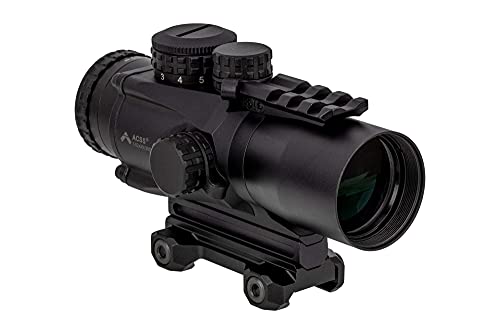 Primary Arms SLX 3x32 Gen III Prism Scope Primary Arms SLX 3x32 Gen III Prism Scope | $299.99 | 3x | Yes | Yes |
 Vortex Spitfire HD Gen II 3X Prism Scope, BDC4 Reticle Vortex Spitfire HD Gen II 3X Prism Scope, BDC4 Reticle | $389.79 | 3x | Yes | Yes |
 Primary Arms SLX 3X MicroPrism Sight, Yard Calibrated Primary Arms SLX 3X MicroPrism Sight, Yard Calibrated | $349.99 | 3x | Yes | Yes |
A dash means the manufacturer does not publish that figure. We leave it blank rather than estimating it.
A lighter alternative, and instead of a prism for a non-astigmatic eye
The Primary Arms SLX 3X MicroPrism Sight, Yard Calibrated shrinks the same idea into a body under 8 ounces, close to the weight of a micro red dot, at the cost of a smaller objective and a tighter field of view. The Vortex Spitfire HD Gen II 3X Prism Scope, BDC4 Reticle is the direct Vortex-built competitor with the same fixed-3x etched-reticle philosophy and Vortex's warranty behind it. For a shooter without astigmatism who does not need an etched reticle at all, a red dot such as the Vortex SPARC Red Dot Sight Gen II, 2 MOA Dot gives unlimited eye relief and a fraction of the weight, at the cost of losing the sharp reticle guarantee this sight exists to provide.
How we chose
We did not test these optics in person and we never claim to. Picks are researched from manufacturer specification sheets, published optical and ballistic formulas, and the recurring themes in verified owner reviews. Every pick is matched to a real objective diameter, a real tube size, a real ring height or a real exit pupil rather than to a price bracket, and it is placed in the tier where its capability actually belongs. Where a figure is shooter convention rather than a sourced number we label it, and where a manufacturer does not publish a figure we leave it out instead of estimating it.
Sources
- Primary Arms published specifications for the SLx 3x32 Gen III Prism Scope
- Owner-review consensus from verified purchaser reviews on major retail listings
Frequently asked questions
Does the Primary Arms SLx 3x32 actually help with astigmatism?
Yes, according to owner-review consensus from shooters with astigmatism, because the reticle is etched into glass rather than projected as a point of light, so it stays a sharp physical shape regardless of how the eye focuses light around it. A projected red dot smears for many astigmatic eyes in a way an etched reticle structurally cannot.
What exit pupil does this prism sight have?
Primary Arms publishes 10.3 mm, which is the figure to trust over a simple objective-divided-by-magnification calculation, since a prism sight's true exit pupil is set by the internal prism aperture rather than the front lens alone. Either figure comfortably exceeds any human pupil, so brightness is never the limiting factor.
Does the reticle still work if the battery dies?
Yes. The ACSS reticle is etched into the glass and remains fully visible without illumination, unlike a projected red dot, which goes dark with a dead battery. Illumination in this sight only adds brightness and contrast in daylight; it does not create the reticle itself.
How forgiving is the eye box on a fixed 3x prism sight?
Less forgiving than a red dot's unlimited eye relief, but genuinely usable once you learn the head position. Primary Arms publishes 2.72 to 2.92 inches of eye relief, and getting your eye outside that window shows up as vignetting or a partial image rather than a silently missed correction.
Is the ACSS CQB reticle useful with a cartridge other than 7.62x39 or .300 Blackout?
The ranging brackets and holdover marks are calibrated specifically to those two cartridges and will be wrong in distance for a materially different trajectory. The reticle still functions as a plain glass-etched pattern with any cartridge, but the calibrated holdover advantage is specific to the loads it was built around.
Should I buy a prism sight or a red dot if I don't have astigmatism?
A red dot, in most cases. Without astigmatism forcing the issue, a red dot gives unlimited eye relief, a fraction of the weight and equally fast target acquisition for most shooters. A prism sight earns its weight and fixed eye relief specifically by solving a problem a red dot cannot, so it makes the most sense when that problem actually exists.
Researched, not professional advice. This page is compiled from published manufacturer specifications, published optical and ballistic formulas, and owner-review consensus, not hands-on testing. Figures described as a rule of thumb are shooter convention rather than sourced numbers, and they are labelled that way wherever they appear. Ballistic figures come from a point mass model using the ballistic coefficient the maker publishes, so treat them as a starting point and confirm them on paper at a measured distance. Confirm your firearm is unloaded with the action open before you mount, level, torque or bore sight anything. Verify a zero only on a supervised range or a safe, legal backstop, know what lies beyond your target, and follow the law where you hunt and shoot, including rules on land access and permitted cartridges.