Prism Sights
Best Prism Sights
Quick answer
The best prism sight for most shooters is the Swampfox Blade 1x25 Prism Scope, Amber BRC Reticle at $205.00, because its etched glass reticle stays sharp no matter how a shooter's eye focuses light, which fixes the starburst a red dot throws for anyone with astigmatism.
Most people choose between a red dot and a prism sight on price or field of view. The argument that actually should decide it is astigmatism, and it is a real optical fact rather than a preference.
A red dot's illuminated point is generated by an LED and reflected back to your eye. If your cornea is not perfectly spherical, which is what astigmatism means, that point of light does not focus to a clean dot on your retina. It smears into a star shape, a blur, or multiple overlapping images, and no amount of adjusting the sight fixes it, because the flaw is in your eye, not the sight.
A prism sight solves this because its reticle is etched into glass and projected as a focused image rather than generated as a point of light. An etched reticle stays crisp regardless of how your eye focuses light, the same way text on a printed page stays legible to someone with astigmatism even though a glowing point of light would not. This roundup is built from published manufacturer specifications and owner-review consensus, not our own hands-on testing.
On this page
What does a shooter with astigmatism actually see through a red dot?
Commonly reported as a star shape radiating out from the dot, a doubled or ghosted dot, or a smeared blur that grows worse as brightness increases. It is not a defect in the sight and it is not fixable by adjusting brightness, cleaning the lens, or trying a different mount. It is the shooter's own cornea failing to focus a point source of light to a clean point on the retina, and it happens with every red dot brand equally.
A shooter who recognizes this description from their own experience is the exact person a prism sight exists for. The etched reticle inside a prism sight is not a point source of light the same way a red dot is; it is a physical pattern illuminated from behind, projected as an image, and an image stays in focus for an eye that cannot properly focus a point of light.
What do you give up for a fixed reticle?
The honest cost of a prism sight against a red dot, since the astigmatism benefit is not free.
A prism sight fixes the astigmatism problem a red dot cannot, at the cost of fixed eye relief and a real eye box instead of the unlimited eye relief a red dot offers.
Shooter convention
| Red dot sight | Prism sight | |
|---|---|---|
| Reticle visible to astigmatism | Often distorted or starburst | Sharp, unaffected |
| Eye relief | Unlimited, any head position works | Fixed, a specific distance from the eye |
| Eye box | Very forgiving | Real and narrower, must be found consistently |
| Weight and size | Usually lighter and smaller | Usually heavier, built like a small scope |
| Magnification | None, 1x only | Fixed magnification, commonly 1x to 5x |
Fixed eye relief means the shooter has to consistently find the same head position behind the sight to see the full picture, which is a genuine skill and mount-height dependency that a red dot does not impose.
Beginner: a 1x prism for a first astigmatism-friendly optic
A 1x prism gets closest to the both-eyes-open, fast feel of a red dot while keeping the etched reticle that solves the actual problem.

Swampfox Blade 1x25 Prism Scope, Amber BRC Reticle
$205.00 Full specificationsTrue 1x magnification with an etched amber reticle, the closest a prism sight gets to red-dot speed while remaining fully usable for a shooter with astigmatism.
Best for: A shooter who wants a red-dot replacement specifically because a red dot does not work for their eyes.
Check price on AmazonIntermediate: the buy-once pick
Fixed 3x magnification adds real identification range over a 1x prism while keeping the same etched-glass advantage.
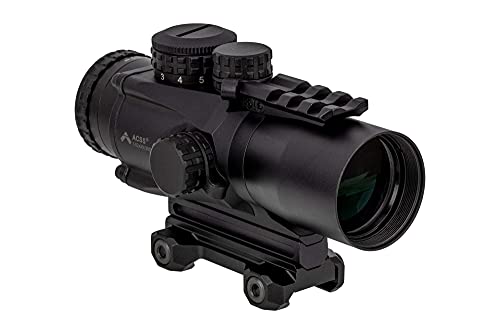
Primary Arms SLX 3x32 Gen III Prism Scope
$299.99 Full specificationsA 3x etched reticle prism with a 32mm objective, giving genuine identification range past what a 1x prism or a red dot can offer, still fully legible for astigmatism.
Best for: A shooter who wants more reach than a 1x prism gives without stepping up to a full LPVO.
Check price on AmazonExpert: the performance ceiling
At this tier the glass, coatings, and reticle etching quality improve, and the housing is built to the same durability standard as a full riflescope rather than a compact reflex sight.

Vortex Spitfire HD Gen II 3X Prism Scope, BDC4 Reticle
$389.79 Full specificationsHD glass and a BDC4 reticle in a 3x prism, built to Vortex's full riflescope durability standard rather than to a compact reflex sight standard.
Best for: A duty or hunting rifle where durability and glass quality both matter alongside the astigmatism fix.
Check price on AmazonWho should not buy this tier: Not for a shooter who does not have astigmatism and simply wants the widest field of view or the lightest possible optic. A red dot serves that shooter better and at a lower price; the fixed eye relief and narrower eye box of a prism are a real cost that only pays for itself when the astigmatism problem is real.
What exit pupil does a prism sight actually give you?
Exit pupil equals objective diameter divided by magnification, the same exact arithmetic used on any magnified optic, applied here to the catalog prism sights that publish an objective size.
The Swampfox Blade at 1x25 gives a 25mm exit pupil by formula, while the Primary Arms SLX 3x32 gives about 10.7mm, both far larger than the pupil of the human eye, which is why brightness is rarely the limiting factor on a prism sight.
Sourced figure
| Model | Magnification x objective | Exit pupil by formula (mm) |
|---|---|---|
| Swampfox Blade | 1x25 | 25.0 |
| Primary Arms SLX 3x32 Gen III | 3x32 | 10.7 |
Primary Arms does not publish an objective diameter for the MicroPrism model, and Vortex does not publish one for the Spitfire HD Gen II 3X, so exit pupil is not calculated for those two rather than estimated. In practice a prism sight's usable eye box is limited by its internal aperture as much as by this formula, which is a separate, generally unpublished figure.
How we chose
We did not test these optics in person and we never claim to. Picks are researched from manufacturer specification sheets, published optical and ballistic formulas, and the recurring themes in verified owner reviews. Every pick is matched to a real objective diameter, a real tube size, a real ring height or a real exit pupil rather than to a price bracket, and it is placed in the tier where its capability actually belongs. Where a figure is shooter convention rather than a sourced number we label it, and where a manufacturer does not publish a figure we leave it out instead of estimating it.
Sources
- Swampfox published specifications
- Primary Arms published specifications
- Vortex published specifications
- Owner-review consensus from shooters who report astigmatism
Frequently asked questions
Why does a red dot look like a starburst to some people?
Because of astigmatism, an irregularity in the shape of the cornea that prevents a point source of light, which is what a red dot's illuminated dot is, from focusing to a clean point on the retina. It smears or radiates instead. This is unrelated to the sight's quality or brightness setting and happens with every red dot equally for an affected eye.
Does a prism sight fix astigmatism the same way glasses do?
No, and it does not need to. A prism sight avoids the problem entirely by using an etched glass reticle projected as an image rather than a point source of light, so there is nothing for an irregular cornea to distort in the first place. Glasses correct the eye; a prism sight simply uses a reticle type that does not require correction to appear sharp.
What do you give up by choosing a prism sight over a red dot?
Fixed eye relief and a real, narrower eye box. A red dot works from almost any head position at almost any distance behind it, while a prism sight needs your eye at a specific distance and position to see the full reticle and field of view, closer to how a riflescope behaves than how a reflex sight does.
Can I use a magnifier behind a red dot instead of buying a prism sight?
A magnifier adds size to the image but does nothing for astigmatism, since it magnifies the same distorted point source rather than replacing it with an etched image. A shooter with astigmatism who adds a magnifier behind a red dot still sees the starburst, just larger. A prism sight is the correct fix, not a magnifier.
Is 1x or 3x the better prism magnification to start with?
Start at 1x if you want the closest replacement for a red dot's speed and field of view. Choose 3x if you want real identification range and are comfortable with the narrower field of view and more deliberate aiming a fixed 3x optic requires. Neither is wrong; it depends on whether speed or reach matters more for your use.
Are prism sights heavier than red dots?
Generally yes, since a prism sight is built more like a small scope with internal glass elements and a housing to protect them, while a reflex red dot is a simpler optical path. The weight difference is real but usually modest, and most shooters who need the astigmatism fix consider it a worthwhile trade rather than a meaningful burden.
Researched, not professional advice. This page is compiled from published manufacturer specifications, published optical and ballistic formulas, and owner-review consensus, not hands-on testing. Figures described as a rule of thumb are shooter convention rather than sourced numbers, and they are labelled that way wherever they appear. Ballistic figures come from a point mass model using the ballistic coefficient the maker publishes, so treat them as a starting point and confirm them on paper at a measured distance. Confirm your firearm is unloaded with the action open before you mount, level, torque or bore sight anything. Verify a zero only on a supervised range or a safe, legal backstop, know what lies beyond your target, and follow the law where you hunt and shoot, including rules on land access and permitted cartridges.