Red Dot Sights
Best Budget Red Dot Sights
Quick answer
The best budget red dot sight is the Vortex Crossfire Red Dot Sight Gen II, 2 MOA Red Dot at $119.99, because a $99 to $130 sight from an established maker with a real warranty beats an unbranded $30 sight on every axis that actually fails: glass coating, drift under recoil, and who answers the phone when it breaks.
Budget does not have to mean risky, but it does mean asking the right question. The honest question at this price point is not "how cheap can a red dot get," it is "which corners are safe to cut and which ones are not."
An established maker at $99 with a real, honored warranty beats an unbranded sight at $30 on the corners that actually cause failures: consistent point of impact under recoil, coatings that do not haze after a season outdoors, and a company that will replace the unit rather than go silent when it fails. The $30 sight is not cheaper insurance, it is a bet that nothing goes wrong, and red dots in this exact price bracket are exactly where things go wrong most often.
This roundup is built from published manufacturer specifications and owner-review consensus, not our own hands-on testing.
On this page
Which corners are actually safe to cut on a budget red dot?
Housing polish, box packaging, and included mounting hardware are safe corners: they affect how the sight looks and unboxes, not whether it works. Turret click repeatability at a coarse tolerance is usually a safe corner too, since most budget red dot uses do not require the precision a match rifle scope needs.
The corners that are not safe to cut are glass coatings, which control how much the dot flares or dims in different light, waterproofing seals, which fail invisibly until the unit fogs internally, and quality control on the emitter circuit, which is what determines whether the point of impact actually holds still under recoil over hundreds of rounds. Those three are exactly the things an established maker with a real warranty has a financial incentive to get right, and an unbranded seller with no support line does not.
A useful shortcut when comparing two budget sights is to look past the feature list entirely and ask who is standing behind the product. A company that sells thousands of units a year and answers a support line has a real incentive to keep the failure rate low, because a warranty claim costs them money. A seller with no verifiable history and no support line has no such incentive, and the sticker price is the only signal you get before buying, which is not enough information to bet a working sight on.
What does the extra $70 to $100 over an unbranded sight actually buy?
An honest, non-numeric comparison, since neither side of this comparison publishes controlled test data.
The gap between an established maker at $99 and an unbranded sight at $30 is concentrated in warranty support, coating quality, and recoil durability rather than in features on the box.
Shooter convention
| What you are buying | Established maker, $99 to $130 | Unbranded, around $30 |
|---|---|---|
| Warranty | Real, honored, often transferable | Often unclear or unenforceable |
| Point of impact under recoil | Consistently reported as stable by owners | Frequently reported as drifting |
| Glass coatings | Anti-reflective, consistent across units | Inconsistent, sometimes absent |
| Battery life claims | Independently verified by owner consensus | Frequently overstated on the listing |
| Who answers when it fails | A company with a support line | Often nobody |
This is a convention drawn from years of owner-review consensus across shooting forums, not a controlled side-by-side measurement, since no manufacturer publishes a direct comparison against unbranded competitors.
Beginner: the lowest safe entry point
The floor for a red dot worth buying: a real warranty, a known maker, and a simple 2 MOA dot with no unnecessary features to fail.

Vortex Triumph 2 MOA Red Dot Sight
$99.00The lowest-priced sight in this catalog from a maker with a transferable lifetime warranty, with no compromise on the coating or emitter quality that actually matters.
Best for: A rimfire rifle, a truck gun, or a first red dot on a limited budget.
Check price on AmazonIntermediate: the buy-once pick
Motion activation and a wider field of view join the warranty at this tier, still comfortably inside a budget price bracket.
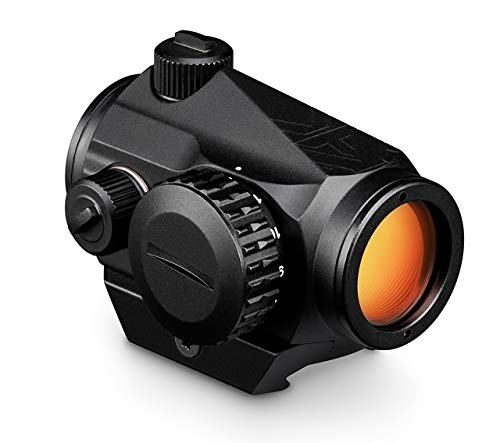
Vortex Crossfire Red Dot Sight Gen II, 2 MOA Red Dot
$119.99Motion activation extends real-world battery life without asking the shooter to remember to switch the sight on, at the top of the budget bracket rather than beyond it.
Best for: A shooter who wants the value of a budget sight without giving up motion activation.
Check price on Amazon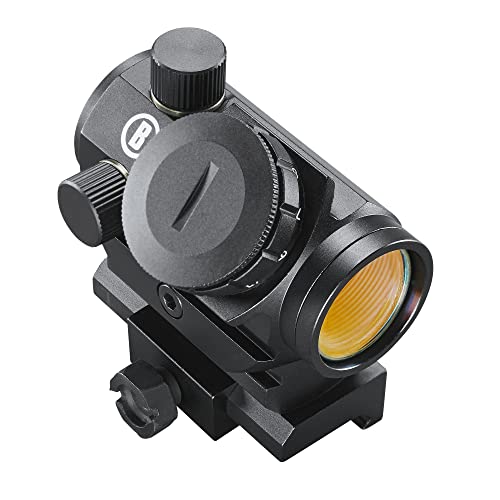
Bushnell TRS-25 HiRise 1x25 Red Dot Sight with Riser
$107.69Comes with a riser for correct AR-pattern height out of the box, removing a separate mount purchase for a shooter working within this budget.
Best for: A first build where a separate mount purchase is not in the budget.
Check price on AmazonExpert: the ceiling within a genuinely budget bracket
Still comfortably under $150, this tier adds shake-awake motion activation and a wider window while staying inside what most shooters would call budget rather than premium.

Holosun ARO-CORE Red Dot Sight with Shake Awake, 22mm Window
$119.99Shake-awake motion activation and a 22mm window at a price that is still recognizably a budget purchase rather than a step into the premium tier.
Best for: A shooter who has confirmed a budget maker fits their needs and wants the best features still available inside that bracket.
Check price on AmazonWho should not buy this tier: Not for a shooter who has decided durability under hard, repeated use is the priority. At true budget prices the housings are adequate rather than rugged, and a shooter who needs duty-grade durability should look at the full best red dot sight roundup instead of staying inside this budget bracket.
How we chose
We did not test these optics in person and we never claim to. Picks are researched from manufacturer specification sheets, published optical and ballistic formulas, and the recurring themes in verified owner reviews. Every pick is matched to a real objective diameter, a real tube size, a real ring height or a real exit pupil rather than to a price bracket, and it is placed in the tier where its capability actually belongs. Where a figure is shooter convention rather than a sourced number we label it, and where a manufacturer does not publish a figure we leave it out instead of estimating it.
Sources
- Vortex published specifications
- Bushnell published specifications
- Holosun published specifications
- Owner-review consensus from budget optics forums and comparison threads
Frequently asked questions
Is a $30 unbranded red dot ever a reasonable buy?
Rarely, and only for an application where a failure genuinely does not matter, like a display piece or a very casual plinking rifle where a lost zero costs nothing. For anything used seriously, the unbranded sight's real cost is the missing warranty and the unverified quality control on the emitter, not the sticker price.
What is the single biggest risk with a cheap red dot?
Point of impact drift under recoil. A red dot that loses zero after repeated recoil impulses is worse than no optic at all, because it gives false confidence. Established makers at $99 and up have a strong, repeated owner consensus around holding zero, while unbranded sights show far more scattered and frequently negative reports on exactly this point.
Does a lifetime warranty actually mean anything on a $99 red dot?
Yes, and it is one of the few signals at this price point backed by the seller's own money. A company only offers a transferable lifetime warranty on a low-cost product if the failure rate is low enough to make that promise affordable, which is itself indirect evidence of build quality that a spec sheet cannot show you.
What features are safe to skip at a budget price?
Multiple reticle patterns, a larger window than you need, and extra brightness settings beyond a handful are all safe to skip. None of them affect whether the sight holds zero or survives weather. Spend the saved money on the warranty and the maker's reputation rather than on features that look good on a comparison chart.
Should I buy a used premium red dot instead of a new budget one?
Only if the warranty transfers and you can verify the unit's history. A used premium sight with no remaining warranty and unknown handling history carries real risk of hidden damage, while a new budget sight with an honored warranty starts with a clean, known history. The warranty coverage matters more than the original price tier.
Do budget red dots hold zero as well as premium ones?
Reasonably well within the established-maker bracket described here, though not to the same standard as a duty-grade housing built for hard, repeated abuse. For a range rifle or a truck gun handled normally, an established $99 to $130 sight holds zero acceptably. For genuinely hard use, step up to the full red dot roundup instead.
Researched, not professional advice. This page is compiled from published manufacturer specifications, published optical and ballistic formulas, and owner-review consensus, not hands-on testing. Figures described as a rule of thumb are shooter convention rather than sourced numbers, and they are labelled that way wherever they appear. Ballistic figures come from a point mass model using the ballistic coefficient the maker publishes, so treat them as a starting point and confirm them on paper at a measured distance. Confirm your firearm is unloaded with the action open before you mount, level, torque or bore sight anything. Verify a zero only on a supervised range or a safe, legal backstop, know what lies beyond your target, and follow the law where you hunt and shoot, including rules on land access and permitted cartridges.