.300 Winchester Magnum zeroing
What does a 300 yard zero do to a .300 Winchester Magnum?
Quick answer
A .300 Winchester Magnum zeroed at 300 yards, using 190 grain match at a catalogue 2,900 feet per second and a 1.8 inch sight height, sits 3.7 inches above the line of sight at 100 yards and 0 inches above it at 300. The bullet never rises more than 4.8 inches above your line of sight.
Choosing a zero distance is choosing where you want your error to be. Every zero is a compromise between shooting high in the middle distances and shooting low at the far end, and there is no zero that avoids both.
The figures below assume 190 grain match at a catalogue 2,900 feet per second and a sight height of 1.8 inches from the centre of the bore to the centre of the scope. Both of those are assumptions, and both matter. Use the muzzle velocity printed on your own box, and measure your own sight height, because a rifle that differs by 100 feet per second or by half an inch of sight height will not match this table at distance.
Enough recoil that eye relief and scope mounting matter as much as the glass. A scope set too far back here is how people get cut.
On this page
Drop table for a .300 Winchester Magnum with a 300 yard zero
What produced these numbers
G1 point mass model, BC 0.533, muzzle velocity 2,900 fps, sight height 1.8 in, zero 300 yd, 10 mph full value crosswind
A positive figure is above your line of sight and a negative one is below it. The MOA and mil columns are the come-up you would dial, so a negative drop needs a positive come-up.
Read the drop column in inches for a hold, or the MOA and mil columns for a dial. Wind is a full value crosswind at 10 miles per hour, which you can scale in your head: a 5 mph wind is half, a 20 mph wind is double.
With a 300 yard zero this load is 4.5 inches from the line of sight at 200 yards and 0 inches at 300, needing -0 MOA of come-up to centre at 300.
Sourced figure
| Distance | Path | Come up (MOA) | Come up (mil) | Velocity | Energy | Wind at 10 mph |
|---|---|---|---|---|---|---|
| 25 yd | -0 in | -0.05 MOA | -0.01 mil | 2,855 fps | 3,440 ft-lb | 0 in |
| 50 yd | 1.5 in | 2.88 MOA | 0.84 mil | 2,810 fps | 3,332 ft-lb | 0.1 in |
| 100 yd | 3.7 in | 3.55 MOA | 1.03 mil | 2,722 fps | 3,127 ft-lb | 0.6 in |
| 150 yd | 4.8 in | 3.02 MOA | 0.88 mil | 2,636 fps | 2,932 ft-lb | 1.3 in |
| 200 yd | 4.5 in | 2.16 MOA | 0.63 mil | 2,552 fps | 2,748 ft-lb | 2.4 in |
| 250 yd | 3 in | 1.14 MOA | 0.33 mil | 2,469 fps | 2,572 ft-lb | 3.8 in |
| 300 yd | 0 in | 0 MOA | 0 mil | 2,387 fps | 2,404 ft-lb | 5.6 in |
| 400 yd | -10.6 in | -2.54 MOA | -0.74 mil | 2,229 fps | 2,097 ft-lb | 10.3 in |
| 500 yd | -28.3 in | -5.4 MOA | -1.57 mil | 2,076 fps | 1,819 ft-lb | 16.6 in |
| 600 yd | -54 in | -8.6 MOA | -2.5 mil | 1,930 fps | 1,572 ft-lb | 24.8 in |
Computed with a G1 point mass model from the published ballistic coefficient. It is not radar data and it does not model spin drift or Coriolis. Confirm it on paper at a measured distance before you trust it past 400 yards.
How a 300 yard zero compares with the alternatives
The same cartridge and the same rifle, at every zero distance worth using. The middle column is how high the bullet ever rides above your line of sight, which is the figure that decides whether you can hold dead centre.
A 300 yard zero keeps this load within 4.8 inches above the line of sight, against 4.8 inches for a 300 yard zero.
Sourced figure
| Zero | Highest above line of sight | Path at 200 yd | Path at 300 yd | |
|---|---|---|---|---|
| 25 yd zero | 4.8 in | 4.6 in | 0.2 in | |
| 50 yd zero | 0.7 in | -1.5 in | -9 in | |
| 100 yd zero | 0 in | -2.9 in | -11.1 in | |
| 200 yd zero | 1.5 in | -0 in | -6.8 in | |
| 300 yd zero | 4.8 in | 4.5 in | 0 in | This page |
A higher mid range trajectory buys you a flatter looking far end and costs you accuracy on a close shot taken with a centre hold.
What is the maximum point blank range for this load?
Point blank range is the distance over which you can hold dead centre and still land inside a target of a chosen size, with no holdover and no dialling at all. It is the most useful concept in hunting ballistics and the most commonly misused.
For this load, with an eight inch vital zone, the best zero is 270 yards, which gives a maximum point blank range of 320 yards. The bullet never rises more than 3.7 inches above the line of sight and has not yet fallen four inches below it at 320 yards.
That is different from the 300 yard zero on this page. A 300 yard zero is easier to confirm on a range that has a 300 yard line, and it is the right choice if you would rather verify your zero properly than squeeze the last few yards out of a centre hold.
The vital radius is your choice and nothing here decides it for you. Four inches is the usual figure for deer sized game and it is a convention, not a standard. Choose a smaller number and your point blank range shrinks, which is the correct trade if you are not confident of the shot.
Where this load stops being useful
This load stays above the speed of sound out to roughly 600 yards in standard conditions. Past the transonic region a bullet can become unstable and groups open up unpredictably, which is why published drop tables become much less reliable there.
Energy is the other limit and it is a matter of ethics rather than physics. At 300 yards this load carries roughly 2,404 foot pounds. What is enough is a judgement about the animal, the shot placement and the law where you hunt, and it is yours to make rather than ours.
Before any of this matters, the scope has to be mounted square and torqued properly. A reticle canted two degrees is invisible at 100 yards and throws the shot several inches sideways by the time you have dialled a come-up this large. Work through levelling the scope before you chase the last tenth of a mil.
Glass and gear for zeroing a .300 Winchester Magnum
Chosen against the numbers on this page rather than from a general list, so the recommendation cannot contradict the arithmetic above.
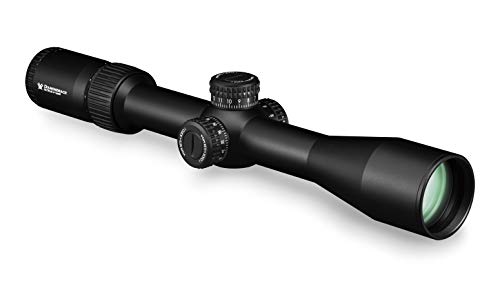
Vortex Diamondback Tactical 4-16x44 First Focal Plane Riflescope, EBR-2C MOA
$399.00 Full specificationsThe cheapest first focal plane scope worth owning, and the one that makes the case for the whole category: the reticle holds its subtension at every magnification, so a hold is a hold rather than a calculation.
Best for: a first precision rifle scope, or a hunting rifle that will be dialled
Check price on Amazon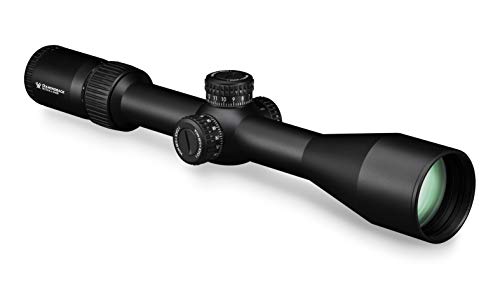
Vortex Diamondback Tactical 6-24x50 First Focal Plane Riflescope
$425.99 Full specificationsTwenty four power and a 50 mm objective for under five hundred dollars. Note that the exit pupil at 24x is only about 2 mm, so the top of the range is a bright-day setting rather than a low light one.
Best for: known distance range work and steel at long range
Check price on Amazon
Athlon Argos BTR GEN3 6-24x50 Riflescope, APRS11 FFP IR MIL Reticle
$379.99 Full specificationsAn illuminated first focal plane mil reticle with a zero stop at a price where those three features almost never appear together, and Athlon transfers its warranty the way Vortex does.
Best for: a mil-reticle precision build on a budget
Check price on Amazon
Arken Optics SH4 GEN2 4-16x50 FFP Riflescope, Illuminated VPR MIL Reticle
$299.99 Full specificationsDirect-to-consumer pricing on a 34 mm tube with a locking zero stop, which is where the internal elevation that long range shooting actually consumes comes from.
Best for: maximum internal elevation travel per dollar
Check price on Amazon
Primary Arms SLX 3-18x50mm FFP Gen II Riflescope
$499.99Primary Arms designs its own ACSS reticles, which combine ranging, holdover and wind holds in one reticle sized to a specific cartridge class rather than to a generic grid.
Best for: a shooter who wants to range and hold without dialling
Check price on Amazon
Athlon Optics Midas TAC HD 6-24x50 First Focal Plane Riflescope, APRS3 FFP MIL
$569.00 Full specificationsThe step from Argos to Midas is glass and turret feel rather than features, and turret feel is what stops you losing count of clicks in the dark with cold hands.
Best for: a competition rifle where the turrets get used every string
Check price on AmazonHow we chose
We did not test these optics in person and we never claim to. Picks are researched from manufacturer specification sheets, published optical and ballistic formulas, and the recurring themes in verified owner reviews. Every pick is matched to a real objective diameter, a real tube size, a real ring height or a real exit pupil rather than to a price bracket, and it is placed in the tier where its capability actually belongs. Where a figure is shooter convention rather than a sourced number we label it, and where a manufacturer does not publish a figure we leave it out instead of estimating it.
Sources
- Published factory load specification: 190 grain match at a catalogue 2,900 feet per second
- G1 standard drag function, the published Ingalls and Siacci reference
Frequently asked questions
Is a 300 yard zero good for a .300 Winchester Magnum?
A 300 yard zero pushes the trajectory higher in the middle distances, peaking at 4.8 inches above the line of sight, in exchange for less drop at the far end. It suits open country where shots are taken past 200 yards.
How high should a .300 Winchester Magnum be at 100 yards?
With a 300 yard zero, 3.7 inches high. The widely repeated advice to be two inches high at 100 yards is a rule of thumb rather than a specification, and it produces a different zero distance for every cartridge. Work from the zero distance you actually want instead, and let the figure at 100 yards be whatever it turns out to be.
Does sight height change my zero?
It changes the whole shape of the trajectory, not just the numbers. A higher scope means the bullet starts further below the line of sight and has to climb further to reach it, which steepens the near part of the path and moves the near zero out. This page assumes 1.8 inches. Measure your own from the centre of the bore to the centre of the scope tube, because it varies by more than an inch across ordinary rifles.
Why does my rifle not match this table?
Almost always muzzle velocity. Catalogue figures come from a test barrel that is usually longer than yours, and a difference of 100 feet per second is completely ordinary. Ballistic coefficient, altitude and temperature account for most of the rest. Chronograph your own load and use that number, and the far end of the table will tighten up considerably.
Should I dial or hold over?
Dial when you have time and a known distance, because it is more precise and it puts the reticle back in the middle of the glass where the optics are best. Hold when the shot is fast or the range is uncertain. Most hunters should set a zero that lets them hold dead centre inside their normal shooting distance and dial only beyond that.
How much elevation travel do I need for this?
Reaching 300 yards with this load needs -0 MOA of come-up from your zero. Half of a scope total travel sits above mechanical centre, and a rifle that is not perfectly aligned eats into that before you dial a click. Check the figure against your scope published travel, and add a canted base if the sum does not leave you a comfortable margin.
Researched, not professional advice. This page is compiled from published manufacturer specifications, published optical and ballistic formulas, and owner-review consensus, not hands-on testing. Figures described as a rule of thumb are shooter convention rather than sourced numbers, and they are labelled that way wherever they appear. Ballistic figures come from a point mass model using the ballistic coefficient the maker publishes, so treat them as a starting point and confirm them on paper at a measured distance. Confirm your firearm is unloaded with the action open before you mount, level, torque or bore sight anything. Verify a zero only on a supervised range or a safe, legal backstop, know what lies beyond your target, and follow the law where you hunt and shoot, including rules on land access and permitted cartridges.