Trajectory and zero
Maximum Point Blank Range Calculator
Quick answer
Maximum point blank range is the farthest distance at which a centre hold stays inside a target of a size you choose. For a 168 grain .308 at 2,650 feet per second with an eight inch vital zone, the best zero is around 220 yards, reaching roughly 260 yards with no holdover at all.
Point blank range is the most useful idea in hunting ballistics and the most commonly misused. It does not mean close range. It means the span over which you can put the reticle on the middle of the target and hit it, with no holdover, no dialling and no range estimation.
The arithmetic finds the zero that keeps the bullet inside a vital zone for the longest possible distance. Zero too close and the bullet drops out the bottom early. Zero too far and it climbs out the top in the middle distances. There is exactly one zero that maximises the span, and that is what this calculates.
The vital radius is your choice and nothing here decides it for you. Four inches, giving an eight inch zone, is the usual convention for deer sized game. It is a convention, not a standard.
Maximum point blank range calculator
Maximum point blank range
| Zero | Point blank range | Highest above sight line | Verdict |
|---|
The method
Scan every zero distance, reject any where the path rises above the vital radius, and keep the one that stays within the radius for the greatest distance. G1 point mass model throughout.
For inside the span, and for past it
Top matches update when you change your numbers.

Vortex Crossfire HD 1400 Laser Rangefinder
$196.88The entry point with angle compensation built in, which is the feature that actually matters: an uncompensated range up a steep slope will make you shoot high.
Best for: a first rangefinder for hunting distances
Check price on Amazon
Leupold RX-1400i TBR/W Gen 2 Rangefinder with Flightpath
$199.99True ballistic range with wind, and a Flightpath display that shows an arrow the bullet path, which is the clearest treatment of overhead obstruction in this price band.
Best for: shooting under branches and up steep slopes
Check price on Amazon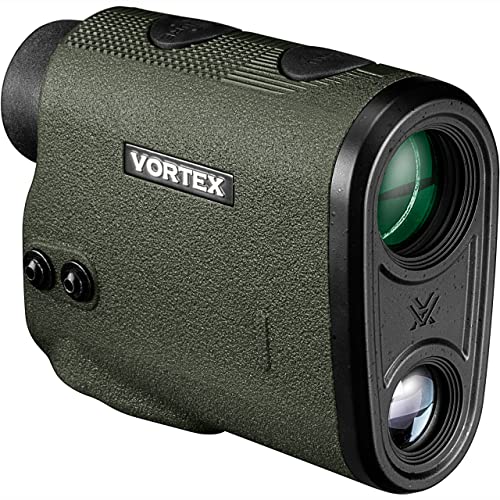
Vortex Diamondback HD 2000 Laser Rangefinder
$299.00Two thousand yards on a reflective target, and far more importantly a faster and more confident read on a soft target like an animal at four hundred.
Best for: reliable reads on soft targets rather than a headline number
Check price on Amazon
Leupold VX-Freedom 3-9x40 CDS Duplex Riflescope
$299.99 Full specificationsThe CDS turret is the point: Leupold will cut you a custom elevation dial marked in yards for your load, so dialling a come-up stops being arithmetic and becomes reading a number off the turret.
Best for: a hunter who wants to dial rather than hold over
Check price on Amazon
Vortex Diamondback 3-9x40 Riflescope, Dead-Hold BDC Reticle
$249.00 Full specificationsThe same configuration as the Crossfire II with better glass and a cleaner image at the top of the magnification range, which is exactly where a cheaper scope goes soft and dark.
Best for: the buy-once hunting scope at a sensible price
Check price on Amazon
Champion Redfield Style Precision Sight-In Targets, 100 Pack
$25.99The grid is printed in one inch squares, so you can read the correction straight off the paper in inches and convert it once rather than estimating.
Best for: reading a correction directly off the target
Check price on AmazonWhat the vital radius actually controls
Halving the vital zone does not halve point blank range, it cuts it by much more, because the trajectory is curving steeply by the time it approaches the lower boundary.
A smaller vital zone shrinks point blank range disproportionately, because the bullet is falling fastest at the far end of the span.
Shooter convention
| Vital radius | Typical quarry | Effect on point blank range |
|---|---|---|
| 2 in | Small game, varmints, precision targets | Much shorter span, and usually not worth using a centre hold at all |
| 3 in | Antelope, small deer, conservative shooters | Noticeably shorter than four inches, and the right choice if unsure |
| 4 in | Deer sized game, the usual convention | The standard figure most published point blank tables assume |
| 6 in | Elk and larger | Longer span, and only honest if you are genuinely confident of the shot |
Choosing a larger vital zone to get a longer number on the page is exactly how point blank range gets misused. Pick the zone you would actually accept as a hit.
Why the optimum zero is rarely a round number
The calculator will frequently return a zero like 217 or 243 yards. That is the mathematical optimum and it is not necessarily the right answer for you.
A zero you can genuinely confirm beats one you cannot. Almost every range has a 100 and a 200 yard line. Very few have a 217. A 200 yard zero that you have verified on paper will serve you better than a 217 yard zero you approximated, because a zero you have not confirmed is not a zero at all.
Compare the two in the table the calculator produces. The difference in point blank range between the optimum and the nearest round number is usually a handful of yards, which is far less than the uncertainty in your range estimation in the field.
When point blank range is the wrong tool
Three situations where you should range and dial instead.
- Steep trajectories. A .45-70 or a .30-30 drops so fast that no zero produces a useful span. The calculator will tell you when no solution exists rather than inventing one.
- Small targets. Once the vital radius drops towards two inches, the span collapses and you are better served by ranging.
- Shooting past the span. Point blank range is a licence to ignore distance inside it. Beyond it you need a rangefinder and a drop table, and treating the two as the same thing is how shots get missed at 400 yards.
Sources
- G1 standard drag function, the published Ingalls and Siacci reference
- Published factory load specifications for the preset cartridges
Frequently asked questions
What is maximum point blank range?
The farthest distance at which you can aim at the centre of the target and still land inside a vital zone of your chosen size, without holdover or dialling. It is found by choosing the zero distance that keeps the bullet inside that zone for the longest possible span, rising no further above the line of sight than the zone allows.
What vital zone size should I use?
Four inches of radius, giving an eight inch circle, is the usual convention for deer sized game and is what most published tables assume. It is a convention rather than a standard. Choose a smaller radius if you are not fully confident of the shot, and accept that it shortens your point blank range considerably.
Should I use the optimum zero or a round number?
Usually a round number you can actually confirm. The mathematical optimum is frequently something like 217 yards, and almost no range has a 217 yard line. A verified 200 yard zero beats an approximated 217 yard one, and the difference in point blank range between them is smaller than your range estimation error in the field.
Does sight height affect point blank range?
Slightly. A higher optical axis lets the bullet cross the line of sight later and spend marginally longer inside the vital zone, adding a handful of yards. It is not a reason to mount a scope higher than your cheek weld wants, because a poor head position costs more accuracy than the extra yards buy.
Why does my cartridge not have a point blank solution?
Because its trajectory is too steep for any zero to keep the bullet inside your chosen vital zone over a useful span. Straight wall cartridges, heavy subsonic loads and rimfire are all in this position. That is not a fault: it means the cartridge asks you to range the target and hold or dial rather than relying on a centre hold.
Can I shoot past my point blank range?
Yes, with a rangefinder and a drop table. Point blank range is a licence to ignore distance inside the span, not a maximum effective range. Treating the two as the same thing is a common and expensive mistake. Beyond the span, range the target and either hold using your reticle or dial the come-up.
Researched, not professional advice. This page is compiled from published manufacturer specifications, published optical and ballistic formulas, and owner-review consensus, not hands-on testing. Figures described as a rule of thumb are shooter convention rather than sourced numbers, and they are labelled that way wherever they appear. Ballistic figures come from a point mass model using the ballistic coefficient the maker publishes, so treat them as a starting point and confirm them on paper at a measured distance. Confirm your firearm is unloaded with the action open before you mount, level, torque or bore sight anything. Verify a zero only on a supervised range or a safe, legal backstop, know what lies beyond your target, and follow the law where you hunt and shoot, including rules on land access and permitted cartridges.