Trajectory and zero
Angle and Cosine Shooting Calculator
Quick answer
Gravity acts over the horizontal component of the flight path, not the slant range, so an angled shot drops less than the range to the target suggests. A 500 yard shot at 30 degrees behaves like a level shot at 433 yards, and dialling the full 500 would put you high.
Shooting steeply uphill or downhill, both directions make you shoot high. That surprises people, who expect uphill and downhill to cancel out in opposite directions. They do not, because the thing that changed is not the direction of gravity but how much horizontal distance the bullet covers while gravity acts on it.
The correction is the rifleman's rule: multiply the slant range by the cosine of the angle to get the horizontal distance, then use your normal drop data for that horizontal distance. The trigonometry is exact. Treating the result as identical to a level shot at that distance is an approximation, and a good one inside ordinary hunting angles and distances.
Angle and cosine calculator
Shoot it like this distance
The formula
horizontal distance = slant range x cosine(angle)
Rangefinders that do this for you
Top matches update when you change your numbers.

Leupold RX-1400i TBR/W Gen 2 Rangefinder with Flightpath
$199.99True ballistic range with wind, and a Flightpath display that shows an arrow the bullet path, which is the clearest treatment of overhead obstruction in this price band.
Best for: shooting under branches and up steep slopes
Check price on Amazon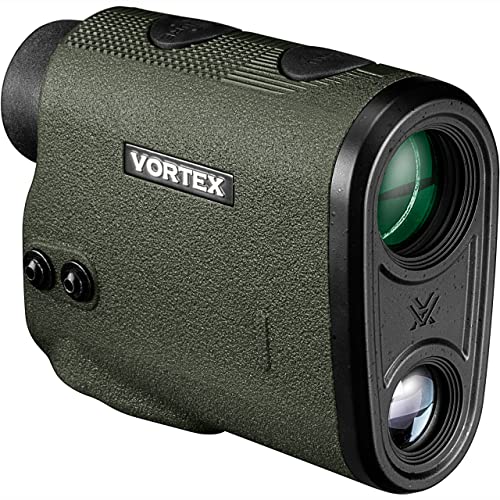
Vortex Diamondback HD 2000 Laser Rangefinder
$299.00Two thousand yards on a reflective target, and far more importantly a faster and more confident read on a soft target like an animal at four hundred.
Best for: reliable reads on soft targets rather than a headline number
Check price on Amazon
SIG SAUER KILO3K 6x22 Laser Rangefinder
$349.99Sig ballistic integration and an onboard solver, so the unit gives you a holdover rather than a distance you then have to convert.
Best for: getting a firing solution rather than a raw range
Check price on Amazon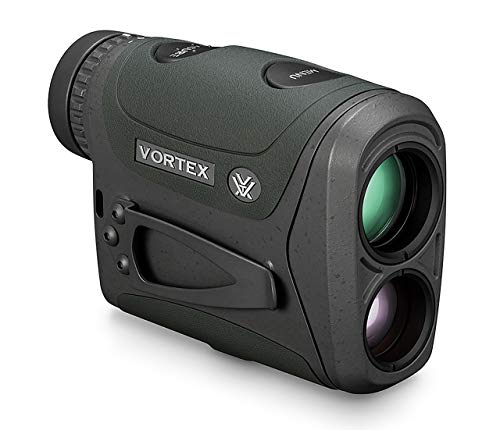
Vortex Razor HD 4000 Laser Rangefinder
$499.00The top of the Vortex line, and the one that reads soft targets at distances where the cheaper units simply return nothing.
Best for: extended range shooting where a failed read costs the shot
Check price on Amazon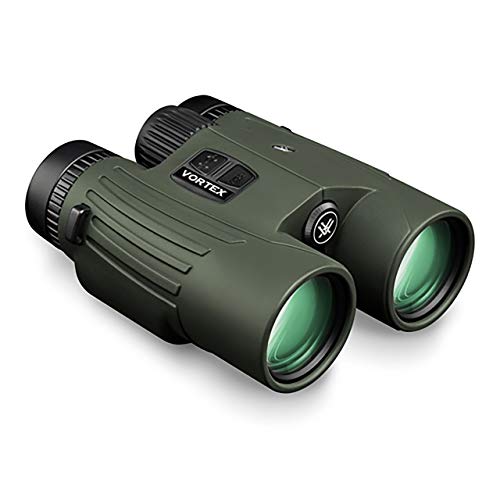
Vortex Fury HD 5000 10x42 Laser Rangefinding Binoculars
$979.00 Full specificationsThe reference in this category at this price, and the unit that made rangefinding binoculars ordinary equipment rather than an exotic purchase.
Best for: a hunter who currently carries binoculars and a rangefinder separately
Check price on Amazon
Vortex Riflescope Bubble Level, 1 inch
$39.00A permanent anti-cant level clamped to the tube, visible in your peripheral vision as you settle behind the rifle. It fixes the error at the moment it matters rather than at the bench.
Best for: checking cant on every shot rather than once at mounting
Check price on AmazonThe cosine of every angle you are likely to shoot
The last column is the error you would make by dialling the slant range at 500 yards, expressed as the distance you would effectively be dialling for.
At 30 degrees the cosine is 0.866, so a 500 yard slant range is a 433 yard shot, and dialling the full 500 would put you 67 yards worth of drop high.
Sourced figure
| Angle | Cosine | From 300 yd slant | From 500 yd slant | Overshoot at 500 yd |
|---|---|---|---|---|
| 5 degrees | 0.9962 | 299 yd | 498 yd | 2 yd |
| 10 degrees | 0.9848 | 295 yd | 492 yd | 8 yd |
| 15 degrees | 0.9659 | 290 yd | 483 yd | 17 yd |
| 20 degrees | 0.9397 | 282 yd | 470 yd | 30 yd |
| 25 degrees | 0.9063 | 272 yd | 453 yd | 47 yd |
| 30 degrees | 0.866 | 260 yd | 433 yd | 67 yd |
| 35 degrees | 0.8192 | 246 yd | 410 yd | 90 yd |
| 40 degrees | 0.766 | 230 yd | 383 yd | 117 yd |
| 45 degrees | 0.7071 | 212 yd | 354 yd | 146 yd |
| 50 degrees | 0.6428 | 193 yd | 321 yd | 179 yd |
| 60 degrees | 0.5 | 150 yd | 250 yd | 250 yd |
Exact trigonometry for the horizontal component. Using that horizontal distance with level-shot drop data is the approximation, and it becomes optimistic past roughly 45 degrees and 500 yards.
Why uphill and downhill both shoot high
Bullet drop is a function of time of flight and gravity acting vertically. On an angled shot, the bullet still takes roughly the same time to cover the slant range, but the vertical drop that matters to your line of sight is only the component perpendicular to that line.
Put more simply: your scope is looking along the slant line, and gravity is pulling perpendicular to the ground rather than perpendicular to your sight line. The steeper the angle, the smaller the fraction of gravity that acts across your line of sight, and the less the bullet appears to drop.
That is symmetric. It does not matter whether you are looking up or down, which is why the cosine is taken of the absolute angle.
How much angle before it matters?
Less than you think at long range and more than you think up close.
At 10 degrees the cosine is 0.985, so a 300 yard shot behaves like 296 yards. That is nothing. At 20 degrees it is 0.940, so 300 becomes 282, which is worth perhaps an inch. At 30 degrees a 500 yard shot becomes 433 yards, and the difference in drop between those two distances is large enough to miss a vital zone.
The practical threshold is roughly 15 degrees combined with distance past 300 yards. Below that, ignore it. Above it, apply the cosine. Many rangefinders do this for you and report an angle compensated range, which is the feature worth paying for in mountain country and the one cheap units frequently omit.
Sources
- Exact trigonometry for the horizontal component of an inclined range
Frequently asked questions
Do you shoot high or low when shooting uphill?
High, and you also shoot high downhill. Both directions produce the same effect, because what changes is how much of gravity acts across your line of sight rather than the direction gravity pulls. Multiply the slant range by the cosine of the angle and use your normal drop data for that shorter horizontal distance.
What is the rifleman’s rule?
Multiply the range to the target by the cosine of the inclination angle, then treat the shot as a level shot at that horizontal distance. The trigonometry for the horizontal component is exact. Using level-shot drop data at that distance is an approximation that holds well inside ordinary hunting angles and starts to run optimistic past about 45 degrees.
At what angle does it start to matter?
Roughly 15 degrees, and only combined with distance past 300 yards. At 10 degrees the cosine is 0.985, so a 300 yard shot becomes 296 and nothing changes. At 30 degrees a 500 yard shot becomes 433, and the drop difference between those is large enough to miss a vital zone entirely.
Does angle affect wind drift too?
Only through the shortened horizontal distance, which slightly reduces drift because the bullet has less horizontal travel for the wind to act over. The effect is small compared with the elevation error, and the wind at different heights on a steep slope is usually a much bigger unknown than the geometry.
Do I need a rangefinder with angle compensation?
If you hunt anywhere steep, yes, and it matters more than maximum ranging distance. An uncompensated range gives you the slant distance, which is the wrong number to dial. A compensated unit reports the horizontal equivalent directly and removes the arithmetic from the field, where you least want to be doing it.
How do I measure the angle without a rangefinder?
A cosine indicator clamped to the scope tube shows the cosine value directly, which is what you actually need. Phone inclinometer apps work and are awkward with a rifle in your hands. Estimating is poor: most people substantially overestimate steep angles, which leads to over-correcting and shooting low.
Researched, not professional advice. This page is compiled from published manufacturer specifications, published optical and ballistic formulas, and owner-review consensus, not hands-on testing. Figures described as a rule of thumb are shooter convention rather than sourced numbers, and they are labelled that way wherever they appear. Ballistic figures come from a point mass model using the ballistic coefficient the maker publishes, so treat them as a starting point and confirm them on paper at a measured distance. Confirm your firearm is unloaded with the action open before you mount, level, torque or bore sight anything. Verify a zero only on a supervised range or a safe, legal backstop, know what lies beyond your target, and follow the law where you hunt and shoot, including rules on land access and permitted cartridges.