Trajectory and zero
Twist Rate Stability Calculator
Quick answer
The Miller Twist Rule estimates gyroscopic stability from bullet weight, diameter, length and twist rate. A 168 grain .308 match bullet, 1.215 inches long, in a 1:12 twist at 2,650 feet per second gives a stability factor of about 1.71, which is comfortably stable.
A bullet is stabilised by spin, and how much spin it needs depends far more on its length than on its weight. This is the part that catches people out: two bullets of the same weight can need very different twist rates if one is a long, sleek boat tail and the other is short and blunt.
The estimator here is the Miller Twist Rule, published by Don Miller in Precision Shooting, which is the standard published method for this. It is used in both directions: give it a twist rate and it returns a stability factor, or give it a target stability and it returns the slowest twist that reaches it.
Two published corrections are applied, both from the same source: a velocity correction and an atmospheric correction for temperature and pressure. Cold, dense air is harder to stabilise in, which is why a load that shoots well in summer can keyhole in winter.
Twist rate stability calculator
Gyroscopic stability factor
The formula
Miller Twist Rule: T = sqrt( 30 m / ( s d^3 l (1 + l^2) ) ) in calibers, with published velocity and atmospheric corrections applied
What tells you whether the problem is the bullet or the optic
Top matches update when you change your numbers.

Garmin Xero C1 Pro Compact Ballistics Chronograph
$499.99The instrument that made chronographs ordinary. It sits beside you on the bench rather than downrange, so there is nothing to shoot through and nothing to set up in front of the muzzle.
Best for: anyone who dials come-ups and wants real numbers
Check price on Amazon
Caldwell Ballistic Precision Chronograph 2.0 with Bluetooth and Sun Screens
$129.99An optical chronograph at a third of the price of a radar unit. It has to sit downrange of the muzzle and it needs consistent light, which is the trade you are making.
Check before buying: An optical chronograph sits in front of the muzzle. Set it up with the action open and the rifle unloaded, and check your alignment before every string: people shoot these every year.
Best for: real velocity data on a tight budget
Check price on Amazon
Vortex Diamondback HD 20-60x85 Angled Spotting Scope
$499.00The largest objective here, and the one that stays usable longest into the evening. At 85 mm the glass quality starts to matter more than the aperture, which is why this is the HD line.
Best for: glassing at last light and judging animals at distance
Check price on Amazon
Champion Redfield Style Precision Sight-In Targets, 100 Pack
$25.99The grid is printed in one inch squares, so you can read the correction straight off the paper in inches and convert it once rather than estimating.
Best for: reading a correction directly off the target
Check price on Amazon
Vortex Riflescope Bubble Level, 1 inch
$39.00A permanent anti-cant level clamped to the tube, visible in your peripheral vision as you settle behind the rifle. It fixes the error at the moment it matters rather than at the bench.
Best for: checking cant on every shot rather than once at mounting
Check price on Amazon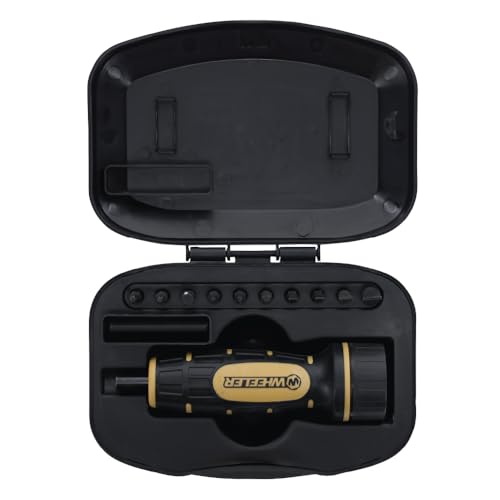
Wheeler Firearms Accurizing Torque Wrench with Bits and Case
$60.13The tool this whole category is named after. Dial the inch pound figure, tighten until it clicks, and the ring screw is at the number the ring maker published rather than at whatever felt right.
Best for: the standard torque wrench for scope mounting
Check price on AmazonWhat a stability factor means
The thresholds below are shooter consensus rather than anything Miller published. They are widely used and they are convention, not a standard.
A stability factor of 1.4 or above is generally treated as adequate and 1.5 as comfortable, while anything under 1.2 is marginal in cold, dense air.
Shooter convention
| Stability factor | Verdict | What it means |
|---|---|---|
| Under 1.0 | Unstable | The bullet is not stabilised and will tumble. Expect keyholed holes in paper and no useful accuracy at any distance. |
| 1.0 to 1.2 | Marginal | Stabilised in the strict sense and not reliably so in cold, dense air. A marginal load frequently shoots well in summer and keyholes in winter. |
| 1.2 to 1.4 | Adequate | Usually shoots, and is where accuracy starts to fall off measurably at distance because the bullet is slow to go to sleep. |
| 1.4 to 2.0 | Comfortable | The band most match loads live in. Enough margin for a cold day at a higher pressure without the drag penalty of a very fast twist. |
| Above 2.0 | Over stabilised | Stable everywhere, at a small cost in drag and a larger one in stress on thin jacketed bullets driven fast. Rarely an accuracy problem on its own. |
The Miller formula is published. The thresholds for what counts as adequate are shooter consensus, and different sources draw the lines in slightly different places.
Why length matters more than weight
The formula divides by bullet length in calibers raised to a high power, which means length dominates the result. A long bullet has more of itself acting as a lever against the airflow trying to tip it, so it needs more spin to resist.
Weight enters the formula too, but far more gently. This is why a 77 grain .224 bullet can need a 1:8 twist while a 62 grain one is happy in 1:9, and why the answer to "what twist do I need" is always "for which bullet" rather than "for which weight".
If you do not know your bullet length, measure it with a caliper. Bullet makers publish it inconsistently, and it is the input the result is most sensitive to, so an estimate here produces an estimate everywhere.
Why this belongs on an optics site
Because an unstable bullet makes an optic look broken.
A marginally stabilised bullet does not go to sleep quickly, which opens groups up at distance in a way that looks exactly like a scope failing to track or a mount shifting. People replace rings, lap them, buy a torque wrench and eventually a new scope, chasing a problem that was never in the optic.
Before blaming a scope for groups that open up past 200 yards, check three things in order: shoot a box test to confirm the turrets track, confirm the ring screws are at the published torque, and run the twist number for the bullet you are shooting. All three are cheaper than a new optic.
Sources
- The Miller Twist Rule, published by Don Miller in Precision Shooting
- Published velocity and atmospheric corrections from the same source
Frequently asked questions
What twist rate do I need for a given bullet?
It depends on the bullet length far more than its weight, so the question has to name the specific bullet. Enter the length, diameter, weight and your muzzle velocity above and the calculator returns the slowest twist that reaches your target stability factor. Most shooters aim for 1.5, which leaves margin for a cold day.
What is a good gyroscopic stability factor?
Above 1.4 is generally treated as adequate and above 1.5 as comfortable. Below 1.2 a load is marginal and can behave differently in cold, dense air than it did in summer. Above about 2.0 the bullet is over stabilised, which costs a little drag and is rarely an accuracy problem on its own.
Can a bullet be over stabilised?
Yes, and it is far less harmful than under stabilisation. Excess spin costs a small amount of drag and puts more stress on thin jacketed bullets driven fast, which can occasionally cause a bullet to come apart. For almost all shooting, erring towards more stability than you need is the safer mistake.
Does temperature really change stability?
Yes, through air density. Cold, dense air resists the bullet more and is harder to stabilise in, which is why a load with a marginal stability factor can shoot well in summer and keyhole in winter. The Miller rule includes a published correction for temperature and pressure, which this calculator applies.
How do I know if my bullet is not stabilising?
Look at the holes in paper. A stabilised bullet leaves a clean round hole. An unstable one leaves an oval or a sideways keyhole, which is unmistakable once you have seen it. Groups that are simply large but made of round holes are an accuracy problem rather than a stability problem.
Where do I find my bullet length?
Measure it with a caliper, because makers publish it inconsistently and it is the input this calculation is most sensitive to. Measure the whole bullet from base to tip. A tenth of an inch of error in length moves the stability factor more than a hundred feet per second of velocity does.
Researched, not professional advice. This page is compiled from published manufacturer specifications, published optical and ballistic formulas, and owner-review consensus, not hands-on testing. Figures described as a rule of thumb are shooter convention rather than sourced numbers, and they are labelled that way wherever they appear. Ballistic figures come from a point mass model using the ballistic coefficient the maker publishes, so treat them as a starting point and confirm them on paper at a measured distance. Confirm your firearm is unloaded with the action open before you mount, level, torque or bore sight anything. Verify a zero only on a supervised range or a safe, legal backstop, know what lies beyond your target, and follow the law where you hunt and shoot, including rules on land access and permitted cartridges.