Scope Rings
Best 30mm Scope Rings
Quick answer
The best 30mm scope ring for most builds is the Warne Maxima 30mm High Matte Mounting Rings at $79.99, published at 1.1 inches to tube centre. A 30mm tube does not gather more light than a 1 inch tube at the same objective: it leaves room for more internal elevation travel, which is the entire reason it became the default.
A 30mm scope tube is the current default on almost anything with exposed, dialling turrets, and the reason people give for that is usually wrong. A 30mm tube does not gather more light. Exit pupil, which controls how bright an image looks, is objective diameter divided by magnification, and the tube diameter does not appear anywhere in that equation.
What the larger tube buys is room. The erector assembly, the small floating tube that carries the reticle and moves when you dial elevation and windage, has more physical space to travel inside a 30mm housing than inside a 1 inch one. More room means more total elevation available before the scope runs out, which matters on a scope built to be dialled at distance and is irrelevant on one that is not.
Every recommendation below is compiled from published manufacturer specifications and owner-review consensus, and no figure here is estimated where the manufacturer has not published one.
On this page
Best budget 30mm scope rings
A 30mm tube on a first scope is increasingly common even at low prices, and a $39 ring holds it exactly as well as an expensive one once torqued correctly. The differences at this tier are height options and finish, not strength.
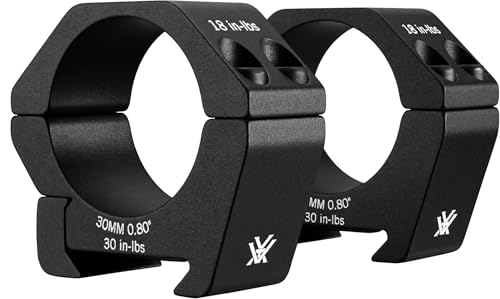
Vortex Sport Riflescope Rings, 30mm, Low 0.80 inch
$39.00Published at 0.80 inches to centre, the lowest stocked option in this line and the right choice on a rifle with a lower comb and a smaller objective.
Best for: A 30mm scope with a 32 to 40 mm objective on a bolt action
Check price on Amazon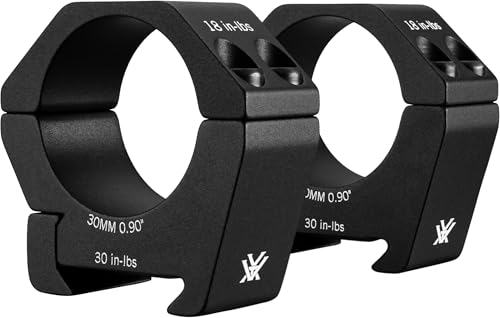
Vortex Sport Riflescope Rings, 30mm, Medium 0.90 inch
$39.00Published at 0.90 inches to centre, which clears most 40 to 44 mm objectives with margin at a low price.
Best for: A general-purpose hunting scope in the 3-9x40 to 4-16x44 range
Check price on Amazon
Burris Zee Rings, 30mm, Medium, Matte Black
$53.41The Zee polymer insert forgives a small mismatch between a budget base and ring at a price close to a stamped set.
Best for: A rifle wearing a base from a different maker than the ring
Check price on AmazonBest buy-once 30mm scope rings
This is where the difference between a matched pair and a stamped pair starts to show, and where the ring stops being the part most likely to be replaced next.

Warne Maxima 30mm High Matte Mounting Rings
$79.99Steel construction and a published height, from a line that has held torque under recoil for a long time.
Best for: A serious hunting rifle carried hard, in an objective 40 mm or larger
Check price on Amazon
Vortex Pro Series Riflescope Rings, 30mm, High 1.26 inch
$71.88Published at 1.26 inches to centre and sold matched, clearing a larger objective without the height going to waste as a fixed 1.5 inch ring would.
Best for: A 44 to 50 mm objective on a bolt action
Check price on Amazon
Burris Signature Zee 30mm High Rings, Matte
$49.77The polymer insert system in its tallest published height, for a bigger objective without switching to metal-on-metal contact.
Best for: A large-objective hunting scope on a mixed-brand base
Check price on AmazonBest precision 30mm scope rings
Factory lapped and matched to a published hundredth of an inch, these rings remove ring-induced erector preload before you touch a lapping bar, which matters most once a scope is being dialled at distance rather than held over.

Vortex Precision Matched Rings, 30mm, 0.87 inch Height, Picatinny
$157.41Published at 0.87 inches to centre on a Picatinny footprint, factory lapped as a pair.
Best for: A precision build on a moderate objective where sitting low matters for cheek weld
Check price on Amazon
Vortex Precision Matched Rings, 30mm, 1.26 inch Height, Picatinny
$159.00The same factory-lapped standard at 1.26 inches to centre, for a larger objective on a precision build.
Best for: A 50 mm objective long range scope on a Picatinny rail
Check price on Amazon
Warne Maxima Quick Detach Rings, 30mm Medium
$103.99Return-to-zero levers machined to the same standard as Warne's fixed line, for a rifle that needs the scope off without losing the zero.
Best for: A rifle that travels disassembled or alternates optics
Check price on AmazonWho should not buy this tier: Skip a factory-lapped, matched 30mm ring if your rifle has never demonstrated a zero problem and is not shot past a few hundred yards. Ring lapping removes erector preload, which is a real failure mode, but it is not a failure mode a hunting rifle with a properly torqued stamped ring is actually experiencing.
Does a 30mm tube actually gather more light?
The working
exit pupil = objective diameter (mm) / magnification a 44mm objective at 10x on a 1 inch tube = 4.4mm the same 44mm objective at 10x on a 30mm tube = 4.4mm
The tube diameter never appears in the equation. Two scopes with the same objective and the same magnification have the identical exit pupil regardless of what the tube between the lenses measures.
No, and the arithmetic settles it completely. Exit pupil, the bright disc of light you see when you hold a scope at arm's length, is the objective diameter divided by the magnification. Tube diameter is not a term in that equation.
Exit pupil and light gathering are identical between a 1 inch and a 30mm tube at the same objective and magnification; what changes is room for the erector to travel, which is why a 30mm tube reaches further before running out of elevation.
Sourced figure
| Property | 1 inch tube | 30mm tube | Why |
|---|---|---|---|
| Exit pupil at a given objective and magnification | Identical | Identical | Exit pupil = objective divided by magnification; tube diameter is not in the equation |
| Light gathered | Identical | Identical | The objective lens collects the light, not the tube wall around the erector |
| Internal elevation travel | Least of the common sizes | Meaningfully more | A larger tube leaves more physical room around the erector assembly for it to move |
| Ring and mount selection | Widest, cheapest | Wide, moderate price | 30mm has been the default for exposed-turret scopes for a long time |
The travel comparison is a relative statement, not a published figure: total elevation travel is set by the specific scope's erector design and is usually not published by the manufacturer at all.
Why a 30mm tube became the default for dialling scopes
Once a scope has exposed turrets meant to be dialled rather than capped and left alone, the amount of elevation available before the erector physically runs out of room becomes the limiting factor on how far the scope can be used. A 30mm housing gives the manufacturer more room to work with than a 1 inch housing does, so a 30mm scope with the same reticle design typically ships with meaningfully more total travel.
This is also why the myth persists: a 30mm scope is disproportionately likely to also have a larger objective and better coatings, because it tends to sit in a higher price tier. The brightness improvement people notice is real, and it comes from the glass and the coatings, not from the tube diameter itself.
How we chose
We did not test these optics in person and we never claim to. Picks are researched from manufacturer specification sheets, published optical and ballistic formulas, and the recurring themes in verified owner reviews. Every pick is matched to a real objective diameter, a real tube size, a real ring height or a real exit pupil rather than to a price bracket, and it is placed in the tier where its capability actually belongs. Where a figure is shooter convention rather than a sourced number we label it, and where a manufacturer does not publish a figure we leave it out instead of estimating it.
Sources
- Manufacturer published exit pupil formula and objective and magnification specifications
- Vortex and Warne published ring height specifications from the product listings in our catalog
Frequently asked questions
Does a 30mm scope tube gather more light than a 1 inch tube?
No. Exit pupil, which controls perceived brightness, is the objective diameter divided by the magnification, and tube diameter does not appear in that formula. A 44mm objective at 10x gives the same 4.4mm exit pupil whether the tube in between is 1 inch or 30mm. Any brightness difference comes from the objective size or the glass coatings, not the tube.
Why did 30mm tubes become the standard anyway?
Room for the erector assembly to travel. A 30mm housing gives the manufacturer more physical space around the internal mechanism than a 1 inch housing, which typically means more total elevation adjustment before the scope runs out. That matters on a scope meant to be dialled at distance and is largely irrelevant on a capped hunting scope.
Do 30mm rings fit a 1 inch scope tube?
No, not without a shim, and a shim concentrates pressure unevenly rather than clamping the full circumference of the tube the way a correctly sized ring does. Buy rings that match your tube diameter exactly. If you are between scopes of different tube sizes, the rings from the smaller tube almost never carry over.
Is 30mm or 34mm better?
34mm gives still more room for elevation travel than 30mm, which mainly matters past 600 to 800 yards. For most hunting and general-purpose shooting inside that range, 30mm is the better value: wider ring selection, lower prices, and travel that comfortably covers ordinary come-ups. Choose 34mm once you have proven a 30mm scope and a canted base are running short.
Do 30mm rings need to be taller than 1 inch rings for the same objective?
Only slightly, and not because of the objective. Ring height is measured to the tube centre, so a larger tube's centre sits marginally higher for a ring of the same physical size. The objective bell, not the tube diameter, is what actually decides the clearance you need, and it is the same regardless of which tube the scope uses.
Are 30mm rings more expensive than 1 inch rings?
Slightly, at most price points, mostly because 30mm dominates the higher end of the scope market and rings get priced alongside it. At the budget end the difference is minimal: a Vortex Sport ring costs the same $39 in either 1 inch or 30mm. Precision matched pairs run somewhat higher in 30mm because more of that market exists.
Researched, not professional advice. This page is compiled from published manufacturer specifications, published optical and ballistic formulas, and owner-review consensus, not hands-on testing. Figures described as a rule of thumb are shooter convention rather than sourced numbers, and they are labelled that way wherever they appear. Ballistic figures come from a point mass model using the ballistic coefficient the maker publishes, so treat them as a starting point and confirm them on paper at a measured distance. Confirm your firearm is unloaded with the action open before you mount, level, torque or bore sight anything. Verify a zero only on a supervised range or a safe, legal backstop, know what lies beyond your target, and follow the law where you hunt and shoot, including rules on land access and permitted cartridges.