Riflescopes under $500
Best Riflescopes Under $500
Quick answer
The best riflescope under $500 is the Vortex Diamondback Tactical 4-16x44 First Focal Plane Riflescope, EBR-2C MOA at $399.00, because it is the cheapest first focal plane scope with turrets that reliably return to zero, which is exactly the capability a $200 ceiling cannot buy. Below $500 the honest ceiling is 500 to 600 yards, not further.
Five hundred dollars is the price where a riflescope stops being purely a hunting tool and starts being able to do the arithmetic of distance shooting, if you choose correctly inside the bracket. It is also the price where people most often overspend on magnification and underspend on the mount that supports it.
What genuinely becomes available under $500 that is not reliably available under $200: a first focal plane reticle whose subtensions are correct at every power, a 30 mm tube with meaningfully more internal elevation travel than a 1 inch tube, and exposed turrets built to be dialled rather than set once. What is still being cut at this price: the turret feel and long-term repeatability that separates a $500 scope from a $1,000 one, and glass coatings that hold up in the last ten minutes of legal light.
Researched from published manufacturer specifications and owner-review consensus rather than a hands-on shooting session. A scope claiming to have been tested in the field by the writer is not describing this page or any other on this site.
On this page
What $500 buys that $200 cannot
The honest capability jump between the two price bands, and where it genuinely stops.
A $500 ceiling reliably buys a first focal plane reticle and a 30 mm tube with real elevation travel, while turret feel and last-light glass performance keep improving well past this price.
Shooter convention
| Capability | Under $200 | Under $500 |
|---|---|---|
| First focal plane reticle | Rare and usually compromised | Reliably available and usually well executed |
| Exposed, dialable turrets | Uncommon | Standard on the scopes built for it |
| Internal elevation travel | Limited by a 1 inch tube in most cases | 30 mm tube gives meaningfully more room to dial |
| Turret return-to-zero after heavy use | Inconsistent | Improved, but still the main thing that separates this tier from the next |
| Glass performance in the last ten minutes of light | Noticeably limited | Better, but not yet at the level of a $1,000-plus scope |
The scopes on this page cover shooting out to roughly 500 to 600 yards competently. Past that, turret repeatability under repeated dialling becomes the limiting factor, not magnification.
A first step into dialling, without overspending
For a shooter moving off a fixed hunting scope toward one they intend to dial, without yet knowing how much elevation they will actually need.

Leupold VX-Freedom 3-9x40 CDS Duplex Riflescope
$299.99 Full specificationsA CDS turret gives a computed come-up without requiring the shooter to learn MOA or mil math first, which is the right bridge for someone who has not dialled a scope before.
Best for: a shooter who wants one accurate turn of the dial rather than a full precision platform
Check price on Amazon
Burris Fullfield 3-12x42 SC Riflescope
$259.36 Full specificationsA 3-12x range on a second focal plane reticle at a price well under the ceiling, useful if the goal is more reach on a hunting rifle rather than a dialling platform.
Best for: stretching a hunting scope out to a slightly longer practical range
Check price on AmazonThe buy-once first focal plane riflescope under $500
This is the scope most people looking to dial come-ups under a $500 ceiling should actually buy, and it is the top pick on this page for that reason.
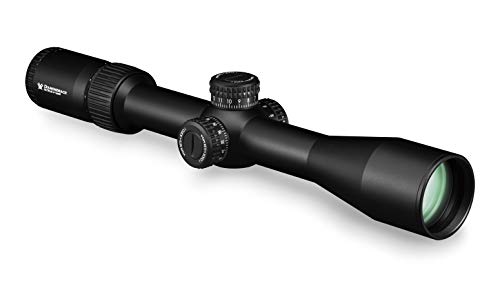
Vortex Diamondback Tactical 4-16x44 First Focal Plane Riflescope, EBR-2C MOA
$399.00 Full specificationsA first focal plane reticle on a 30 mm tube with turrets that hold up to real dialling, at the lowest price where that combination is genuinely reliable rather than a marketing claim.
Best for: a rifle that will be dialled to a real come-up past 300 yards
Check price on Amazon
Athlon Argos BTR GEN3 6-24x50 Riflescope, APRS11 FFP IR MIL Reticle
$379.99 Full specificationsAn illuminated first focal plane mil reticle with a zero stop, a feature combination that rarely appears together this far under $500, on a maker whose warranty transfers the same way Vortex does.
Best for: a shooter who wants more magnification headroom at a similar price
Check price on AmazonThe most riflescope $500 will honestly buy
Right at the ceiling, one genuine step up in glass and turret feel over the intermediate tier, at the cost of most of the remaining budget.

Primary Arms SLX 3-18x50mm FFP Gen II Riflescope
$499.99A first focal plane scope with a purpose-built holdover reticle, a 30 mm tube and capped turrets designed for repeatable return to zero, priced right at the edge of this bracket.
Best for: a shooter who wants to range and hold rather than dial for every shot
Check price on AmazonWho should not buy this tier: Anyone who has never mounted or zeroed a scope before, or who is shooting a rifle that will never leave 200 yards. This tier is built for distance and its exposed turrets, first focal plane reticle and 50 mm objective all add cost that a close-range hunting rifle does not need. Start with the beginner tier on this page or the flagship riflescope roundup instead.
How far can a $500 riflescope actually be trusted to shoot?
The honest answer is 500 to 600 yards for a shooter using a chronographed muzzle velocity, a canted base and a properly mounted scope, and considerably less for a shooter using catalog numbers and a flat base. Past that, the limiting factor is rarely the glass: it is whether the turret returns to the same place after a hundred revolutions in the cold, which is exactly what separates this price tier from the next one up.
Check what your own load needs at your longest realistic distance against the MOA and mil figures at 500 yards before assuming a scope in this bracket has enough internal travel to reach it.
How we chose
We did not test these optics in person and we never claim to. Picks are researched from manufacturer specification sheets, published optical and ballistic formulas, and the recurring themes in verified owner reviews. Every pick is matched to a real objective diameter, a real tube size, a real ring height or a real exit pupil rather than to a price bracket, and it is placed in the tier where its capability actually belongs. Where a figure is shooter convention rather than a sourced number we label it, and where a manufacturer does not publish a figure we leave it out instead of estimating it.
Sources
- Vortex Optics published specifications and turret specifications
- Athlon Optics and Primary Arms published specifications
- Owner-review consensus aggregated across major retailers
Frequently asked questions
What is the best riflescope for under $500?
The Vortex Diamondback Tactical 4-16x44 First Focal Plane Riflescope, EBR-2C MOA at $399.00. It is the cheapest first focal plane scope on a 30 mm tube whose turrets reliably return to zero, which is the specific capability that separates a genuine dialling scope from one that merely has exposed turrets.
Is first focal plane worth paying extra for under $500?
If the rifle will be dialled or held over past 300 yards, yes: the reticle stays proportionally correct at every magnification, so a hold taken at 8x is the same hold at 16x. For a hunting rifle that stays inside 300 yards, a second focal plane scope in the beginner or intermediate tier of the main riflescope roundup is the better trade.
How far can a riflescope under $500 shoot accurately?
Competently to 500 or 600 yards with a chronographed load and a properly torqued mount. The glass and the turrets in this bracket are honest about that range and start showing their limits past it, mainly in turret repeatability rather than optical resolution.
Do I need a 30mm tube under $500?
If dialling elevation past roughly 400 yards, yes, because a wider tube leaves more room for the internal erector to travel before it runs out. If the rifle stays inside 300 yards, a 1 inch tube on a second focal plane hunting scope in a lower price band does the same job for less money.
What is the difference between the under $200 and under $500 riflescope tiers?
Mainly turret capability and reticle type. Under $200, capped turrets set once and a second focal plane reticle are the safer bet. Under $500, first focal plane reticles and exposed turrets become reliable enough to actually dial, which is the whole point of spending more at this level.
Should I spend $500 on glass or split it with the mount?
Split it. A first focal plane scope on a flat base with mismatched rings will still fail to reach its advertised elevation travel, because the mount eats into it before the scope does. A 20 MOA base and a matched set of rings cost a fraction of the scope and frequently solve the actual problem better than more magnification does.
Researched, not professional advice. This page is compiled from published manufacturer specifications, published optical and ballistic formulas, and owner-review consensus, not hands-on testing. Figures described as a rule of thumb are shooter convention rather than sourced numbers, and they are labelled that way wherever they appear. Ballistic figures come from a point mass model using the ballistic coefficient the maker publishes, so treat them as a starting point and confirm them on paper at a measured distance. Confirm your firearm is unloaded with the action open before you mount, level, torque or bore sight anything. Verify a zero only on a supervised range or a safe, legal backstop, know what lies beyond your target, and follow the law where you hunt and shoot, including rules on land access and permitted cartridges.