Hunting scopes
Best Scopes for a .308 Winchester
Quick answer
A .308 Winchester zeroed at 200 yards needs about 9.84 MOA of come-up to reach 500 yards, which is why the Vortex Diamondback Tactical 4-16x44 First Focal Plane Riflescope, EBR-2C MOA at $399.00 earns its place: a first focal plane reticle and a 30mm tube with real elevation travel to spare for that reach.
A .308 Winchester is the reference cartridge for almost every published drop chart, and for good reason: it is common, moderate in recoil, and its trajectory is well understood at every distance this site publishes. The question a scope has to answer for it is not exotic. It is whether the turrets track and repeat, and whether the tube has room to dial the come-up a .308 actually needs past 300 yards.
Recoil is the other real consideration. A .308 generates enough recoil, over enough rounds, to expose a scope with weak turret detents or a spring that loses tension. None of that shows up on a spec sheet, which is why warranty and owner-review consensus matter as much as the numbers here.
This roundup is researched from published manufacturer specifications and owner-review consensus. We did not test these scopes in person.
On this page
What does a .308 actually ask of a scope at distance?
What produced these numbers
G1 point mass model, .308 Winchester, 168 grain match hollow point at a catalogue 2,650 fps, BC 0.462, 1.8 in sight height, 200 yard zero, 10 mph full value crosswind
Computed with the same model behind the zero distance cluster on this site. It is not radar data and it does not model spin drift.
Real numbers change the conversation from how much magnification to how much elevation travel and how much tracking precision. Here is what a 200 yard zero on a .308 actually costs you at distance.
Reaching 500 yards from a 200 yard zero needs 9.84 MOA (2.86 mil) of dialled come-up and the bullet drifts 22.6 inches in a 10 mph crosswind, which is why turret travel and tracking matter more than raw magnification for this cartridge.
Sourced figure
| Distance | Drop from line of sight | Come-up (MOA) | Come-up (mil) | Wind drift at 10 mph |
|---|---|---|---|---|
| 300 yd | 8.7 in low | 2.78 MOA | 0.81 mil | 7.5 in |
| 400 yd | 25.4 in low | 6.07 MOA | 1.77 mil | 13.8 in |
| 500 yd | 51.5 in low | 9.84 MOA | 2.86 mil | 22.6 in |
| 600 yd | 88.8 in low | 14.13 MOA | 4.11 mil | 33.9 in |
Confirm this on paper before trusting it. See the full computed .308 Winchester 200 yard zero page for every distance in between, including velocity and energy.
What .308 recoil actually asks of the mount, not just the scope
A .308 is not a hard-recoiling cartridge by rifle standards, but it is hard enough, over a season of shooting, to find a ring that was not torqued to the published figure or a base screw that backed out. That is a mounting problem rather than a scope problem, and it is fixed with a torque driver rather than a more expensive scope.
See the ring torque guide and the torque tool roundup before assuming a wandering zero is the scope's fault.
The other common failure is an eye relief that was fine on paper and too short once the rifle is fired from field positions rather than a bench. A .308 pushed back against the shoulder from a kneeling or off-hand stance sits closer to the scope than it does prone, and a scope mounted at the edge of its eye relief will find the shooter's brow eventually. Mount with a margin, not the minimum.
Beginner: enough for a woods .308
Most .308 rifles are hunting rifles taking shots inside 300 yards. Both picks here handle that completely without exposed turrets or a first focal plane reticle to learn.

Vortex Crossfire II 3-9x40 Riflescope, Dead-Hold BDC Reticle
$128.99 Full specificationsMost .308 rifles are hunting rifles taking shots inside 300 yards, and a Dead-Hold BDC reticle at {{price:vortex-crossfire-ii-3-9x40}} handles that completely, with a transferable lifetime warranty if recoil ever does loosen something.
Best for: A .308 hunting rifle that rarely sees a shot past 300 yards.
Check price on Amazon
SIG SAUER Buckmasters 3-9x40 Riflescope
$125.97 Full specificationsA plain duplex reticle at {{price:sig-buckmasters-3-9x40}} for shooters who would rather hold dead-on inside their zero than read holdover marks.
Best for: Hunters who zero once and rarely dial.
Check price on AmazonIntermediate: built to reach 500 yards
This is where a .308 setup starts to reach its own real limit, which is closer to 600 yards than to 300. Both picks give room to dial the come-up that distance needs.
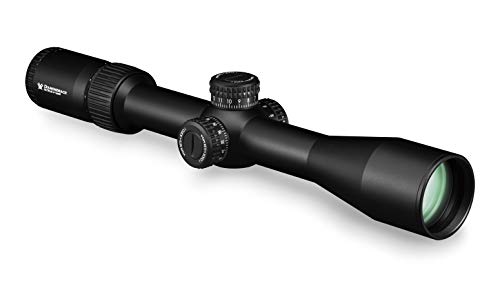
Vortex Diamondback Tactical 4-16x44 First Focal Plane Riflescope, EBR-2C MOA
$399.00 Full specificationsFirst focal plane and exposed turrets at {{price:vortex-diamondback-tac-4-16x44}} that reach the 9.84 MOA a .308 needs at 500 yards with turret travel to spare, in a 30mm tube built for exactly this.
Best for: A .308 shot regularly past 300 yards, where dialing beats holding over.
Check price on Amazon
Primary Arms SLX 3-18x50mm FFP Gen II Riflescope
$499.99An 18x top end and a 50mm objective at {{price:primary-arms-slx-3-18x50}} for shooters who want more magnification headroom than a 4-16x offers at the same 500 to 600 yard range a .308 reaches comfortably.
Best for: Shooters who want more magnification at the top end without changing tube size.
Check price on AmazonExpert: dialing a .308 past 600 yards
Past 600 yards a .308 is trading velocity fast and needs everything to be right: glass, turrets and a rifle that has already proven it can hold the group this scope can resolve.

Athlon Optics Midas TAC HD 6-24x50 First Focal Plane Riflescope, APRS3 FFP MIL
$569.00 Full specificationsA 6-24x range and FFP reticle at {{price:athlon-midas-tac-6-24x50}} for shooters who dial a .308 out past 600 yards regularly, where turret tracking under repeated recoil is the whole story.
Best for: Shooters who shoot a .308 at distance often enough to need every bit of elevation travel and glass quality.
Check price on AmazonWho should not buy this tier: A .308 hunting rifle that spends its life inside 300 yards in the woods. The magnification, weight and price here solve a problem that a 200 yard zero on a duplex reticle already solves for less.
How we chose
We did not test these optics in person and we never claim to. Picks are researched from manufacturer specification sheets, published optical and ballistic formulas, and the recurring themes in verified owner reviews. Every pick is matched to a real objective diameter, a real tube size, a real ring height or a real exit pupil rather than to a price bracket, and it is placed in the tier where its capability actually belongs. Where a figure is shooter convention rather than a sourced number we label it, and where a manufacturer does not publish a figure we leave it out instead of estimating it.
Sources
- Published factory load specification: 168 grain match hollow point at a catalogue 2,650 feet per second
- G1 standard drag function, computed from the published ballistic coefficient
Frequently asked questions
How much elevation does a .308 need to reach 500 yards?
About 9.84 MOA or 2.86 mil of dialled come-up from a 200 yard zero, using a 168 grain match load at a catalogue 2,650 feet per second. Half a scope's total elevation travel usually sits above mechanical centre, so check your scope's published travel against this figure before assuming it reaches 500 yards.
Does .308 recoil damage cheap scopes?
Not usually outright, but it exposes weak points over time: a turret that loses its zero, a ring screw that was never torqued to spec, or an erector spring that wears faster than a premium one. A transferable lifetime warranty is the practical answer for a budget scope, and a torque driver on the rings is the cheaper fix than a better scope.
Is a 30mm tube necessary for a .308 scope?
Not for hunting distances, but it helps once you dial past 400 yards. A 30mm tube does not track any finer than a 1 inch tube, but it holds more internal elevation travel, which is exactly what a .308's 9.84 MOA come-up at 500 yards needs room for.
Should a .308 scope be first or second focal plane?
Second focal plane for hunting inside 300 yards, where a constant reticle size matters more than exact subtension at every power. First focal plane earns its place once you regularly dial or hold at 400 yards and beyond, where the reticle needs to read correctly at whatever magnification you are on.
How much wind drift does a .308 have at 500 yards?
About 22.6 inches in a 10 mph full value crosswind, using a 168 grain match load at a catalogue 2,650 feet per second. That is more drift than a higher ballistic coefficient load like 6.5 Creedmoor sees at the same distance, which is why wind reading matters as much as the scope for a .308 at range.
Do I need a mil or MOA reticle for a .308?
Either works, and one mil equals 3.44 MOA at any distance. What actually matters is that the reticle and the turrets use the same unit, so a correction you read off the glass is one you can dial without converting it in the field. Pick whichever unit your rangefinder and ballistic app already use.
Researched, not professional advice. This page is compiled from published manufacturer specifications, published optical and ballistic formulas, and owner-review consensus, not hands-on testing. Figures described as a rule of thumb are shooter convention rather than sourced numbers, and they are labelled that way wherever they appear. Ballistic figures come from a point mass model using the ballistic coefficient the maker publishes, so treat them as a starting point and confirm them on paper at a measured distance. Confirm your firearm is unloaded with the action open before you mount, level, torque or bore sight anything. Verify a zero only on a supervised range or a safe, legal backstop, know what lies beyond your target, and follow the law where you hunt and shoot, including rules on land access and permitted cartridges.