Spotting scopes
Best Spotting Scopes
Quick answer
The best all-round spotting scope is the Vortex Diamondback HD 20-60x85 Angled Spotting Scope at $499.00, because its 85 mm objective gives a 4.25 mm exit pupil at 20x but only 1.42 mm at 60x, which is the honest tradeoff every spotter makes and this one makes at a fair price.
A spotting scope is a single instrument that does two things badly if you buy it wrong: it needs a wide, bright field of view to find something and a narrow, resolving one to judge it. That is why every spotter on the market is a zoom, and why the number printed on the box, such as 20-60x85, describes a range rather than a single answer.
The number that actually matters is the exit pupil, which is the objective diameter divided by the magnification. An 85 mm objective at 20x gives a 4.25 mm exit pupil, comfortably bright. The same scope at 60x gives 1.42 mm, which is a setting for a sunny midday and nothing else. Nobody publishes this on the box, so this guide does the arithmetic for every scope in the catalog.
These recommendations are researched from published manufacturer specifications and owner-review consensus. We did not test these scopes side by side in the field, and any roundup that claims to have compared forty spotting scopes in a weekend is telling you a story rather than a fact.
On this page
What does exit pupil actually do on a zoom spotting scope?
The working
exit pupil = objective diameter / magnification. An 85 mm objective at 20x gives 85 / 20 = 4.25 mm. At 60x it gives 85 / 60 = 1.42 mm.
This is exact arithmetic, sourced directly from the two numbers printed on every spotting scope. It says nothing about the quality of the glass.
A dark-adapted human pupil opens to somewhere between 5 and 7 mm depending on age. Below that, a smaller exit pupil means a dimmer image, a smaller eye box, and a picture that blacks out at the edges if your eye is not dead centre behind the eyepiece.
Every spotting scope in this catalog falls below a 1.5 mm exit pupil at its maximum magnification, which is why the top of the dial is a bright-day setting rather than a daily one.
Sourced figure
| Scope | Low end | Exit pupil, low | High end | Exit pupil, high |
|---|---|---|---|---|
| Crossfire HD 12-36x50 | 12x | 4.17 mm | 36x | 1.39 mm |
| Crossfire HD 16-48x65 | 16x | 4.06 mm | 48x | 1.35 mm |
| Ultima 20-60x80 | 20x | 4.00 mm | 60x | 1.33 mm |
| Diamondback HD 20-60x85 | 20x | 4.25 mm | 60x | 1.42 mm |
| Viper HD 15-45x65 | 15x | 4.33 mm | 45x | 1.44 mm |
Exit pupil is exact arithmetic from objective diameter and magnification. Light transmission through the coatings and prisms is a separate question the formula cannot answer, and it is where the price difference between these scopes actually shows up.
How much magnification do you actually need?
Almost nobody should run a spotting scope at its printed maximum as a habit. Past about 40x on most days, mirage from ground heat distorts the image long before the objective runs out of resolving power, and the exit pupil has usually already dropped below 2 mm.
The useful working range on an 85 mm scope is closer to 20x to 40x, where the exit pupil stays above 2 mm and the image is still stable enough to judge detail. Reserve the top of the dial for a genuinely still, bright morning, and expect to turn it back down the moment the air starts shimmering over open ground.
This is also why a smaller, lighter 65 mm scope is not automatically the wrong choice. A Vortex Crossfire HD 16-48x65 Angled Spotting Scope used mostly in its bright, sharp middle range will out-perform an 85 mm scope run flat out on a hazy afternoon, at a third of the weight to carry up a hill.
Angled or straight, and why it matters more than the brand
An angled body, where the eyepiece points up at roughly 45 degrees rather than straight back, is the better default for almost every use on this site. It lets the tripod sit lower and steadier, it is far easier to share between two people without resetting the legs, and it is more comfortable to use from a seated position glassing over a ridge.
A straight body earns its keep from a vehicle window or when you need to acquire something fast and track it, because pointing a straight tube at a moving target is more intuitive than pointing an angled one. Every scope in the table above is angled except where noted, which reflects how this category is actually used.
Beginner: the spotting scope that gets carried
A first spotting scope should be light enough that it actually comes on the hike rather than staying in the truck. This tier optimizes for the lowest total cost to a genuinely useful zoom range, not the biggest number on the box.
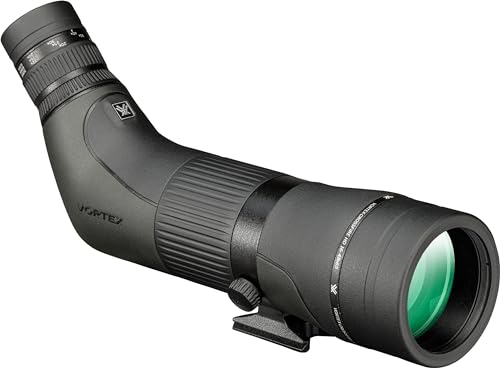
Vortex Crossfire HD 16-48x65 Angled Spotting Scope
$249.00A 65 mm objective keeps the weight and the price down while still giving a 4.06 mm exit pupil at the low end of its zoom, and Vortex's transferable warranty backs it for as long as you own it.
Best for: A first spotter for checking targets or judging game at moderate range without carrying an 85 mm scope up a mountain.
Check price on AmazonIntermediate: the buy-once 85 mm scope
This is the tier built for someone who has already worn out a smaller scope, or who knows from the start that they want the extra reach an 85 mm objective buys at last light. It optimizes for the best resolving power per dollar rather than the cheapest entry point.

Vortex Diamondback HD 20-60x85 Angled Spotting Scope
$499.00The largest objective in the mid-price band, with HD glass that controls colour fringing around a skylined animal, at a price well under the Viper HD above it.
Best for: Open country glassing where you need to judge an animal, not just find it, and where the extra weight of an 85 mm objective is worth carrying.
Check price on Amazon
Athlon Optics Argos HD 20-60x85 Spotting Scope, 45 Degree
$249.99The same 85 mm objective and zoom range at a noticeably lower price, for a buyer who wants the reach without the Vortex brand premium.
Best for: A second scope kept at a fixed observation post, or a first 85 mm scope on a tighter budget.
Check price on AmazonExpert: glass over aperture
At this tier the honest advice is that the glass matters more than the last few millimetres of objective diameter. This is the performance ceiling for resolving fine detail at long range, not for gathering the absolute most raw light.

Vortex Viper HD 15-45x65 Angled Spotting Scope
$699.00APO glass elements control chromatic aberration at the top of the zoom range in a way the Crossfire and Diamondback lines cannot, which is where the price difference actually lives.
Best for: A shooter or hunter who spends hours a day behind a spotter and notices colour fringing and edge softness that a casual user would not.
Check price on AmazonWho should not buy this tier: Not for anyone who mostly needs maximum brightness at last light or the biggest objective for the money. The Viper HD's 65 mm objective is smaller than the Diamondback HD's 85 mm, and a buyer chasing raw low-light performance should buy the larger, cheaper objective instead and put the savings toward a better tripod.
How we chose
We did not test these optics in person and we never claim to. Picks are researched from manufacturer specification sheets, published optical and ballistic formulas, and the recurring themes in verified owner reviews. Every pick is matched to a real objective diameter, a real tube size, a real ring height or a real exit pupil rather than to a price bracket, and it is placed in the tier where its capability actually belongs. Where a figure is shooter convention rather than a sourced number we label it, and where a manufacturer does not publish a figure we leave it out instead of estimating it.
Sources
- Vortex Optics published specifications
- Athlon Optics published specifications
- Celestron published specifications
- Exit pupil, objective diameter divided by magnification, standard published optical formula
Frequently asked questions
What magnification spotting scope do I need?
For most hunting and target work, a scope that reaches 40x to 60x on paper but is mostly used between 20x and 40x. Past 40x, mirage from ground heat usually blurs the image before the optic runs out of resolving power, and the exit pupil has typically already dropped below 2 mm, which dims the picture noticeably.
Why is my spotting scope so dark at maximum zoom?
Exit pupil, which is objective diameter divided by magnification. An 85 mm scope at 60x gives a 1.42 mm exit pupil, smaller than even a bright-adapted daytime pupil in some light, which is why the image dims and the eye box shrinks to almost nothing at the top of the dial. This is normal for every zoom spotting scope, not a defect in yours.
Is an 85 mm objective worth the extra weight over a 65 mm?
Only if you actually use the top half of the zoom range or glass regularly at dawn and dusk. At a shared magnification the larger objective gives a brighter, larger exit pupil, but at 20x both a 65 mm and an 85 mm scope are already brighter than most eyes can use in daylight, so the difference only shows up as the light fades or the power climbs.
Angled or straight spotting scope, which should I buy?
Angled for almost everyone. It sits lower and steadier on a tripod, it is far easier for a second person to use without resetting the legs, and it is more comfortable from a seated glassing position. Straight bodies earn their keep from a vehicle window or when you need to point and track something moving quickly.
Do I need a spotting scope if I already have binoculars?
Only once you are regularly trying to judge, not just find, something at distance. A binocular is the better tool for searching because two eyes are less tiring over an hour. A spotting scope earns its place when you need to count points, read a mirror flash or resolve detail a binocular cannot at 10x or 12x.
Do these spotting scopes come with a tripod?
No, and budgeting for one separately is not optional. A spotting scope above about 30x amplifies hand tremor and wind to the point of being unusable without support. See the dedicated tripod guide for a head that tracks rather than one built for a camera, because the two jobs are different.
Researched, not professional advice. This page is compiled from published manufacturer specifications, published optical and ballistic formulas, and owner-review consensus, not hands-on testing. Figures described as a rule of thumb are shooter convention rather than sourced numbers, and they are labelled that way wherever they appear. Ballistic figures come from a point mass model using the ballistic coefficient the maker publishes, so treat them as a starting point and confirm them on paper at a measured distance. Confirm your firearm is unloaded with the action open before you mount, level, torque or bore sight anything. Verify a zero only on a supervised range or a safe, legal backstop, know what lies beyond your target, and follow the law where you hunt and shoot, including rules on land access and permitted cartridges.