Red dot sight reviews
Aimpoint PRO Review
Quick answer
The Aimpoint PRO at $512.00 is built around one published number: 30,000 hours, over three years, of continuous battery life left switched on, and it ships with a QRP2 quick release mount and spacer already matched to it.
Most red dots on this site solve battery anxiety with a motion sensor. The Aimpoint PRO solves it differently: Aimpoint publishes over 30,000 hours, more than three years, of continuous runtime on a single battery with the sight left switched on the entire time. That is not a claim about how efficiently it manages power when idle. It is a claim about never needing to think about the switch at all.
This review is built from Aimpoint's own published specifications for the PRO, the exact MOA arithmetic its 2 MOA dot allows, and the consensus of verified owner reviews describing this sight in long-term duty and patrol use. We did not test this sight in person.
On this page
- How big is the 2 MOA dot at real distances?
- What does the bundled QRP2 mount actually save you over buying a mount separately?
- What does owner-review consensus say about the PRO in long-term duty use?
- The catch: paying a premium mostly for battery life and durability, not features
- A solar-backed step up in features, and a cheaper motion-activated alternative instead
How big is the 2 MOA dot at real distances?
The working
dot diameter = MOA x 1.047 x (range in yards / 100)
Exact trigonometry from the published 2 MOA dot size. Exit pupil does not apply to a 1x reflex sight, so this subtension is the real precision ceiling.
The 2 MOA dot covers 2.09 inches at 100 yards and 4.19 inches at 200, identical to any other genuine 2 MOA dot, since dot size is arithmetic rather than a brand advantage.
Sourced figure
| Distance | Dot diameter |
|---|---|
| 100 yd | 2.09 in |
| 200 yd | 4.19 in |
See the full MOA and mil conversion chart for the same arithmetic at any distance.
What does the bundled QRP2 mount actually save you over buying a mount separately?
Aimpoint includes a QRP2 quick release mount and a spacer with the PRO, matched to the sight rather than sourced separately. Aimpoint's own published detail states the sight achieves absolute co-witness with iron sights when the spacer is installed, which as a rule of thumb needs the optic's centre close to 1.4 inches above a flat top rail. See the worked figures on the 1.4 inch sight height cluster page for what that height actually does to point of impact up close. A separately purchased mount for a bare-tube sight is a real added cost and a real chance of buying the wrong height. This sight removes both problems at the point of sale.
What does owner-review consensus say about the PRO in long-term duty use?
The recurring positive theme, consistent across years of reviews from patrol and duty carbine owners, is that the PRO genuinely gets mounted, zeroed and forgotten: left switched on continuously for the length of a duty cycle without a dead battery being a factor. The waterproof and shockproof housing and the ten brightness settings, including one extra-bright daylight setting, come up repeatedly as matching harder use than a home-defence or range carbine typically sees.
The recurring caution is size and weight relative to a compact micro reflex sight: the PRO's tube housing is noticeably larger and heavier than a Romeo5 or a SPARC, which is the trade a duty-grade tube design makes for its durability record.
The catch: paying a premium mostly for battery life and durability, not features
At $512.00, the PRO costs roughly four times a SIG Romeo5 Gen II for a sight that publishes the same 2 MOA dot size and no solar backup, no shake awake motion sensing and no swappable reticle. The premium is almost entirely battery longevity, waterproof and shockproof durability, and a duty-proven reputation, not a longer features list. A buyer who wants a feature-rich sight rather than a boring, reliable one is paying for the wrong thing here.
Like every red dot, the PRO's dot is a projected point of light, so an astigmatic eye will see it smear rather than resolve cleanly. Aimpoint does not publish an astigmatism-specific fix, and a prism sight with an etched glass reticle remains the standard workaround for that specific limitation, on this sight as on any other.
A solar-backed step up in features, and a cheaper motion-activated alternative instead
If solar backup and a switchable reticle matter more than years of continuous battery life, the Holosun 510C at $295.84 adds both for less money, reviewed separately. If price is the deciding factor and a motion sensor is an acceptable trade for the always-on philosophy here, the SIG Romeo5 Gen II at $128.98 is the cheaper motion-activated alternative instead.
| Model | Price | Magnification | Dot size | Motion activation |
|---|---|---|---|---|
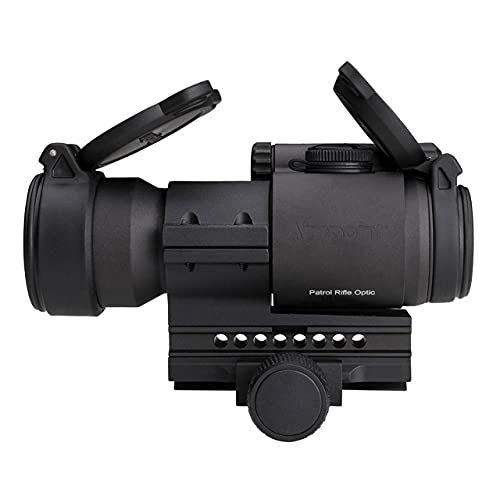 Aimpoint PRO Red Dot Reflex Sight with QRP2 Mount and Spacer, 2 MOA Aimpoint PRO Red Dot Reflex Sight with QRP2 Mount and Spacer, 2 MOA | $512.00 | 1x | 2 MOA | - |
 Holosun 510C Multi-Reticle 2 MOA Dot and 65 MOA Circle Open Reflex Sight Holosun 510C Multi-Reticle 2 MOA Dot and 65 MOA Circle Open Reflex Sight | $295.84 | 1x | 2 MOA | Yes |
 SIG SAUER ROMEO5 GEN II 1x20 Red Dot Sight SIG SAUER ROMEO5 GEN II 1x20 Red Dot Sight | $128.98 | 1x | 2 MOA | Yes |
A dash means the manufacturer does not publish that figure. We leave it blank rather than estimating it.
How we chose
We did not test these optics in person and we never claim to. Picks are researched from manufacturer specification sheets, published optical and ballistic formulas, and the recurring themes in verified owner reviews. Every pick is matched to a real objective diameter, a real tube size, a real ring height or a real exit pupil rather than to a price bracket, and it is placed in the tier where its capability actually belongs. Where a figure is shooter convention rather than a sourced number we label it, and where a manufacturer does not publish a figure we leave it out instead of estimating it.
Sources
- Aimpoint published specifications for the PRO
- Owner-review consensus from long-term duty and patrol carbine use
Frequently asked questions
How long does the battery actually last on the Aimpoint PRO?
Aimpoint publishes over 30,000 hours, more than three years, of continuous operation on a single DL1/3N battery with the sight left switched on the entire time. That figure assumes no motion sensor and no automatic shutoff, since the PRO is designed to be mounted and left on rather than managed.
Does the Aimpoint PRO come with a mount?
Yes. It ships with a QRP2 quick release mount and a spacer, both matched to the sight rather than sold separately. With the spacer installed, Aimpoint states the sight achieves absolute co-witness with iron sights, which removes the common risk of buying a mount at the wrong height for a bare-tube sight.
Is the Aimpoint PRO worth the price over a cheaper red dot?
If years of switched-on battery life and a duty-proven housing matter more than price, yes. The dot size and basic optical performance are similar to sights costing a quarter as much. The premium buys longevity and durability rather than a longer features list, so a buyer chasing features like solar backup should look elsewhere.
How big is the Aimpoint PRO 2 MOA dot at 100 yards?
2.09 inches, the same as any genuine 2 MOA dot from any manufacturer, computed as 2 MOA times 1.047 inches per MOA at 100 yards. Dot size is fixed arithmetic rather than a brand advantage, so this figure does not change between the PRO and a cheaper 2 MOA sight.
Does the Aimpoint PRO have shake awake or a motion sensor?
No. It has no motion sensor and no automatic power management of any kind. It is designed to be switched on once and left running for years, which is a different philosophy from a sight that manages its own power, and it is the entire reason the published battery figure is stated in years rather than hours of use.
Will the Aimpoint PRO work for someone with astigmatism?
Not reliably. Its dot is a projected point of light like any other red dot, and an astigmatic eye smears a point source into a star or comma shape regardless of brand or price. Aimpoint does not publish an astigmatism-specific correction for this model. A prism sight with an etched glass reticle is the standard alternative.
Researched, not professional advice. This page is compiled from published manufacturer specifications, published optical and ballistic formulas, and owner-review consensus, not hands-on testing. Figures described as a rule of thumb are shooter convention rather than sourced numbers, and they are labelled that way wherever they appear. Ballistic figures come from a point mass model using the ballistic coefficient the maker publishes, so treat them as a starting point and confirm them on paper at a measured distance. Confirm your firearm is unloaded with the action open before you mount, level, torque or bore sight anything. Verify a zero only on a supervised range or a safe, legal backstop, know what lies beyond your target, and follow the law where you hunt and shoot, including rules on land access and permitted cartridges.