Hunting scope reviews
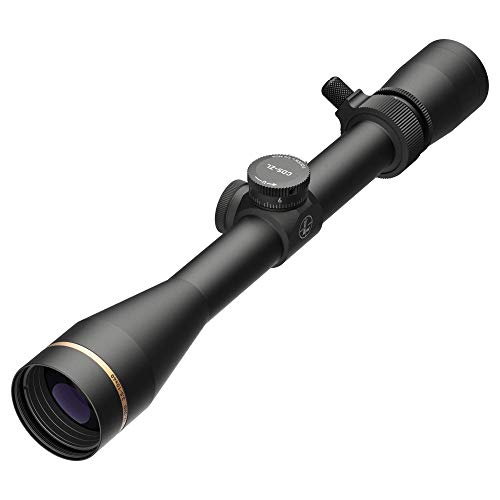
Leupold VX-Freedom 3-9x40 CDS Review
Quick answer
The Leupold VX-Freedom 3-9x40 CDS at $299.99 is built around one feature: a custom-cut CDS elevation dial ordered from Leupold to match your own load's drop, turning a 300 yard shot into reading a number off the turret instead of guessing a holdover.
Every other scope on this site's hunting shelf uses a duplex or BDC reticle and asks you to hold over. The Leupold VX-Freedom 3-9x40 CDS asks you to dial instead, and it is built around the one feature that makes that practical for an ordinary hunter: a turret cut specifically to your rifle's load rather than a generic MOA or mil scale.
This review is built from Leupold's own published specifications and product description, the exact ballistic arithmetic that a custom dial depends on, and the consensus of verified owner reviews describing how the CDS ordering process and the dial itself perform in practice. We did not test this scope in person.
On this page
- What does a CDS turret actually do that a standard turret does not?
- What does dialing actually save you, in real numbers?
- What does owner-review consensus say about living with a CDS turret?
- What ring height and exit pupil come with this configuration?
- The catch with a CDS turret
- The simpler alternative, and the step up in glass
What does a CDS turret actually do that a standard turret does not?
A standard capped turret is set once at 100 yards and left alone. Leupold's Custom Dial System replaces the stock dial with one engraved with actual distances, calculated for your specific bullet weight, muzzle velocity and zero distance, using ballistic data you provide when you order it. Dialing a 300 yard shot then means turning the turret to the number printed for 300 yards, rather than holding over on a reticle mark calibrated to a different load than the one in your rifle.
Leupold's own materials describe the CDS dial as a separate order placed after buying the scope, built from the load data you submit. That is a real limitation worth planning around rather than a criticism of the scope itself: the turret is only as accurate as the ballistic data behind it, and it is calculated for one specific load at a time.
What does dialing actually save you, in real numbers?
What produced these numbers
G1 point mass model, .308 Winchester, 168 grain match hollow point at a catalogue 2,650 fps, BC 0.462, 1.8in sight height, 200 yard zero
Computed with the same model behind the zero distance cluster on this site. A CDS dial ordered for a different load produces different numbers.
This is the exact shape of the problem a CDS dial solves: instead of holding over by an estimated amount at each distance, the dial is engraved with the yardage itself.
A CDS dial engraved for this load would read "300," "400" and "500" directly rather than asking you to hold over 2.78, 6.07 or 9.84 MOA from memory.
Sourced figure
| Distance | Come-up (MOA) | Come-up (mil) |
|---|---|---|
| 300 yd | 2.78 MOA | 0.81 mil |
| 400 yd | 6.07 MOA | 1.77 mil |
| 500 yd | 9.84 MOA | 2.86 mil |
See the full computed .308 Winchester 200 yard zero page for every distance in between. A CDS dial ordered for your own load replaces this table with a printed turret.
What does owner-review consensus say about living with a CDS turret?
The recurring positive theme is exactly what the feature promises: owners consistently describe dialing being faster and less error-prone under field pressure than holding over on a reticle mark, once the correct dial has arrived and been installed. Leupold's published Twilight Light Management coating also comes up frequently as adding real usable minutes at dusk, consistent with its stated purpose.
The recurring caution is about the ordering step itself: a CDS dial requires knowing your load's actual muzzle velocity, not the number on the ammunition box, and getting that number wrong produces a dial that reads confidently and incorrectly. Several owner reviews describe chronographing their own load before ordering a dial rather than trusting a published velocity figure.
What ring height and exit pupil come with this configuration?
The VX-Freedom shares the same 40mm objective and 3-9x range as the Diamondback and the Crossfire II, so it produces the same 4.44mm exit pupil at 9x and needs the same ring height for a 25.4mm, or 1 inch, tube. See the worked figures for a 40mm objective on a 1 inch tube before ordering rings.
The catch with a CDS turret
A CDS dial is cut for one load. Change ammunition, seating depth or even a batch of powder enough to shift muzzle velocity meaningfully, and the dial stops matching reality. At that point you either order a new dial for a fee, or go back to using it as an approximate reference and holding over the remaining error, which defeats the point of buying it.
The dial also is not included at the point of purchase. It has to be ordered separately with your own ballistic data, which takes time and effort a duplex or BDC reticle scope simply does not ask for. If you shoot one factory load and never change it, this is a real, durable advantage. If you experiment with handloads or switch ammunition often, it is a recurring cost rather than a one-time one.
The simpler alternative, and the step up in glass
If you would rather hold over on a BDC reticle than manage a custom dial, the Vortex Diamondback 3-9x40 Riflescope, Dead-Hold BDC Reticle at $249.00 shares the same 3-9x40 configuration without the ordering step. If you want CDS dialing with a meaningfully clearer image and a wider zoom range, the Leupold VX-3HD 3.5-10x40 CDS-ZL at $599.99 adds a locking version of the same idea.
| Model | Price | Magnification | Objective lens | Tube diameter | Focal plane | Reticle |
|---|---|---|---|---|---|---|
 Leupold VX-Freedom 3-9x40 CDS Duplex Riflescope Leupold VX-Freedom 3-9x40 CDS Duplex Riflescope | $299.99 | 3-9x | 40 mm | 25.4 mm | Second | Duplex |
 Vortex Diamondback 3-9x40 Riflescope, Dead-Hold BDC Reticle Vortex Diamondback 3-9x40 Riflescope, Dead-Hold BDC Reticle | $249.00 | 3-9x | 40 mm | 25.4 mm | Second | Dead-Hold BDC |
 Leupold VX-3HD 3.5-10x40 CDS-ZL Duplex Riflescope Leupold VX-3HD 3.5-10x40 CDS-ZL Duplex Riflescope | $599.99 | 3.5-10x | 40 mm | 25.4 mm | Second | Duplex |
A dash means the manufacturer does not publish that figure. We leave it blank rather than estimating it.
How we chose
We did not test these optics in person and we never claim to. Picks are researched from manufacturer specification sheets, published optical and ballistic formulas, and the recurring themes in verified owner reviews. Every pick is matched to a real objective diameter, a real tube size, a real ring height or a real exit pupil rather than to a price bracket, and it is placed in the tier where its capability actually belongs. Where a figure is shooter convention rather than a sourced number we label it, and where a manufacturer does not publish a figure we leave it out instead of estimating it.
Sources
- Leupold's published specifications and product description for the VX-Freedom 3-9x40 CDS
- G1 point mass ballistic model computed from a published .308 Winchester factory load
- Owner-review consensus on the CDS ordering process and turret performance
Frequently asked questions
What is a CDS turret on a Leupold scope?
Custom Dial System, a replacement elevation turret Leupold engraves with actual yardages rather than generic MOA or mil marks, calculated from the specific muzzle velocity, bullet weight and zero distance you submit for your load. It is ordered separately after buying the scope and turns dialing a shot into reading a printed distance rather than doing arithmetic.
Does the CDS dial come with the scope when you buy it?
No. The scope ships with a standard dial, and the custom CDS dial is ordered afterward using your own load's ballistic data. Leupold's own materials describe this as a separate step, which is worth planning for and budgeting time around before you assume the scope is ready to dial out of the box.
What happens if I change ammunition after ordering a CDS dial?
The dial stops matching your actual trajectory, since it was cut for one specific load's muzzle velocity and bullet weight. You can still use it as an approximate reference and hold over the remaining error, or order a new dial for the new load. This is the main ongoing limitation of the CDS system.
What is the exit pupil of the Leupold VX-Freedom 3-9x40 at 9x?
4.44mm, the same as any 40mm objective at 9x magnification, since exit pupil is the objective diameter divided by magnification. This covers ordinary daylight hunting comfortably and most of dusk, falling short only in the final minutes of legal shooting light where a larger objective pulls ahead.
Is the VX-Freedom CDS better than a BDC reticle scope for hunting?
For a hunter who shoots one known load at varying distances and is comfortable dialing rather than holding over, yes, it removes the guesswork a BDC reticle still requires. For a hunter who changes ammunition often or prefers holding over instinctively, a BDC reticle scope like the Diamondback avoids the ordering step and the load-specific limitation entirely.
What ring height does the VX-Freedom 3-9x40 need?
The same as any 40mm objective on a 25.4mm, or 1 inch, tube: enough ring height to clear the objective bell over the barrel and base. Ring height names like low and medium are conventions rather than measurements, so check a published height figure against your own rifle rather than trusting the label.
Researched, not professional advice. This page is compiled from published manufacturer specifications, published optical and ballistic formulas, and owner-review consensus, not hands-on testing. Figures described as a rule of thumb are shooter convention rather than sourced numbers, and they are labelled that way wherever they appear. Ballistic figures come from a point mass model using the ballistic coefficient the maker publishes, so treat them as a starting point and confirm them on paper at a measured distance. Confirm your firearm is unloaded with the action open before you mount, level, torque or bore sight anything. Verify a zero only on a supervised range or a safe, legal backstop, know what lies beyond your target, and follow the law where you hunt and shoot, including rules on land access and permitted cartridges.