Torque wrenches and drivers
Wheeler F.A.T. Wrench Review
Quick answer
The Wheeler Firearms Accurizing Torque Wrench with Bits and Case is the torque wrench this whole category is named after, priced at $60.13 with a 10 to 65 inch pound adjustable range. Ring screws typically carry a published figure of 15 to 25 inch pounds, far less than it feels by hand, and getting it wrong in either direction presents as the same symptom: a scope that will not hold zero.
Ring screw torque is one of the few numbers in scope mounting that manufacturers actually publish, and it is routinely ignored because 15 to 25 inch pounds feels like almost nothing compared with how tight a screw feels when you are turning it with a plain hex key and no way to measure the result. That mismatch between feel and the real figure is exactly what the FAT Wrench, short for Firearms Accurizing Torque, exists to remove: dial the published number, tighten until it clicks, and the screw is at the figure the ring maker specified rather than at whatever felt sufficiently tight.
At $60.13 this is the standard tool in this category, the one most competing torque wrenches and drivers are implicitly compared against, and it has earned that position by being simple, accurate within its stated tolerance and compatible with the bit patterns most scope rings and bases actually use.
This review is researched from Wheeler published specifications and owner-review consensus on major retail listings, not from a hands-on shooting session, and states plainly why guessing at torque produces the same symptom from two opposite mistakes.
On this page
- Why does a small torque figure matter this much?
- Why do both under-torquing and over-torquing look like the same failure?
- What does the FAT Wrench actually include?
- Where the FAT Wrench costs you: an adjustable dial can be knocked or mis-set
- Fixed limiters, a digital readout and a portable alternative instead of the manual wrench
- Fixed limiters, a live digital readout, and a pocket-sized option
Why does a small torque figure matter this much?
Most ring makers publish a torque specification somewhere between 15 and 25 inch pounds for the screws that clamp the ring around the scope tube, and base and rail screws often carry a separate, sometimes higher figure. Fifteen to twenty five inch pounds is a genuinely small amount of rotational force, well under what most people apply by feel with an ordinary hex key, because a hand tightening a screw has no reference point for what any given number of inch pounds actually feels like.
The FAT Wrench solves this with a simple mechanical clutch: set the dial to the published figure, apply the wrench, and it slips with an audible and tactile click the instant that torque is reached, regardless of how much further force you apply afterward. Wheeler's own published accuracy is plus or minus 2 inch pounds up to 40 inch pounds and plus or minus 5 percent from 40 to 65, which comfortably covers the range most ring and base screws call for.
Why do both under-torquing and over-torquing look like the same failure?
Both under-torquing and over-torquing a ring screw present as a scope that will not hold zero, which is why the failure is so often misdiagnosed as a bad scope rather than a mounting mistake.
Shooter convention
| Mistake | What actually happens | What the shooter sees |
|---|---|---|
| Under-torqued | The ring does not grip the tube firmly enough to resist recoil | The scope creeps in the rings shot to shot; zero drifts |
| Over-torqued | The ring pinches the tube out of round, stressing the internal erector | Tracking becomes inconsistent; zero shifts unpredictably |
| Torqued to spec | The ring grips evenly at the force the maker engineered for | The scope holds its zero shot after shot |
Ring screw torque values are shooter-standard published figures that vary by maker and by ring design; always check the specific torque printed by the ring or base manufacturer rather than assuming a single number applies everywhere.
What does the FAT Wrench actually include?
Wheeler ships the manual FAT Wrench with ten bits covering the hex, Torx and flat-blade patterns most scope rings, bases and guard screws use, including a Leupold-specific flat blade bit, plus a quarter inch socket adapter and a storage case. That bit selection matters as much as the wrench itself: a bit that does not fully seat in a screw head is the single most common cause of a rounded-out screw, and a kit that covers the common patterns removes the temptation to force an almost-fitting bit from a mismatched driver set.
The wrench itself is a straightforward adjustable clutch mechanism rather than a digital readout, which is a deliberate simplicity: there is one dial, one number to set, and one click to feel for, with nothing to power on or calibrate before use.
Where the FAT Wrench costs you: an adjustable dial can be knocked or mis-set
The honest weakness of this specific design, against the alternative Wheeler sells in the same line, is that an adjustable dial is a setting that can be bumped, misread in poor light, or left at the wrong figure from the last job. Wheeler's own F.A.T. Stix uses fixed torque limiters instead, one physical part per torque value, which cannot be knocked to the wrong number because there is no dial to knock. That is slower if you need several different torque values in one sitting, since it means swapping limiters rather than turning a dial, and it is effectively foolproof against the one failure mode the adjustable wrench has.
The second limitation, shared with every mechanical clutch torque wrench, is that it tells you nothing until the instant it clicks. A digital unit with a live readout lets you watch torque build as you approach the target figure, which is a genuine advantage when working up to a torque on an action screw where seeing the number rise matters more than a single click at the end.
Fixed limiters, a digital readout and a portable alternative instead of the manual wrench
Three directions depending on what the manual wrench's own limitations cost you specifically.
| Model | Price |
|---|---|
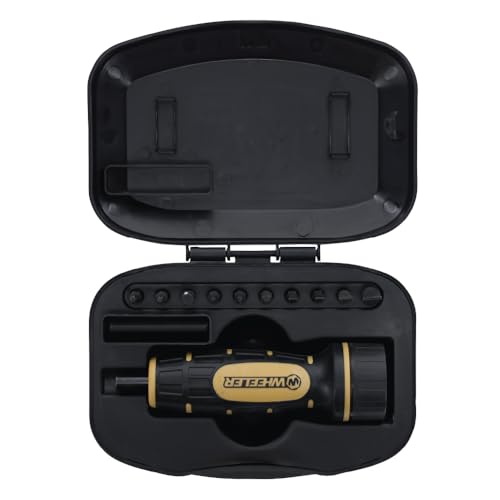 Wheeler Firearms Accurizing Torque Wrench with Bits and Case Wheeler Firearms Accurizing Torque Wrench with Bits and Case | $60.13 |
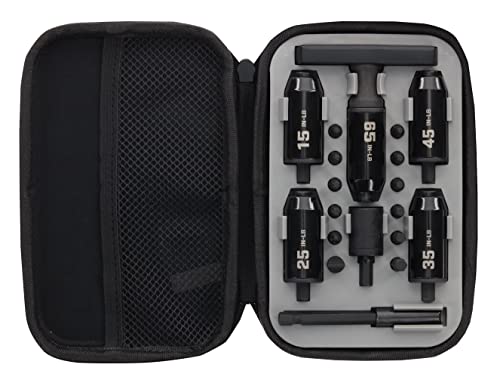 Wheeler F.A.T. Stix with 12 Bits, 5 Torque Limiters and Case Wheeler F.A.T. Stix with 12 Bits, 5 Torque Limiters and Case | $93.80 |
 Wheeler Digital FAT Wrench with Interchangeable Bits and LCD Display Wheeler Digital FAT Wrench with Interchangeable Bits and LCD Display | $67.99 |
A dash means the manufacturer does not publish that figure. We leave it blank rather than estimating it.
Fixed limiters, a live digital readout, and a pocket-sized option
The Wheeler F.A.T. Stix with 12 Bits, 5 Torque Limiters and Case replaces the adjustable dial with fixed torque limiters at 15, 25, 35, 45 and 65 inch pounds, removing any chance of a mis-set dial at the cost of needing the correct limiter on hand for the job. The Wheeler Digital FAT Wrench with Interchangeable Bits and LCD Display adds an LCD display that shows the applied torque as you build it rather than only announcing the target with a click, which suits working up to a figure on an action screw more than a quick ring job. For a torque driver small enough to live in a range bag or a pack rather than a dedicated case, the Fix It Sticks All-In-One Torque Driver, Accurate to 10 percent covers the same 15 to 65 inch pound range in a noticeably more compact tool.
How we chose
We did not test these optics in person and we never claim to. Picks are researched from manufacturer specification sheets, published optical and ballistic formulas, and the recurring themes in verified owner reviews. Every pick is matched to a real objective diameter, a real tube size, a real ring height or a real exit pupil rather than to a price bracket, and it is placed in the tier where its capability actually belongs. Where a figure is shooter convention rather than a sourced number we label it, and where a manufacturer does not publish a figure we leave it out instead of estimating it.
Sources
- Wheeler Engineering published specifications for the Firearms Accurizing Torque Wrench
- Owner-review consensus from verified purchaser reviews on major retail listings
Frequently asked questions
Is the Wheeler FAT Wrench worth buying?
Yes, for anyone mounting more than one scope, based on published specifications and long-standing owner-review consensus as the reference tool in this category. It puts ring, base and guard screws at the manufacturer's published torque figure instead of at whatever feels tight by hand, which is the single most common mistake in home scope mounting.
What torque should I actually use for scope rings?
Check the specific figure published by your ring or base manufacturer, since it varies by design, but most ring screws fall between 15 and 25 inch pounds. That is a smaller number than it feels like by hand, which is exactly why a torque wrench rather than a plain hex key is worth using.
What happens if I over-torque a scope ring?
The ring can pinch the tube slightly out of round, which stresses the internal erector assembly and can cause inconsistent tracking or an unpredictable zero shift, sometimes not immediately but after enough recoil cycles. This looks identical in the field to a scope that simply will not hold zero, which is why over-torquing is as much a mistake as under-torquing.
What happens if I under-torque a scope ring?
The ring does not grip the tube firmly enough to resist recoil, and the scope creeps inside the rings shot to shot, which shows up as a drifting zero that looks exactly like an over-torqued mount from the shooter's side. Both mistakes produce the same symptom and only a torque wrench tells you which one you actually have.
Is the manual FAT Wrench accurate enough for scope mounting?
Wheeler publishes plus or minus 2 inch pounds of accuracy up to 40 inch pounds and plus or minus 5 percent from 40 to 65, which comfortably covers the 15 to 25 inch pound range most ring screws call for. That is well within the tolerance scope and ring manufacturers design around.
Should I buy the manual FAT Wrench or the digital version?
The manual wrench for most scope mounting jobs, since a single click at the target torque is all a ring or base screw needs. The digital version is worth the extra cost if you frequently work up to a torque on action screws, where watching the number build as you turn matters more than a single click at the end.
Researched, not professional advice. This page is compiled from published manufacturer specifications, published optical and ballistic formulas, and owner-review consensus, not hands-on testing. Figures described as a rule of thumb are shooter convention rather than sourced numbers, and they are labelled that way wherever they appear. Ballistic figures come from a point mass model using the ballistic coefficient the maker publishes, so treat them as a starting point and confirm them on paper at a measured distance. Confirm your firearm is unloaded with the action open before you mount, level, torque or bore sight anything. Verify a zero only on a supervised range or a safe, legal backstop, know what lies beyond your target, and follow the law where you hunt and shoot, including rules on land access and permitted cartridges.