Hunting scopes
Best Elk Hunting Riflescopes
Quick answer
Elk hunting happens in open country at real distance, so the Athlon Argos BTR GEN3 6-24x50 Riflescope, APRS11 FFP IR MIL Reticle at $379.99 earns its place with a first focal plane MIL reticle and enough internal travel to dial out past 500 yards, which a 3-9x hunting scope was never built to do.
Elk hunting is the one hunting discipline on this site that behaves like a precision discipline rather than a woods hunt. Shots are frequently taken across open basins and clear-cuts at distances a whitetail hunter never sees, and that changes every decision about the scope.
Two things separate an elk setup from a deer setup: magnification and elevation travel. A 6-24x50 or a 4-16x44 covers the open-country ranges elk hunting actually produces, and a first focal plane reticle with real internal travel lets you dial or hold a correction that a 3-9x simply has no room for.
This roundup is researched from published manufacturer specifications and owner-review consensus. We did not test these scopes in person. Turret repeatability across hundreds of clicks is the one thing a spec sheet cannot show you, and it is worth confirming with your own box test before you trust a scope at distance.
On this page
How much elevation does an elk shot actually need?
The subtension figures below are exact geometry and hold for any cartridge. What changes by cartridge is how many MOA or mils of come-up you need to reach a given distance, which the worked example after this table covers.
At 500 yards, 1 MOA covers 5.24 inches and 1 mil covers 18.0 inches, which is why a scope with only a few minutes of total travel runs out of room before an elk-distance shot does.
Sourced figure
| Distance | 1 MOA subtends | 1 mil subtends |
|---|---|---|
| 300 yd | 3.14 in | 10.8 in |
| 400 yd | 4.19 in | 14.4 in |
| 500 yd | 5.24 in | 18.0 in |
| 600 yd | 6.28 in | 21.6 in |
These figures are exact trigonometry and do not depend on cartridge. See the full subtension table at 500 yards for click values and ranging figures at this distance.
A worked example: what a 500 yard elk shot actually needs
Take a .308 Winchester zeroed at 200 yards, a common elk-country setup. Reaching 500 yards needs about 9.84 MOA (2.86 mil) of dialled come-up, and the bullet has already dropped roughly 51 inches from the line of sight by then. Half of a scope's total elevation travel typically sits above mechanical centre, so a scope needs real room to spare before you have used up the zero itself.
See the full computed drop table for a .308 Winchester zeroed at 200 yards for the numbers at every distance in between, including wind. A 6.5 Creedmoor needs slightly less come-up for the same distance and drifts noticeably less in wind, which is covered on the 6.5 Creedmoor scope roundup.
Wind is the part elk hunters underestimate most, because open basins that make an elk visible at distance are exactly the terrain that funnels and accelerates wind. A 10 mph crosswind at 500 yards moves either of these loads well over a foot, which is more error than most turret adjustments account for unless you have actually ranged the wind rather than guessed it.
Beginner: the step up from timber to open country
The goal here is more reach and a bigger objective without learning a new turret system. Both picks keep a familiar hunting reticle rather than moving to exposed turrets.

Vortex Diamondback 3.5-10x50 Riflescope, Dead-Hold BDC Reticle
$299.00 Full specificationsA 50mm objective and a 10x top end for {{price:vortex-diamondback-3-5-10x50}} stretches a familiar BDC hunting reticle into open country without learning a first focal plane turret system.
Best for: Hunters moving from timber to open country for the first time.
Check price on Amazon
Burris Fullfield 3-12x42 SC Riflescope
$259.36 Full specificationsA 3-12x42 configuration for {{price:burris-fullfield-3-12x42}} adds real reach over a 3-9x without moving to a first focal plane reticle or exposed turrets.
Best for: Hunters who want more top-end magnification but are not ready to dial elevation.
Check price on AmazonIntermediate: the buy-once pick
This is where an elk setup starts to look like a distance setup: first focal plane, real elevation travel, and turrets built to be dialled rather than left capped.

Athlon Argos BTR GEN3 6-24x50 Riflescope, APRS11 FFP IR MIL Reticle
$379.99 Full specificationsThe MIL reticle and 6-24x range at {{price:athlon-argos-btr-gen3-6-24x50}} covers everything from a 200 yard timber shot to a 500 yard basin crossing without changing scopes.
Best for: Hunters who want one scope for the whole spread of elk-country distances.
Check price on Amazon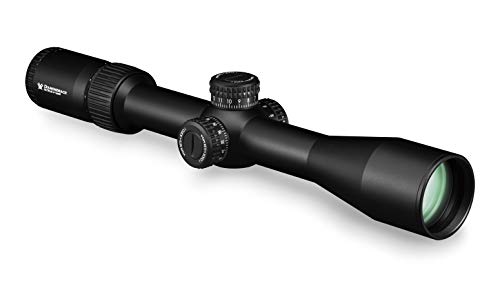
Vortex Diamondback Tactical 4-16x44 First Focal Plane Riflescope, EBR-2C MOA
$399.00 Full specificationsFirst focal plane at {{price:vortex-diamondback-tac-4-16x44}} with turrets that return to zero reliably, and a 30mm tube with real elevation travel to spare for a 500 yard come-up.
Best for: Elk hunters who have confirmed they need to dial past 400 yards.
Check price on AmazonExpert: turret repeatability when it counts
At this tier the scope is no longer the limiting factor, provided the shooter, the mount and the ammunition are not either. That is worth confirming before spending here.

Vortex Viper PST Gen II 5-25x50 First Focal Plane Riflescope, EBR-7C MOA
$999.00 Full specificationsTurret repeatability that survives hundreds of revolutions is the actual upgrade at {{price:vortex-viper-pst-gen2-5-25x50}}, which matters once you are dialing elevation on every stalk rather than occasionally.
Best for: Elk hunters who dial a real come-up on most shots and have already proven their current scope is the limiting factor.
Check price on AmazonWho should not buy this tier: Elk hunters who stalk close in dark timber, or anyone who has not yet run out of capability with the intermediate tier. If your longest realistic shot is inside 300 yards, this scope's weight, price and elevation range solve a problem you do not have.
How we chose
We did not test these optics in person and we never claim to. Picks are researched from manufacturer specification sheets, published optical and ballistic formulas, and the recurring themes in verified owner reviews. Every pick is matched to a real objective diameter, a real tube size, a real ring height or a real exit pupil rather than to a price bracket, and it is placed in the tier where its capability actually belongs. Where a figure is shooter convention rather than a sourced number we label it, and where a manufacturer does not publish a figure we leave it out instead of estimating it.
Sources
- Manufacturer published magnification, objective and turret travel specifications
- G1 point mass ballistic model computed from published cartridge muzzle velocity and ballistic coefficient
Frequently asked questions
How much magnification do I need for elk hunting?
Enough to see and range an animal across an open basin, which usually means 12x to 20x on a variable scope, not a fixed high number. A 4-16x44 or a 6-24x50 covers essentially every elk shot. More than that mostly buys resolution in conditions where mirage already limits what you can see.
Is first focal plane worth it for elk hunting?
More often than for deer, because elk shots regularly stretch past 300 yards and a first focal plane reticle subtends correctly at any magnification, so a mil or MOA hold is accurate whether you are at 6x or 20x. In dark timber it can be harder to see at low power, which is the one real trade-off.
Should an elk scope be MOA or mil?
Neither is more accurate, and one mil equals 3.44 MOA at any distance. What matters is that the reticle and the turrets share the same unit, so a correction read off the glass is a correction you can dial without doing arithmetic in the field. Mil is slightly easier to compute in your head because the constant is a round number.
How much elevation travel do I need for a 500 yard elk shot?
A .308 Winchester zeroed at 200 yards needs roughly 9.84 MOA of dialled come-up to reach 500 yards. Half a scope's total elevation travel usually sits above mechanical centre, and the zero itself consumes some of that, so check your scope's published travel against your own load before assuming it reaches the distance you plan to shoot.
Is a 50mm objective worth it for elk hunting?
Yes, more often than for deer, because elk are frequently glassed and shot in open country at higher magnification, where exit pupil shrinks fastest. A 50mm objective holds more usable brightness at 16x or 20x than a 40mm does, at the cost of taller rings and more weight carried across open country all day.
What ring height do I need for a 50mm elk scope?
Roughly the height that clears the objective bell with an eighth of an inch to spare, which for most 50mm scopes lands in the high or extra-high range depending on the maker. Ring height names are marketing rather than measurements, so check the published number rather than trusting a word like medium.
Researched, not professional advice. This page is compiled from published manufacturer specifications, published optical and ballistic formulas, and owner-review consensus, not hands-on testing. Figures described as a rule of thumb are shooter convention rather than sourced numbers, and they are labelled that way wherever they appear. Ballistic figures come from a point mass model using the ballistic coefficient the maker publishes, so treat them as a starting point and confirm them on paper at a measured distance. Confirm your firearm is unloaded with the action open before you mount, level, torque or bore sight anything. Verify a zero only on a supervised range or a safe, legal backstop, know what lies beyond your target, and follow the law where you hunt and shoot, including rules on land access and permitted cartridges.