Lens cleaning
Best Lens Cleaning Kits for Optics
Quick answer
The buy-once pick is the Zeiss Lens Cleaning Kit with Lens Spray and Microfibre Cloths at $13.49, because a spray and a fresh microfibre cloth together handle the wipe step correctly only after grit is already removed, which is the step most cleaning routines get backward.
Coated optical glass is softer than the coating applied to it, which means the wrong cleaning order can permanently scratch a lens that was never actually damaged, only cleaned incorrectly. The correct sequence exists for a specific reason: blow the loose grit off first, brush away what the air could not move, and only then wipe. Wiping before those first two steps drags whatever grit is sitting on the glass directly across the coating under pressure from your hand.
Most lens cleaning failures are not a chemical problem or a cloth quality problem. They are an order-of-operations problem, and the fix costs nothing beyond doing the steps in the right sequence with tools built for each one rather than reaching for whatever cloth is nearest.
These recommendations are researched from published manufacturer guidance and owner-review consensus. Nobody on this site scratched a set of lenses on purpose to compare cleaning methods, and the sequence below reflects standard published optical care guidance rather than an in-house test.
On this page
- The correct order: blow, brush, then wipe
- Lens cleaning products by role in the sequence
- Why a bulk eyeglass cloth is the wrong product for this job
- How to clean a riflescope lens correctly
- Beginner: a pen that fits in a pocket
- Intermediate: the full home-bench kit
- Expert: individually sealed, for the field
The correct order: blow, brush, then wipe
No product in this catalog is a dedicated air blower, and that is worth saying plainly rather than skipping the step. A rocket-style air blower is the correct first tool for this job and none of the specialty riflescope brands in this catalog sell one, so a rocket-style air blower from a general optics supplier fills that specific gap honestly.
The brush step is where a lens pen earns its place, with a retractable soft brush built into one end specifically for sweeping away whatever the air did not move. Only after both of those steps is a cloth, moistened or dry, the correct tool, and using one any earlier in the sequence is how a coating gets scratched.
Why the order matters
Loose grit dragged across coated glass under any pressure, including a soft cloth, can scratch the coating permanently. Removing that grit with moving air first, then a soft brush for anything remaining, leaves only a clean surface for the wipe step to touch.
This is standard published optical care guidance, not a manufacturer marketing claim specific to any one brand of cloth or cleaner.
Lens cleaning products by role in the sequence
Every product in this catalog fits into one step of the blow, brush, wipe sequence. None of them replace the step before it.
A lens pen such as the Nikon 7072 Lens Pen Cleaning System handles the brush step, and a spray and cloth kit such as the Zeiss Lens Cleaning Kit with Lens Spray and Microfibre Cloths handles the wipe step, but neither replaces a genuine blow-off step first.
Shooter convention
| Product | Sequence step | Price |
|---|---|---|
| Nikon 7072 Lens Pen Cleaning System | Brush | $7.08 |
| LensPen NLP-1 Lens Cleaning Pen | Brush | $12.95 |
| Celestron LensPen Optics Cleaning Tool | Brush | $11.95 |
| Leupold Lens Pen, Matte | Brush | $19.60 |
| Zeiss Lens Cleaning Kit with Lens Spray and Microfibre Cloths | Wipe, spray and cloth | $13.49 |
| Sig Sauer Lens Cleaning Kit | Wipe, spray and cloth | $13.90 |
| Celestron Lens Cleaning Kit for Telescopes, Binoculars and Cameras | Wipe, spray and cloth | $19.99 |
| Zeiss Pre-Moistened Lens Cleaning Wipes, 200 Count | Wipe, pre-moistened single use | $14.99 |
| Zeiss Microfibre Lens Cleaning Cloth, Jumbo XL, Pack of 2 | Wipe, dry cloth only | $9.99 |
| MagicFiber Microfibre Cleaning Cloths, 6 pack | Wipe, dry cloth only | $14.99 |
A lens pen's brush tip and cleaning tip are two ends of the same tool, but the brush end is the one that matters for this step. The cleaning tip on the other end is a wipe-step tool and should only be used after brushing, not instead of it.
Why a bulk eyeglass cloth is the wrong product for this job
A microfibre cloth that lives loose in a range bag, a glove compartment, or a jacket pocket is not a clean cloth by the time it reaches the lens, no matter how soft it feels. Lint, dust, and fine grit collect in the fibers between uses, and the next time that cloth wipes a lens, it is dragging that accumulated grit directly across the coating rather than removing anything.
This is exactly what individually sealed, pre-moistened wipes such as the Zeiss Pre-Moistened Lens Cleaning Wipes, 200 Count solve: each one is used once and discarded, so there is no accumulated grit to worry about. A dry microfibre cloth such as the Zeiss Microfibre Lens Cleaning Cloth, Jumbo XL, Pack of 2 or the MagicFiber Microfibre Cleaning Cloths, 6 pack works just as well as a wipe-step tool, but only if it is kept in a sealed pouch between uses and never left loose where it can pick up grit of its own.
How to clean a riflescope lens correctly
- Confirm the rifle is unloaded. Open the action and check the chamber before handling anything mounted on it, exactly as with any other maintenance task on the rifle.
- Blow off the loose grit. Use a rocket-style air blower held close to the lens, angled so debris moves off the glass rather than across it. This step alone removes most of what causes a scratch.
- Brush what remains. Extend the lens pen's brush tip and sweep gently across the glass in one direction, clearing anything the air did not dislodge.
- Wipe last, and only last. Use a fresh, individually sealed wipe or a clean microfibre cloth kept in a sealed pouch, wiping in a single direction rather than a scrubbing motion.
- Inspect in good light. Check the lens at an angle under bright light for any remaining smudge or streak before putting the caps back on, rather than assuming the job is done.
Beginner: a pen that fits in a pocket
This tier optimizes for the lowest cost to a real brush-and-wipe tool that lives in a pocket or a pack, accepting that a separate blower is still worth adding.

Nikon 7072 Lens Pen Cleaning System
$7.08A retractable brush and a cleaning tip in one small tool at the lowest price in this category, covering the brush step and a basic wipe step in a single item.
Best for: A shooter who wants one small tool that handles a quick field cleanup without carrying a separate spray and cloth kit.
Check price on AmazonIntermediate: the full home-bench kit
This is the buy-once tier for a proper cleaning setup kept on a bench, pairing a spray-and-cloth kit for the wipe step with a lens pen for the brush step.

Zeiss Lens Cleaning Kit with Lens Spray and Microfibre Cloths
$13.49A dedicated optical cleaning spray and a fresh microfibre cloth handle the wipe step correctly, and paired with any lens pen and a separate blower, completes the full sequence.
Best for: A home cleaning station for someone who maintains more than one optic and wants a proper spray and cloth rather than improvising with household products.
Check price on Amazon
Leupold Lens Pen, Matte
$19.60A premium lens pen to pair with the spray kit above, covering the brush step with the same attention to build quality as the scope it is cleaning.
Best for: Completing the sequence alongside a spray-and-cloth kit for a full bench setup rather than a single all-in-one tool.
Check price on AmazonExpert: individually sealed, for the field
This tier is the performance ceiling for someone cleaning glass constantly in dusty or wet field conditions, where a reused cloth accumulating grit is a real, repeated risk rather than a rare one.
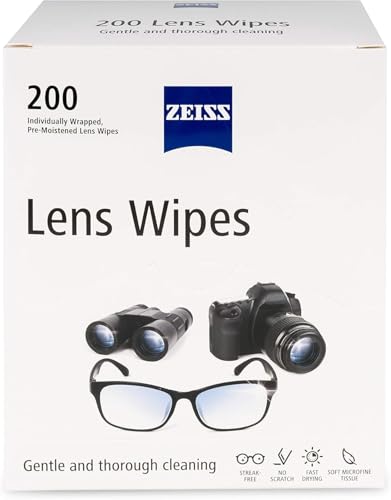
Zeiss Pre-Moistened Lens Cleaning Wipes, 200 Count
$14.99Two hundred individually sealed, pre-moistened wipes eliminate the accumulated-grit risk of a reused cloth entirely, which matters for someone cleaning glass in the field across many outings.
Best for: Frequent field use where a fresh, sealed wipe every time removes any chance of a dirty cloth doing more harm than good.
Check price on AmazonWho should not buy this tier: Not for someone who cleans lenses at home over a workbench a handful of times a year. Two hundred individually sealed wipes are overkill for that use, and a basic lens pen plus a cloth kept in a sealed pouch is plenty.
How we chose
We did not test these optics in person and we never claim to. Picks are researched from manufacturer specification sheets, published optical and ballistic formulas, and the recurring themes in verified owner reviews. Every pick is matched to a real objective diameter, a real tube size, a real ring height or a real exit pupil rather than to a price bracket, and it is placed in the tier where its capability actually belongs. Where a figure is shooter convention rather than a sourced number we label it, and where a manufacturer does not publish a figure we leave it out instead of estimating it.
Sources
- Zeiss published lens care guidance
- LensPen manufacturer instructions
- General published optical coating care guidance
Frequently asked questions
What is the correct order to clean a riflescope lens?
Blow off loose grit first with moving air, brush away anything remaining with a soft brush such as a lens pen's brush tip, and only then wipe with a clean cloth or a pre-moistened wipe. Wiping before the first two steps drags grit across the glass under pressure, which is how coatings get scratched.
Why does wiping first scratch the coating?
Optical coatings are thinner and softer than the glass beneath them. Any grit still sitting on the lens gets dragged across that soft coating the moment a cloth applies pressure, leaving fine scratches that are permanent. Removing the grit with air and a brush first means the wipe step touches only clean glass.
Are eyeglass cleaning cloths safe for riflescope lenses?
A clean, dedicated microfibre cloth is fine as a wipe-step tool. The problem is a cloth that lives loose in a bag or pocket between uses, which collects lint and grit and then drags that debris across the lens the next time it is used. Keep any reusable cloth in a sealed pouch, or use individually sealed disposable wipes instead.
Do I need a special lens cleaner or is water fine?
A dedicated optical cleaning spray is formulated to avoid residue and to be safe on coatings, and is the safer default. Plain water can work in a pinch for the wipe step, but only after the blow and brush steps, and only with a genuinely clean cloth, since water does nothing to remove the grit that actually causes scratches.
How often should riflescope lenses be cleaned?
Only when they actually need it. Cleaning a lens that looks fine adds unnecessary risk for no benefit. Check before a hunt or a range session, clean if there is visible dust, fingerprints, or moisture, and otherwise leave a clean lens alone rather than wiping it out of habit.
Can a lens pen replace a blower and cloth entirely?
For a quick field touch-up, yes, since it covers the brush and a light wipe step in one tool. For a thorough cleaning at home, a proper blower removes grit more completely than a brush alone can, and a dedicated spray and cloth handle a genuinely dirty lens better than a lens pen's small cleaning tip.
Researched, not professional advice. This page is compiled from published manufacturer specifications, published optical and ballistic formulas, and owner-review consensus, not hands-on testing. Figures described as a rule of thumb are shooter convention rather than sourced numbers, and they are labelled that way wherever they appear. Ballistic figures come from a point mass model using the ballistic coefficient the maker publishes, so treat them as a starting point and confirm them on paper at a measured distance. Confirm your firearm is unloaded with the action open before you mount, level, torque or bore sight anything. Verify a zero only on a supervised range or a safe, legal backstop, know what lies beyond your target, and follow the law where you hunt and shoot, including rules on land access and permitted cartridges.