Hunting scopes
Best Scopes for .223 Remington and 5.56 NATO
Quick answer
Most .223 and 5.56 rifles sit on a flat top receiver with a scope mounted well above the bore, so the Vortex Strike Eagle 1-8x24 Second Focal Plane Riflescope, BDC3 MOA at $307.99 fits better than a hunting 3-9x40: an LPVO built for a 2.6 inch sight height and a 1x to 8x range covering both close and 400 yard shots.
A .223 Remington or 5.56 NATO rifle is usually built on a flat top receiver, which changes two things a hunting scope was never designed around: the optical axis sits much higher above the bore, typically about 2.6 inches instead of 1.6 to 1.8, and the rifle is frequently used at both very close range and out to 300 or 400 yards on the same outing.
That combination points away from a 3-9x40 hunting scope and toward either a low power variable optic running from 1x to 6x or 8x, or a dedicated 4-16x for a rifle used mostly at distance. The higher sight height also means ring and mount height need more attention than they do on a bolt action, because the extra distance from bore to scope steepens the near part of the trajectory noticeably.
This roundup is researched from published manufacturer specifications and owner-review consensus. We did not test these scopes in person.
On this page
What does a 2.6 inch sight height actually do to a .223?
What produced these numbers
.223 Remington, 55 grain soft point at a catalogue 3,240 fps, BC 0.243, 2.6 in sight height, 100 yard zero, G1 point mass model
Computed with the same model behind the sight height cluster on this site.
A higher sight height steepens the trajectory close in and moves the near zero. Here is what that means for a .223 on a flat top receiver, zeroed at 100 yards.
A .223 Remington zeroed at 100 yards on a 2.6 inch sight height is already 24.9 inches low by 400 yards, which is why most flat top 5.56 rigs are built around an LPVO or a 4-16x rather than a hunting 3-9x that runs out of dial before the bullet does.
Sourced figure
| Distance | Path from line of sight | Come-up (MOA) | Come-up (mil) | Velocity |
|---|---|---|---|---|
| 100 yd | 0.0 in (zero) | 0.00 MOA | 0.00 mil | 2,829 fps |
| 200 yd | 1.8 in low | 0.85 MOA | 0.25 mil | 2,454 fps |
| 300 yd | 9.4 in low | 2.98 MOA | 0.87 mil | 2,109 fps |
| 400 yd | 24.9 in low | 5.93 MOA | 1.73 mil | 1,794 fps |
See the full computed 2.6 inch sight height page for a .223 Remington for the near zero and close range holds this sight height also produces.
LPVO or a dedicated 4-16x: which fits your rifle?
An LPVO earns its place when the same rifle is used at both close range and out to 300 or 400 yards, because a true 1x setting with both eyes open covers a fast up-close shot and 6x to 10x covers the distance work, all in one scope. A dedicated 4-16x makes more sense when the rifle is used almost entirely at distance and never needs a true 1x setting.
See the LPVO against a fixed power scope comparison and the LPVO roundup if this page's picks do not fit how you actually use the rifle.
Beginner: a first LPVO for a flat top rifle
The goal here is a genuine 1x setting and enough top end for a few hundred yards, without paying for glass or turret features a carbine will not use.

Vortex Strike Eagle 1-6x24 Second Focal Plane Riflescope, BDC3 MOA
$225.75 Full specificationsA 1-6x24 second focal plane BDC3 MOA reticle at {{price:vortex-strike-eagle-1-6x24}} covers a true 1x for close work and 6x for a 300 yard shot on a flat top receiver.
Best for: A first LPVO on a flat top .223 or 5.56 rifle.
Check price on Amazon
Athlon Optics Argos BTR GEN2 1-8x24 Riflescope, ATSR5 SFP IR BDC
$239.99 Full specificationsAn 1-8x24 second focal plane configuration at {{price:athlon-argos-btr-gen2-1-8x24}} for a little more top-end reach than a 1-6x, still at a genuinely low price.
Best for: Shooters who want extra reach past 300 yards without paying for the tier above.
Check price on AmazonIntermediate: the buy-once pick
This tier covers close range and a genuine 400 yard shot on the same optic, which is the whole point of building around a flat top receiver rather than a bolt gun.

Vortex Strike Eagle 1-8x24 Second Focal Plane Riflescope, BDC3 MOA
$307.99 Full specificationsA 1-8x24 range with a BDC3 MOA reticle at {{price:vortex-strike-eagle-1-8x24}} covers close work and a genuine 400 yard shot on the same flat top rifle.
Best for: A do-everything optic for a flat top .223 or 5.56 rifle.
Check price on Amazon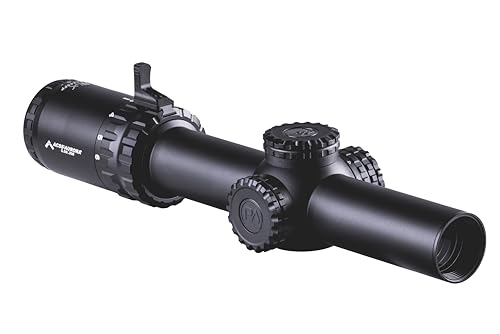
Primary Arms SLX 1-6x24 Second Focal Plane Gen IV LPVO Riflescope
$349.99 Full specificationsA Gen IV illuminated reticle and a glass upgrade over the beginner tier at {{price:primary-arms-slx-1-6x24-gen4}}, for shooters who want the reliability step up without moving to a higher top end.
Best for: Shooters who want better glass at a true 1-6x rather than more magnification.
Check price on AmazonExpert: close range speed and real distance reach together
The step up here is top-end magnification without giving up a genuine 1x setting, for a rifle that gets used at both ends of the distance range.

Primary Arms SLX 1-10x28 SFP Riflescope
$449.99A 1-10x28 range at {{price:primary-arms-slx-1-10x28}} for shooters who want true 1x close-range speed and enough top end to stretch a 5.56 load to 500 yards on the same optic.
Best for: Shooters who want one scope to cover both close-quarters and distance work on a single flat top rifle.
Check price on AmazonWho should not buy this tier: Shooters who never need more than 6x on a flat top .223 or 5.56 rig. The extra top-end magnification and length over a 1-6x LPVO are wasted weight on close-range carbine work, where a shorter, lighter optic handles the job better.
How we chose
We did not test these optics in person and we never claim to. Picks are researched from manufacturer specification sheets, published optical and ballistic formulas, and the recurring themes in verified owner reviews. Every pick is matched to a real objective diameter, a real tube size, a real ring height or a real exit pupil rather than to a price bracket, and it is placed in the tier where its capability actually belongs. Where a figure is shooter convention rather than a sourced number we label it, and where a manufacturer does not publish a figure we leave it out instead of estimating it.
Sources
- Published factory load specification: .223 Remington 55 grain soft point at a catalogue 3,240 feet per second
- G1 standard drag function, computed from the published ballistic coefficient
Frequently asked questions
Why does a flat top receiver need a different scope than a bolt action?
Mainly sight height. A flat top rifle typically mounts the scope around 2.6 inches above the bore against 1.6 to 1.8 inches on a bolt action, which steepens the near part of the trajectory and moves the near zero. It also usually needs a scope that works at both close range and distance, which points toward an LPVO rather than a fixed hunting scope.
LPVO or a dedicated magnified scope for .223?
An LPVO if the rifle is used at both close range and distance on the same outing, because a true 1x setting covers a fast up-close shot with both eyes open. A dedicated 4-16x or similar makes more sense if the rifle is used almost entirely at distance and a true 1x is never needed.
How low is a .223 at 400 yards with a 100 yard zero?
About 24.9 inches low, using a 55 grain soft point load at a catalogue 3,240 feet per second. That steep a drop past 300 yards is why most 5.56 platforms are built around a reticle with holdover marks or exposed turrets rather than a plain duplex meant for closer hunting shots.
Does ring height matter more on a flat top rifle?
Yes. The higher the scope sits above the bore, the more the trajectory's near portion changes, and a flat top's Picatinny rail already adds height before the rings do. Measure your own sight height rather than assuming a bolt-action figure, because the difference is often close to a full inch.
What reticle unit should a 5.56 LPVO use?
Match it to whatever your rangefinder or ballistic app already outputs, MOA or mil, since neither is inherently better for this cartridge. A BDC reticle calibrated to a common 55 or 62 grain load is also a reasonable choice if you are not planning to dial and just want a fast holdover.
Is true 1x magnification necessary on an LPVO?
For anything used at close range with both eyes open, yes. A true 1x setting on a well built LPVO behaves like a red dot at that end of the dial, with almost no eye box penalty. Optics advertised as 1x that are not truly 1x show a slight magnified image even at the lowest setting, which is worth checking before buying.
Researched, not professional advice. This page is compiled from published manufacturer specifications, published optical and ballistic formulas, and owner-review consensus, not hands-on testing. Figures described as a rule of thumb are shooter convention rather than sourced numbers, and they are labelled that way wherever they appear. Ballistic figures come from a point mass model using the ballistic coefficient the maker publishes, so treat them as a starting point and confirm them on paper at a measured distance. Confirm your firearm is unloaded with the action open before you mount, level, torque or bore sight anything. Verify a zero only on a supervised range or a safe, legal backstop, know what lies beyond your target, and follow the law where you hunt and shoot, including rules on land access and permitted cartridges.